Researchers from Suzhou University in China have proposed a high-fidelity quantum state transfer scheme for two spin qubits mediated by virtual microwave photons. The scheme, which uses a superadiabatic pulse to eliminate nonadiabatic transitions, achieved a 95.1% fidelity within 60 nanoseconds under realistic conditions.
The team also demonstrated that the scheme could be applied to generate a remote Bell entangled state with a 97.6% fidelity. This development could pave the way for fault-tolerant quantum computation on spin quantum network architecture platforms, a crucial step towards practical quantum computing. However, further research is needed to optimize the scheme and overcome remaining challenges.
What is the Significance of Quantum State Transfer and Remote Entanglement?
Quantum state transfer and remote entanglement are crucial aspects of quantum information processing. They are particularly relevant to spin qubits in semiconductor quantum dots, which are considered a promising candidate for scalable quantum information processing. The ability to reliably transfer quantum states and establish entanglement between spatially separated spin qubits is a highly desirable, yet challenging goal.
The research team from the School of Mechanical and Electronic Engineering and the Institute of Quantum Information Technology at Suzhou University in China has proposed a fast and high-fidelity quantum state transfer scheme for two spin qubits. This scheme is mediated by virtual microwave photons and uses a superadiabatic pulse to eliminate nonadiabatic transitions without increasing control complexity.
The team demonstrated that arbitrary quantum state transfer can be achieved with a fidelity of 95.1% within a short time of 60 nanoseconds under realistic parameter conditions. This scheme also proved robust against experimental imperfections and environmental noises.
How Does the Quantum State Transfer Scheme Work?
The quantum state transfer scheme proposed by the researchers involves the use of a superadiabatic pulse. This pulse is used to eliminate nonadiabatic transitions, which are transitions that do not follow the adiabatic theorem of quantum mechanics. The adiabatic theorem states that a quantum-mechanical system remains in its instantaneous eigenstate if a given perturbation is acting on it slowly enough and if there is a gap between the eigenvalue and the rest of the Hamiltonian’s spectrum.
The researchers’ strategy does not require increased control complexity, making it a practical solution for quantum state transfer. They demonstrated that arbitrary quantum state transfer can be achieved with a high fidelity of 95.1% within a short time of 60 nanoseconds under realistic parameter conditions.
What is the Role of Virtual Microwave Photons in this Scheme?
In the proposed scheme, the quantum state transfer between two spin qubits is mediated by virtual microwave photons. These virtual photons are not real photons but are a mathematical tool used in quantum electrodynamics to explain phenomena such as the Coulomb force.
The use of virtual microwave photons in this scheme allows for a direct transfer of quantum information between the two qubits. This direct approach can avoid additional resource consumption and quantum information loss due to photon leakage, which are common issues in schemes based on real photon processes.
How Does this Scheme Contribute to Quantum Computing?
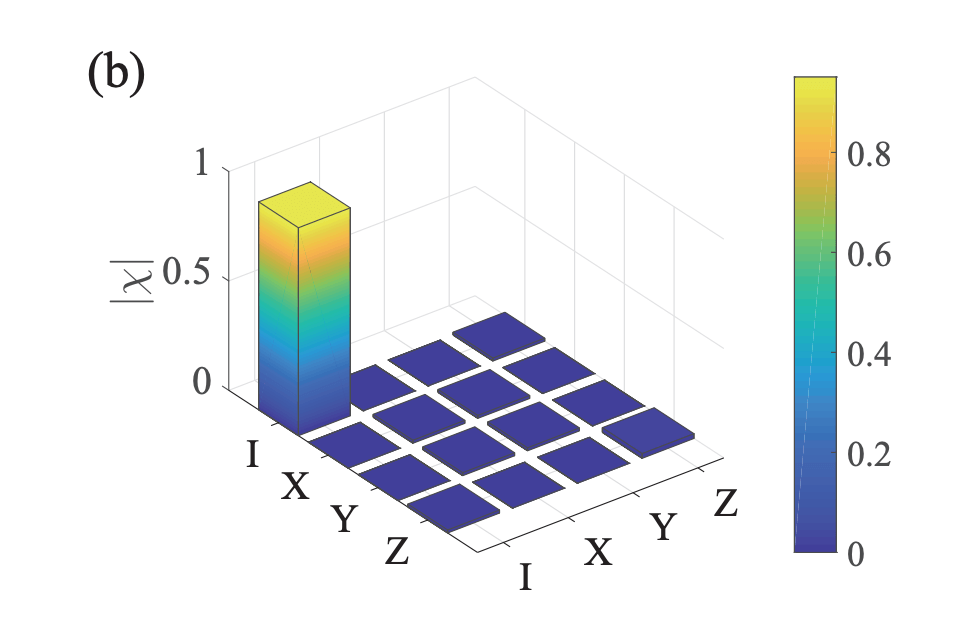
The proposed quantum state transfer scheme can be directly applied to the generation of a remote Bell entangled state, a specific type of quantum entangled state. The researchers demonstrated that this could be achieved with a high fidelity of 97.6%.
These results pave the way for fault-tolerant quantum computation on spin quantum network architecture platforms. Fault-tolerant quantum computation is a type of quantum computing that includes error correction. It is crucial for practical quantum computing as it allows quantum computers to function correctly even in the presence of errors.
What are the Challenges in Quantum State Transfer?
Designing a scheme for long-distance quantum state transfer of spin qubits is a highly desirable but challenging goal. One of the main challenges is the strong coupling between the spin qubit and the resonator due to the small magnetic dipole moment of spin qubits.
Quantum state transfer requires fast and high fidelity, even in the presence of operational errors and decoherence effects. Decoherence is a process that causes quantum systems to lose their quantum behavior and become classical systems. It is one of the main obstacles to practical quantum computing.
How Does the Proposed Scheme Address these Challenges?
The researchers addressed these challenges by employing a single-electron spin qubit in a double quantum dot (DQD). Due to spin-charge hybridization, the spin qubit exhibits charge characteristics, enabling strong coupling with the resonator.
They also designed a superadiabatic pulse for state transfer between spin qubits mediated by virtual microwave photons. By modifying the parameters of the control pulse, they effectively eliminated nonadiabatic transitions and significantly reduced the state transfer time.
The researchers demonstrated that the quantum state transfer could achieve a high fidelity of 95.1% within a short time of 60 nanoseconds under realistic conditions, while exhibiting robustness to experimental imperfections and environmental noises.
What is the Future of Quantum State Transfer and Remote Entanglement?
The proposed quantum state transfer scheme and its successful demonstration represent a significant step forward in the field of quantum information processing. It opens up new possibilities for the development of scalable quantum computing architectures and the realization of fault-tolerant quantum computation.
However, further research is needed to optimize the scheme and overcome the remaining challenges. The researchers’ work provides a solid foundation for future studies in this area. The successful implementation of efficient and high-fidelity quantum state transfer and remote entanglement between spatially separated spin qubits could revolutionize quantum computing and quantum information processing.
Publication Date: 2024-04-29
Authors: Yue Wang, Ting Wang and Xingyu Zhu
Source: Entropy
DOI: https://doi.org/10.3390/e26050379