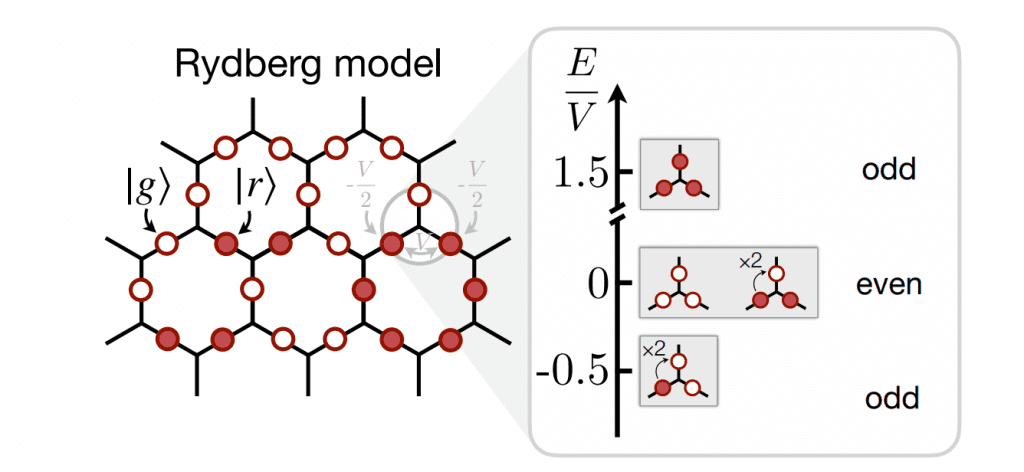
Understanding how complex systems reach equilibrium remains a fundamental challenge in physics, yet provides crucial insights into emergent behaviour. Lukas Homeier, Andrea Pizzi, Hongzheng Zhao, and colleagues now demonstrate a pathway to thermalisation within interacting systems, revealing a surprising prethermal structure stabilised by seemingly simple interactions. Their numerical study of a spin model shows that two-body interactions can create a dynamically stable, gauge-invariant state with an unexpectedly long lifetime, before eventually decaying through the formation of defects. Remarkably, the team discovered that this breakdown exhibits behaviour consistent with a well-known model of surface growth, linking the dynamics to a broader universality class and offering a new testbed for quantum simulators and experiments with Rydberg atoms.
Emergent Gauge Structures and Thermalization Dynamics
Scientists investigate the behavior of interacting spin systems, revealing the emergence of a prethermal phase and its eventual breakdown. Through simulations of a spin model containing thousands of interacting components, researchers observe a stable, gauge-invariant plateau indicative of a prethermal lattice gauge structure exhibiting dynamical matter. This plateau persists for an extended period before decaying due to the proliferation of defects that violate Gauss’ law, a process reminiscent of bubble formation in false vacuum decay. This decay provides insights into how the system eventually reaches thermal equilibrium.
To validate these findings, the team compared their simulations to semi-classical approximations and exact diagonalization methods, revealing that the approximations become inaccurate when the system exhibits numerous local symmetries. These symmetries significantly influence the thermalization process, demonstrating their crucial role in governing the system’s evolution. This innovative methodology provides a valuable testbed for quantum simulators and has direct applicability to large-scale arrays of Rydberg atoms. Researchers further analyzed the energy landscape governing Gauss’ law, deriving equations to describe how the gauge structure breaks down.
By adjusting the strength of interactions, they identified a critical threshold above which the system stabilizes into the prethermal plateau. Below this threshold, strong oscillations in Gauss’ law indicated an unstable system. They then tracked the growth of defects, revealing ballistic spreading and non-linear roughening consistent with a well-known pattern in surface growth.
Stable Prethermal State Mimics Gauge Theory
Scientists have demonstrated a pathway to stabilize a prethermal structure resembling a lattice gauge theory within a system of interacting spins. This work numerically investigates the dynamics of a spin model with thousands of interacting components, revealing that carefully designed interactions can create a metastable state with properties mirroring those of fundamental force-carrying particles. The team discovered that this prethermal state, characterized by a gauge-invariant plateau, exhibits an exceptionally long lifetime, persisting far beyond typical timescales for such systems. Experiments revealed that this stable configuration eventually breaks down through the proliferation of defects, analogous to bubble formation in a false vacuum.
Detailed analysis of this breakdown process uncovered spatio-temporal correlations consistent with the Kardar-Parisi-Zhang (KPZ) universality class, a well-known pattern in non-linear surface growth. Measurements confirm that the system’s evolution follows the characteristics of this KPZ class, indicating a specific type of critical behavior during the breakdown of the gauge structure. The team benchmarked their results against semi-classical discrete time Wigner approximation and exact diagonalization methods in smaller systems. Surprisingly, these comparisons showed that the mean-field dynamics accurately captured the system’s behavior, while the discrete time Wigner approximation failed to predict the long-lived prethermal plateau. This suggests that thermalization in these lattice gauge theories is not simply a scrambling of fluctuations, but is instead strongly influenced by the emergent local symmetries within the system. The model provides a testbed for quantum simulators and is directly implementable using large-scale arrays of Rydberg atoms, offering a promising avenue for exploring complex quantum phenomena.
Prethermal Gauge Structure and Dynamical Breakdown
The research demonstrates the stabilization of a prethermal lattice gauge structure within a system of interacting spins, achieved through experimentally feasible two-body interactions. This structure, exhibiting dynamical matter, remains stable for an extended period, evidenced by a gauge-invariant plateau in the system’s behavior. Eventually, this prethermal state breaks down due to the proliferation of defects that violate Gauss’ law, a process analogous to bubble formation in false vacuum decay. Importantly, the breakdown of the gauge structure follows a pattern consistent with the Kardar-Parisi-Zhang universality class, indicating a specific type of non-linear surface growth.
The team benchmarked their findings against both semi-classical approximations and exact diagonalization calculations, revealing that the approximations fail when the system exhibits an extensive number of local symmetries, highlighting the importance of these symmetries in governing the thermalization process. This model provides a platform for simulating complex physical systems and is directly implementable using arrays of Rydberg atoms. The authors acknowledge that the duration of gauge invariance is limited by the emergence of these Gauss’ law defects, and the precise lifetime depends on the strength of the interactions and the system’s initial conditions. Future research directions include exploring the impact of disorder on the stability of the gauge structure and investigating the potential for manipulating this structure to create novel quantum states.
🗞 Prethermal gauge structure and surface growth in lattice gauge theories
🧠 ArXiv: https://arxiv.org/abs/2510.12800