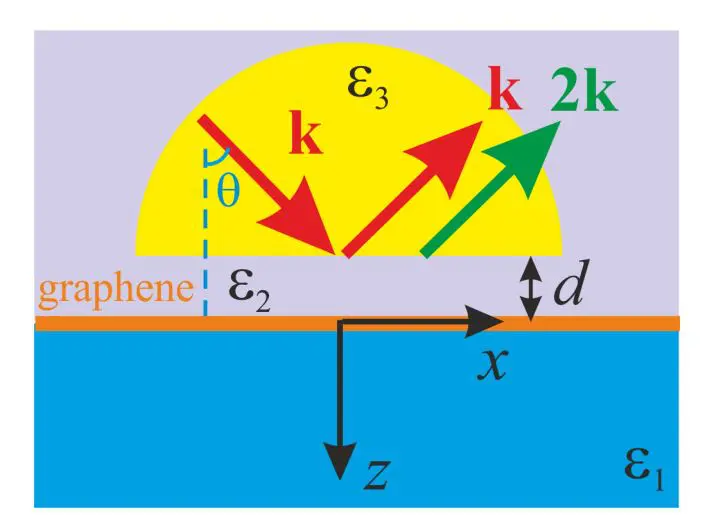
Researchers are actively exploring ways to enhance the efficiency of nonlinear optical processes in two-dimensional materials, and a new theoretical study by João M. Alendouro Pinho, Simão S. Cardoso, Yuliy V. Bludov, et al. demonstrates a significant boost to second-harmonic generation in graphene using surface plasmon-polaritons. The team, affiliated with institutions including the Physics Center of Minho and Porto Universities and the University of Lisbon, reveals that embedding graphene within an attenuated total internal reflection configuration dramatically increases the efficiency of this process. This enhancement arises from the synergistic interaction between graphene’s unique electronic properties and the resonant characteristics of surface plasmon-polaritons, effectively amplifying nonlinear optical signals and offering a pathway towards more efficient optoelectronic devices. The findings provide a comprehensive theoretical framework for understanding how light interacts with graphene in this configuration, paving the way for innovative applications in photonics and materials science.
Graphene’s Strong Nonlinear Optical Responses
This collection of research comprehensively explores nonlinear optics in graphene and related two-dimensional materials, covering fundamental theory, device applications, and phenomena like optical bistability. Studies reveal that graphene’s unique electronic structure generates strong nonlinear optical responses, including second-harmonic generation and third-harmonic generation, influenced by its Dirac cone, symmetry, and any existing defects. A key theme involves leveraging plasmonic resonances to dramatically enhance nonlinear optical signals by concentrating electromagnetic fields within graphene structures. Researchers are also actively engineering graphene-based heterostructures, carefully controlling dielectric materials and layer thicknesses to tailor nonlinear optical properties and create functional devices.
Investigations into optical bistability, where light transmission depends on its intensity, demonstrate potential for creating all-optical switches and devices. Theoretical modeling and simulations play a vital role in predicting and understanding graphene’s nonlinear optical behavior. The presence of atomic-scale defects significantly influences second-harmonic generation, a critical consideration for practical device development. These studies reveal that the angle and frequency of incident light are primary tuning parameters for plasmonic resonances, and further research focuses on incorporating nonlocal effects, considering quantum interactions, bridging the gap between simulations and device fabrication, and exploring specific applications like optical modulators and sensors. They meticulously model light-matter interactions by solving Maxwell’s equations within layered media comprising a prism, graphene, and a dielectric substrate. This involves deriving solutions for both the fundamental and second-harmonic frequencies of incident light, allowing detailed analysis of light propagation and interaction with graphene. Expanding electromagnetic fields to include first and second harmonic components accurately represents the second-harmonic generation process.
Parameterizing field solutions using matrix representations simplifies complex calculations determining field amplitudes within each layer, providing a precise description of electromagnetic field distribution and its dependence on angle of incidence and material properties. The Boltzmann transport equation models the nonlinear current generated within the graphene monolayer, linking graphene’s electronic properties to its nonlinear optical response. Specific boundary conditions at material interfaces reveal that exciting surface plasmon-polaritons significantly enhances second-harmonic generation efficiency. This attenuated total reflectance scheme not only facilitates surface plasmon-polariton excitation but also optimizes conditions for second-harmonic generation, creating a synergistic effect that amplifies nonlinear optical signals and paving the way for advanced nonlinear optical devices.
Surface Plasmon Enhancement of Second Harmonic Generation
This work presents a detailed theoretical investigation of second-harmonic generation within a monolayer material integrated into an attenuated total internal reflection configuration. Researchers demonstrate that exciting surface plasmon-polaritons significantly enhances the efficiency of second-harmonic generation, creating a synergistic effect between the material’s unique electronic properties and the resonant characteristics of surface plasmon-polaritons. This enhancement arises from strong field confinement and the resonant nature of surface plasmon-polaritons, effectively increasing the interaction between incident light and the monolayer. The study establishes a comprehensive theoretical framework elucidating the interplay between electronic structure and optical fields governing this process.
Researchers derived equations describing nonlinear conductivities responsible for second-harmonic generation, revealing that these conductivities are proportional to the in-plane component of the wavevector and only become non-zero with oblique incidence, breaking inversion symmetry. The analysis confirms agreement with previously reported results for purely intraband responses at energies below the Fermi level. Results show that the attenuated total internal reflection structure exhibits minima in reflectance at specific frequencies and angles of incidence, coinciding with the excitation of surface plasmon-polaritons, similar to observations in linear materials, indicating effective energy transfer from the incident wave to the surface plasmon-polaritons. Furthermore, the calculations reveal distinct maxima in second-harmonic generation efficiency, which are linked to the excitation of surface plasmon-polaritons, confirming that the developed attenuated total internal reflection scheme not only facilitates surface plasmon-polariton excitation but also optimizes conditions for efficient second-harmonic generation, paving the way for advanced nonlinear optical devices.
Enhanced Nonlinear Optics via Plasmon Resonance
This research demonstrates a significant enhancement in second-harmonic generation efficiency when a monolayer material is integrated within an attenuated total reflection configuration. By employing a theoretical framework grounded in Maxwell’s equations and the Boltzmann transport equation, scientists have revealed that the excitation of surface plasmon-polaritons plays a crucial role in boosting the nonlinear optical response. The team’s analysis indicates that the interplay between the unique electronic properties of the monolayer and the resonant characteristics of surface plasmon-polaritons creates a synergistic effect, leading to amplified nonlinear optical signals.
🗞 Plasmon polariton assisted second-harmonic generation in graphene
🧠 ArXiv: https://arxiv.org/abs/2511.19640