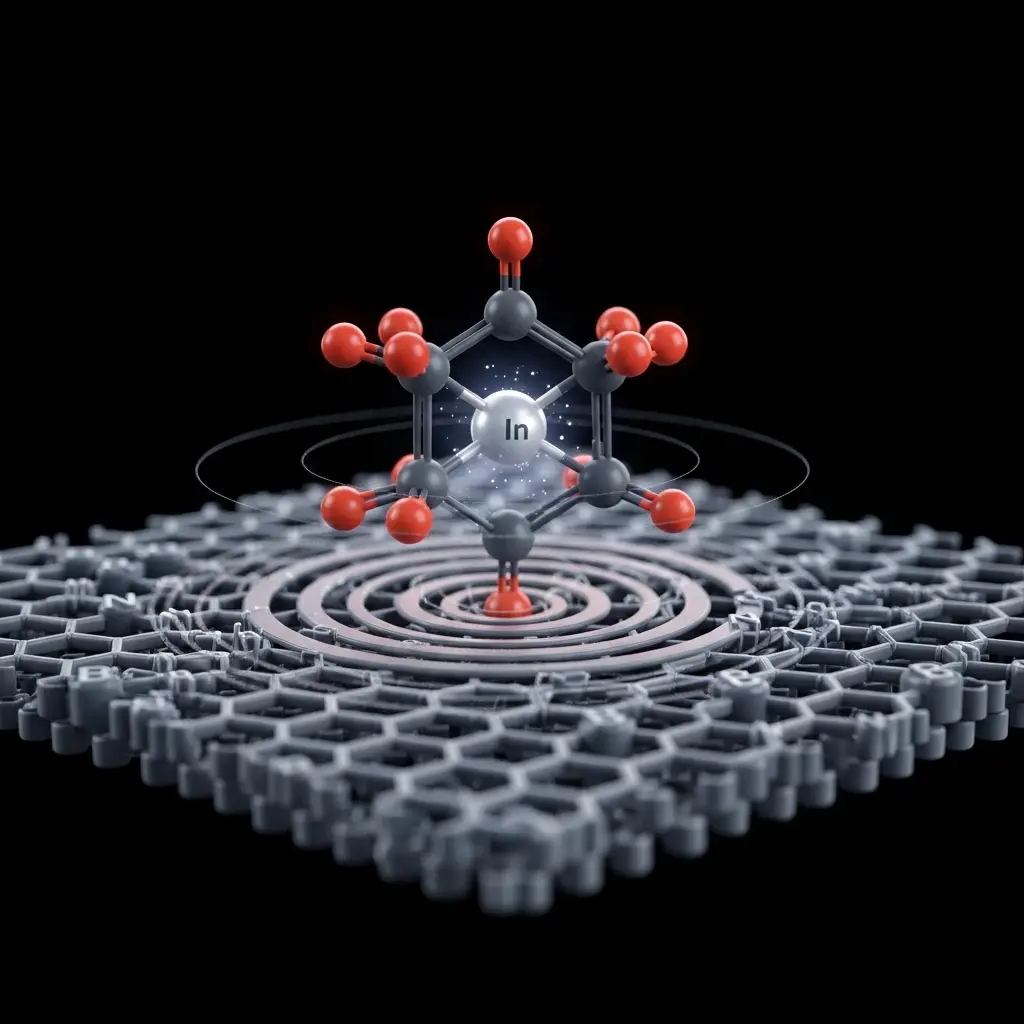
Scientists are tackling the persistent challenge of building stable, high-performing molecular qubits for quantum technologies. Tian-Xing Zheng (University of Chicago) and M. Iqbal Bakti Utama (Northwestern University), alongside Xingyu Gao et al, present a novel surface-scaffolded molecular qubit formed from pentacene molecules supported by hexagonal boron nitride. This innovative approach overcomes limitations in existing systems by maintaining coherence lifetimes , reaching an impressive 214 seconds under dynamical decoupling , whilst enabling direct surface integration and scalable fabrication. The research significantly advances the field by demonstrating coherence exceeding that of state-of-the-art shallow nitrogen-vacancy centres in diamond, and unlocks exciting possibilities for quantum sensing, simulation and the development of hybrid quantum devices.
This innovative platform overcomes a significant challenge in quantum technology, maintaining qubit performance while reducing system size and enabling surface integration for practical applications. The research establishes a novel approach to qubit design by leveraging the unique properties of 2D materials to support and stabilize organic molecules with inherent spin properties. Pentacene molecules were strategically positioned on the hBN surface, creating a robust and scalable system for quantum information processing.
This precise control over the spin environment is crucial for achieving high-fidelity quantum control and entanglement. This breakthrough combines true surface integration with exceptionally long coherence, alongside a scalable fabrication process, opening exciting avenues for Quantum sensing, quantum simulation, and the development of hybrid quantum devices. The study unveils a platform where the qubit’s performance isn’t compromised by its surface placement, a critical step towards building practical and interconnected quantum systems. Furthermore, the work paves the way for exploring a broader family of 2D material-supported molecular qubits, potentially expanding the toolkit for quantum technologies and enabling new functionalities.
The exceptional coherence times achieved, 22μs and 214μs with dynamical decoupling, significantly outperform other established qubit platforms, as illustrated by a comparative analysis of coherence versus qubit size. This performance is particularly noteworthy given the qubit’s direct positioning on a surface, a configuration that traditionally leads to reduced coherence due to increased noise and instability. Measurements demonstrate stable ODMR contrast for extended periods, with the hBN-scaffolded pentacene exhibiting a half-life of 37 minutes in ambient conditions, and significantly improved stability with hBN encapsulation, reaching 58 hours. These results confirm the robustness and potential for long-term operation of this novel qubit architecture.
Pentacene molecules on hexagonal boron nitride lattices exhibit
This innovative architecture combines the electronic spin qubit functionality of molecular systems with the integration advantages offered by 2D materials, as depicted schematically in Figure 0.1a. The research team employed a home-built confocal microscope to excite and read out the qubit using an off-resonance green laser at 520nm, while microwave control of the spin levels was achieved through precise manipulation of the applied field. To enhance coherence, researchers fully deuterated the pentacene molecules, achieving a significant improvement in Hahn-echo coherence from 2.5 ±0.1μs to 22.4 ±0.5μs. This isotopic substitution minimized the influence of nuclear spins, effectively reducing decoherence pathways.
Figure 0.1b illustrates a comparative analysis of T2 coherence times versus qubit size for various optically addressable spin qubits, clearly demonstrating the superior performance of the hBN-scaffolded pentacene. Detailed characterization of the qubit environment was performed using transmission electron microscopy (TEM) following focused ion beam (FIB) sectioning of hBN-encapsulated pentacene samples. Energy-dispersive X-ray spectroscopy (EDS) line-scans revealed the distribution of carbon, boron, and nitrogen elements, with carbon signals fitted to two Gaussian components exhibiting full-width-half-maxima (FWHM) of 2.28nm and 1.21nm, respectively. ODMR spectra, measured at 4 K in vacuum, showed a distinct signal at 2.38GHz corresponding to a π-pulse at the 1.43GHz transition, with ODMR contrast defined as C = IMW,on/IMW,off.
Pentacene molecular qubits demonstrate extended coherence times
The research introduces a system where fluorescent spins are positioned directly on a surface, maximising coupling to nearby spins and fields for nanoscale sensing and integration with photonic devices. The team measured the fitted half-life of the hBN-scaffolded pentacene qubit at ambient conditions to be 37 ±3 minutes, with no bleaching observed for qubits at 4 K in vacuum after over six months. Significantly, hBN encapsulation improved the stability of the pentacene qubit in ambient conditions, achieving a half-life of 58 ±17 hours. TEM imaging of the hBN surface revealed a 100nm slice cut by focused ion beam (FIB), while EDS line-scan results showed the distribution of carbon, boron, and nitrogen elements, with carbon signals fitted with two Gaussian components having full width at half maximums (FWHMs) of 2.28nm and 1.21nm, respectively.
Results demonstrate that through isotopic substitution of hydrogen with deuterium, the Hahn-echo coherence improved by almost an order of magnitude, increasing from 2.5 ±0.1μs to 22.4 ±0.5μs. Incorporating dynamical decoupling and multilevel spin control pushed the coherence time to 214 ±19μs, a breakthrough delivering performance competitive with established platforms while residing directly on a surface. The hBN-scaffolded pentacene achieves the smallest device footprint among optically addressable spin qubits, maintaining a competitive coherence time. ODMR measurements resolved three transition frequencies at (1.430 ±0.002) GHz, (0.95 ±0.01) GHz, and (2.38±0.02) GHz, matching the expected values based on zero-field splitting (ZFS) parameters of D = 2π×(1.905±0.005) GHz and E = −2π×(0.475±0.005) GHz. This platform establishes a new pathway for engineering molecular qubits at the surface of 2D hosts, combining long coherence, optical addressability, and facile sample preparation, and paving the way for nanoscale sensing, programmable spin networks, and hybrid quantum devices.
Pentacene spins demonstrate record coherence times, exceeding previous
Scientists have developed a novel platform for quantum technologies based on fluorescent spins integrated directly onto a surface. This achievement combines true surface integration with exceptionally long coherence times and the potential for scalable fabrication, opening avenues for advancements in quantum sensing, quantum simulation, and the creation of hybrid quantum devices. The team demonstrated coherent Rabi rotations of a dark-spin ensemble using a microwave drive, establishing proximal electron spins as controllable ancillary resources addressable through the hBN-scaffolded pentacene sensor. While acknowledging that the observed coherence times are comparable to those of near-surface NV centres in diamond, the authors highlight that their system achieves this performance while being positioned an order of magnitude closer to the surface. Limitations include reliance on defect densities within the hBN material for qubit formation, and future work will focus on exploring the platform’s potential for probing nanoscale phenomena in 2D moiré superlattices and biological systems.
👉 More information
🗞 A Surface-Scaffolded Molecular Qubit
🧠 ArXiv: https://arxiv.org/abs/2601.19976