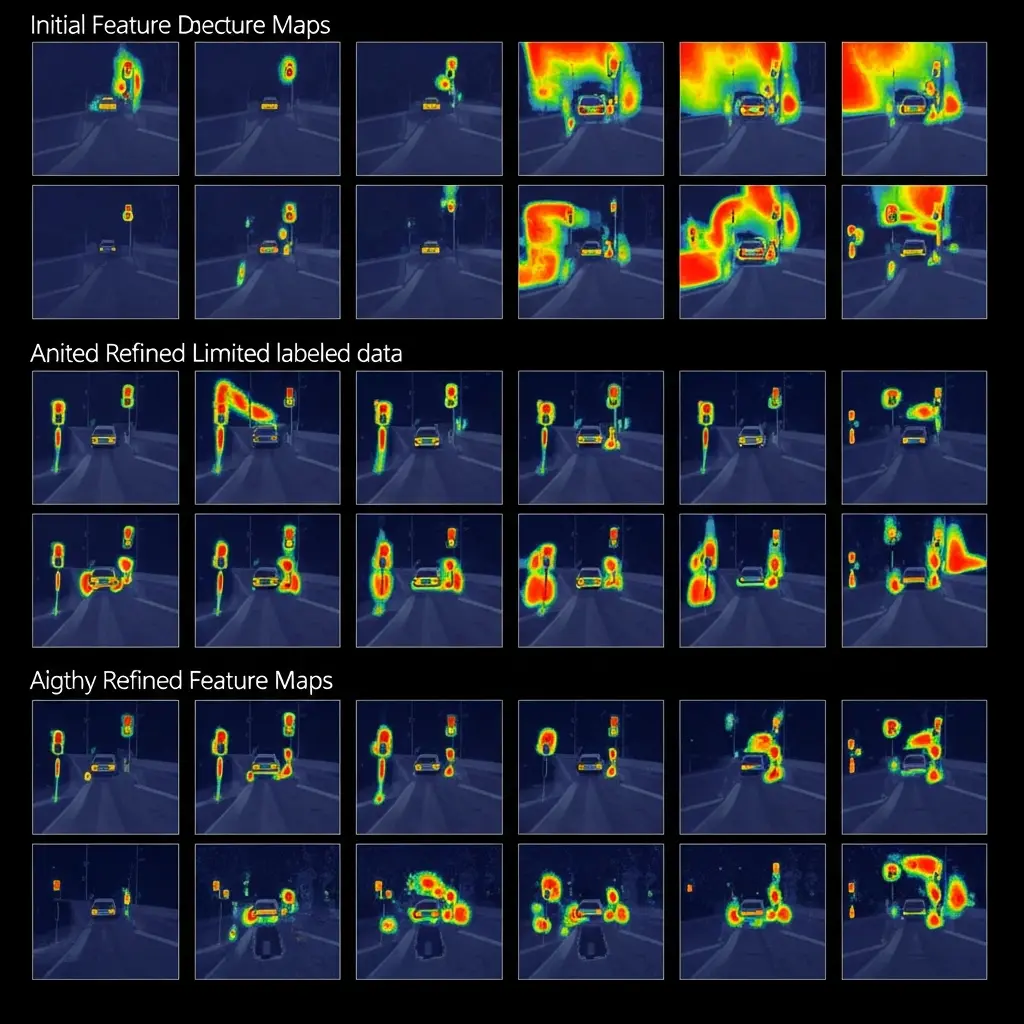
Scientists are increasingly focused on improving object detection when labelled data is limited, a significant challenge in many real-world applications. Chaoxin Wang from Dominican University, Bharaneeshwar Balasubramaniyam and Doina Caragea from Kansas State University, alongside Anurag Sangem and Nicolais Guevara from Peak Technologies et al., present a crucial investigation into semi-supervised object detection (SSOD) techniques , methods that cleverly combine small labelled datasets with vast quantities of unlabelled images. Their research offers a comprehensive comparison of leading SSOD approaches, MixPL, Semi-DETR and Consistent-Teacher, revealing how performance fluctuates as the amount of labelled data changes, and importantly, provides practical insights into selecting the optimal method for resource-constrained scenarios using standard benchmarks like MS-COCO and Pascal VOC, as well as a custom Beetle dataset. This work is significant because it directly addresses the need for robust and efficient object detection in data-scarce environments, paving the way for wider deployment in areas where extensive manual labelling is impractical.
SSOD performance with limited labelled data
Scientists have recently focused on semi-supervised object detection (SSOD) to address the challenge of limited labelled data, a common issue in fields like manufacturing, agriculture, and robotics. SSOD leverages readily available, unlabelled images alongside a small number of annotated images to create robust object detectors, significantly reducing the costly and time-consuming process of manual annotation. This study presents a comprehensive comparison of three state-of-the-art SSOD approaches, MixPL, Semi-DETR, and Consistent-Teacher, to understand how performance fluctuates with varying quantities of labelled images. Researchers conducted experiments using the widely recognised MS-COCO and Pascal VOC datasets, ensuring standardised evaluation, and also created a custom Beetle dataset to assess performance on specialised datasets with fewer object categories.
The team achieved a detailed analysis of these SSOD methods, investigating their behaviour under explicitly defined, limited numbers of labelled images per category. Unlike previous studies that often report performance based on percentages of datasets, this work standardised evaluation by fixing the number of labelled images per class, ranging from 1 to 150. This approach allows for a clearer understanding of how each method performs with a specific amount of training data, providing valuable insights into their suitability for low-data scenarios. Furthermore, the study extends beyond mere performance metrics, also considering crucial factors like model size and inference time, which are often overlooked but critical for real-world applications with limited resources.
Datasets and Experimental Design Parameters
Experiments were conducted using the MS-COCO and Pascal VOC datasets, containing images with 80 and 20 common object categories respectively, alongside a custom Beetle dataset featuring 7 beetle species. The researchers meticulously controlled the number of labelled images per category, ensuring each category appeared in at least k images, while acknowledging the varying number of instances within the MS-COCO and Pascal VOC datasets. This rigorous methodology enabled the team to pinpoint how performance changes as the number of labelled images increases, offering recommendations for achieving desired performance on new datasets. The work opens avenues for developing more efficient and effective object detection systems in data-scarce environments.
Understanding Trade-offs in Detection Performance
This research establishes a clear understanding of the trade-offs between accuracy, model size, and latency in SSOD, providing valuable guidance for selecting the most appropriate method for low-data regimes. The study reveals that while some methods excel in accuracy, they may come at the cost of increased model size and slower inference times, highlighting the need for a balanced approach. By analysing MixPL, Semi-DETR, and Consistent-Teacher, scientists prove that a nuanced understanding of these trade-offs is essential for deploying SSOD systems in practical applications where computational resources and speed are paramount. Additionally, they curated a custom Beetle dataset, comprising images of seven beetle categories, enabling focused analysis on specialised datasets with fewer object classes. Experiments involved training each SSOD model with a defined number, k, of labelled images per category, ensuring each category appeared in at least k images, though co-occurrence in MS-COCO and Pascal VOC meant some categories appeared in more.
The study meticulously tracked performance metrics alongside model size and inference time, addressing a gap in prior SSOD research which often prioritises accuracy alone. Researchers harnessed publicly available implementations of MixPL, Semi-DETR, and Consistent-Teacher, excluding Sparse Semi-DETR and STEP-DETR due to a lack of publicly accessible code at the study’s commencement. The team systematically varied the number of labelled images to investigate performance trends, moving beyond reporting results as percentages of the MS-COCO dataset and instead focusing on explicit image counts. This approach enables a precise understanding of the relationship between data scarcity and detection accuracy.
The MS-COCO and Pascal VOC datasets, containing 80 and 20 categories respectively, were used alongside the Beetle dataset, which presented a more controlled environment with images containing one or more beetles of the same type. This methodology pioneers a detailed analysis of the trade-offs between accuracy, model size, and latency, providing crucial insights for deploying SSOD techniques in resource-constrained environments. The work highlights which methods are best suited for low-data regimes, offering practical guidance for applications in manufacturing, agriculture, and robotics where labelled data is expensive and time-consuming to obtain. The findings demonstrate how SSOD can effectively leverage unlabeled data to improve object detection performance, even with limited annotations.
SSOD performance versus labelled image quantity often shows
Comparing State-of-the-Art SSOD Methodologies
Scientists achieved a comprehensive comparison of three state-of-the-art semi-supervised object detection (SSOD) approaches, MixPL, Semi-DETR, and Consistent-Teacher, to understand performance variations with differing numbers of labeled images. The research team conducted experiments using the MS-COCO and Pascal VOC datasets, alongside a custom Beetle dataset, enabling standardized evaluation and insights into performance on specialized datasets with fewer object categories. Findings highlight trade-offs between accuracy, model size, and latency, informing the selection of optimal methods for low-data regimes. Experiments revealed that the study standardized evaluation by fixing the number of labeled images per class, varying this number from 1 to 150, specifically k ∈ {1, }.
The team applied this few-shot sampling strategy to the MS-COCO, Pascal VOC, and Beetle datasets, noting that the total number of object instances in the labeled set often exceeded k × c due to multiple instances per image and class imbalance. Data shows that each dataset presented unique challenges, with MS-COCO and Pascal VOC containing complex, multi-object scenes requiring robust detection capabilities. Results demonstrate that MixPL, leveraging pseudo-Mixup and pseudo-Mosaic augmentations, effectively addresses challenges in detecting small and tail-class objects, maintaining robustness across various labeled data regimes. Scientists recorded that Semi-DETR, a transformer-based approach, introduces Stage-wise Hybrid Matching (SHM) and Cross-view Query Consistency (CQC) to improve pseudo-label quality and training stability, particularly crucial in data-scarce scenarios.
Measurements confirm that Consistent-Teacher, employing Adaptive Sample Assignment (ASA) and a 3D Feature Alignment Module (FAM-3D), mitigates overfitting caused by noisy pseudo-boxes, enhancing the reliability of supervision signals. The breakthrough delivers a benchmarking framework for evaluating SSOD models in realistic few-shot settings, providing valuable insights into their performance characteristics. Tests prove that the selected methods, MixPL, Semi-DETR, and Consistent-Teacher, represent diverse learning paradigms, offering a broad evaluation lens under few-shot constraints. The study considered not only detection accuracy but also practical factors like model size and inference latency, offering a holistic assessment of each approach. The findings demonstrate that while all three models exhibit some ability to generalise with limited labelled data, performance declines as labelled instances become fewer.
MixPL and Semi-DETR achieve competitive results with small labelled datasets, but at the cost of significantly larger model sizes and increased latency compared to Consistent-Teacher. Consequently, Consistent-Teacher emerges as a potentially viable alternative in very low-data and resource-constrained scenarios. The authors acknowledge that the performance degradation observed with decreasing labelled data warrants further investigation. Future research could extend this work by exploring the behaviour of SSOD models in conjunction with large language and vision models (LLM/VLM) on diverse datasets. Specifically, investigating datasets characterised by either few objects with few instances per image, or few objects with many instances per image, could provide valuable insights. Overall, this study offers new understanding of the applicability and limitations of current SSOD models in resource-limited settings, guiding future development and deployment strategies.
🗞 Practical Insights into Semi-Supervised Object Detection Approaches
🧠 ArXiv: https://arxiv.org/abs/2601.13380