

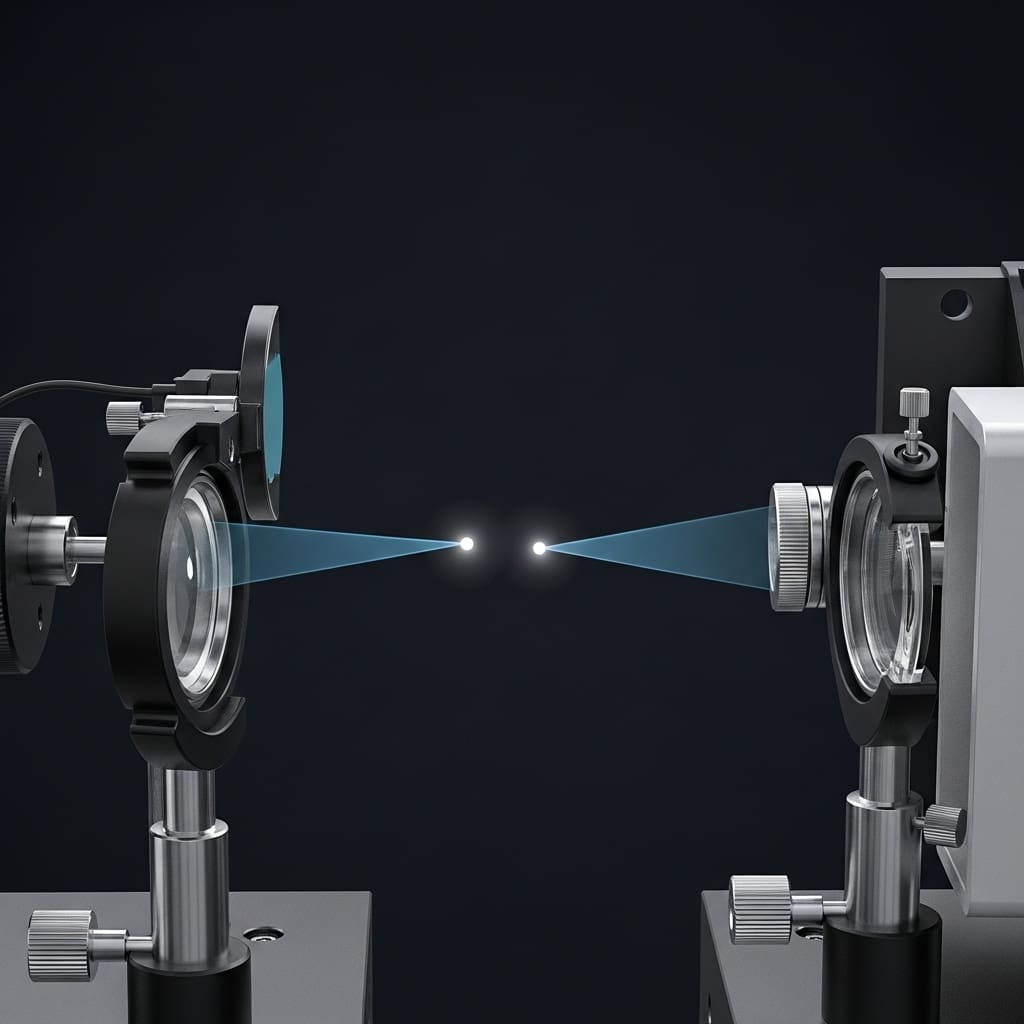
Scientists have, for the first time, simultaneously determined the position, separation and brightness of two closely-spaced, incoherent light sources beyond the conventional diffraction limit. Antonin Grateau from Laboratoire Kastler Brossel, alongside Alexander Boeschoten and Tanguy Favin-Lévêque, and their colleagues, detail a new technique called spatial-mode demultiplexing (SPADE) that achieves this super-resolution imaging. This breakthrough, published recently, significantly advances the field of optical microscopy and sensing, potentially enabling higher-resolution imaging in biological and materials science , and crucially, they’ve rigorously benchmarked their results against fundamental physical limits using the Cramér-Rao bound.
This breakthrough, published recently, significantly advances the field of optical microscopy and sensing, potentially enabling higher-resolution imaging in biological and materials science, and crucially, they’ve rigorously benchmarked their results against fundamental physical limits using the Cramér-Rao bound.
Sub-Rayleigh imaging via shifted SPADE demultiplexers enables high-resolution
This breakthrough enables super-resolved scene characterization, allowing for imaging beyond the conventional diffraction limit of light. The study meticulously benchmarks its performance against the fundamental limits set by Fisher-information-based Cramér-Rao bounds, providing a rigorous assessment of its capabilities and identifying the ultimate precision limits achievable. Researchers investigated two distinct scenarios to fully explore the method’s robustness: a realistic case involving slightly non-identical sources, and an idealized case assuming indistinguishable sources. This dual approach allowed for a comprehensive understanding of the technique’s performance under varying conditions and highlighted its adaptability.
The team’s work establishes a new standard for super-resolution imaging, moving beyond single-parameter estimation towards a more complete and versatile approach to scene reconstruction. This research introduces a dual-basis approach using two multi-plane light converters (MPLCs), one standard and one deliberately shifted, to enhance parameter sensitivity and robustness. Conventional SPADE using a single Hermite-Gaussian basis is insufficient for simultaneously estimating source separation, centroid, and brightness imbalance due to inherent symmetries. By introducing the shifted MPLC, the team created a complementary mode basis, lifting these degeneracies and significantly improving estimator performance.
Importantly, this configuration is more practical than implementing a full set of optimal, scene-dependent modes, making it more readily applicable to real-world imaging scenarios. The researchers constructed estimators directly from experimentally measured calibration curves, allowing them to model both distinguishable and indistinguishable sources. By carefully analysing the classical Fisher information matrix and associated Cramér-Rao bounds, they demonstrated the potential for achieving precision limits approaching the fundamental quantum limits of measurement. This work paves the way for practical applications in areas such as microscopy, astronomy, and security imaging, where super-resolution capabilities are crucial for extracting detailed information from complex scenes.,.
SPADE for Sub-Rayleigh Source Characterisation is a novel
This innovative approach allows for detailed analysis of closely spaced light sources previously indistinguishable with conventional methods. Experiments employed two custom-built demultiplexers, each designed to separate light based on its spatial mode, with one unit intentionally displaced to create interference patterns crucial for parameter estimation. The system delivers high-precision measurements by analysing these interference patterns, effectively enhancing resolution beyond the classical Rayleigh limit, approximately 10−2w0 for both separation and centroid, over a wide parameter range. Researchers meticulously benchmarked performance against Fisher-information-based Cramér-Rao bounds, establishing a clear understanding of the theoretical limits of their measurement precision and validating the effectiveness of the SPADE configuration.
The study investigated two distinct scenarios to assess robustness: a realistic case featuring slightly non-identical sources and an idealised scenario with indistinguishable sources. This dual approach clarified the practical scope of multiparameter SPADE measurements for super-resolution imaging, demonstrating consistent performance even under imperfect conditions. Although conducted in a high-photon-flux regime, the team highlighted the adaptability of the method to lower-flux conditions through appropriate detection schemes, potentially paving the way for applications in fields like astronomical imaging where light is scarce. Furthermore, the researchers engineered a scalable methodology, noting that the technique isn’t limited to two sources and can be readily extended to three or more incoherent emitters. The addition of further sources primarily increases the complexity of the parameter estimation process, but the underlying SPADE principle remains applicable, suggesting a versatile platform for complex scene reconstruction and analysis, this work received funding from the European Defence Fund under grant agreement 101103417 EDF-2021-DIS-RDIS-ADEQUADE.
Sub-Rayleigh source characterisation via SPADE
The research benchmarked performance using Fisher-information-based Cramér-Rao bounds, investigating both realistic scenarios with slightly non-identical sources and an idealized case of indistinguishable sources. Data shows the team computed the classical Fisher information matrix and associated Cramér-Rao bounds (CRBs) assuming shot-noise-limited detection, with the lower limit on the achievable standard deviation for each parameter α calculated as σα ≥ σα,CRB = p (F−1)αα. Measurements confirm that simulations were performed on an ensemble of scenes spanning the relevant parameter range at a fixed total photon number of N = 1011, and for each configuration, the marginal Cramér-Rao bounds on each parameter were extracted. The breakthrough delivers a reduction in the average value of the CRB for source separation, d, as a function of the source separation d/w0, with shaded areas illustrating the 90% range of computed values.
For indistinguishable sources, the averaged value of the quantum Cramér-Rao bound (QCRB) was computed, revealing a minimum difference of approximately a factor of 8 between the classical sensitivity of the 2-MPLC configuration and the QCRB. The experimental setup employed two independent, fiber-coupled continuous-wave lasers at 1550nm to generate incoherent light sources, each with a Gaussian beam waist of w1 ≃1135μm. Precise control over spatial separation at the beam splitter was achieved using motorized translation stages with a minimum step size of 20nm, allowing for fine adjustment of transverse displacement. The team imaged and mode-matched the beams for optimal coupling into a demultiplexer with a waist of w0 ≃320μm, effectively implementing a unitary transformation to spatially separated Gaussian modes for independent detection.
Sub-Rayleigh imaging via SPADE parameter estimation enables high-resolution
This achievement enables super-resolved scene characterization, effectively surpassing the diffraction limit typically imposed on optical imaging systems. The findings clarify the practical scope of multiparameter SPADE measurements for super-resolution imaging, reaching separation uncertainties of 10−3w0 in realistic scenarios with slightly distinguishable sources and 10−2w0 for indistinguishable sources, where w0 represents a fundamental unit of spatial scale. Although the current experiment was conducted with high photon flux, the authors acknowledge that the approach could be adapted for lower-flux conditions with improved detection schemes, potentially opening avenues for applications like astronomical imaging. Future work could extend the method beyond two sources, generalising it to three or more incoherent emitters, although this would increase the complexity of parameter estimation.
👉 More information
🗞 Multiparameter estimation for the superresolution of two incoherent sources
🧠 ArXiv: https://arxiv.org/abs/2601.14876


