

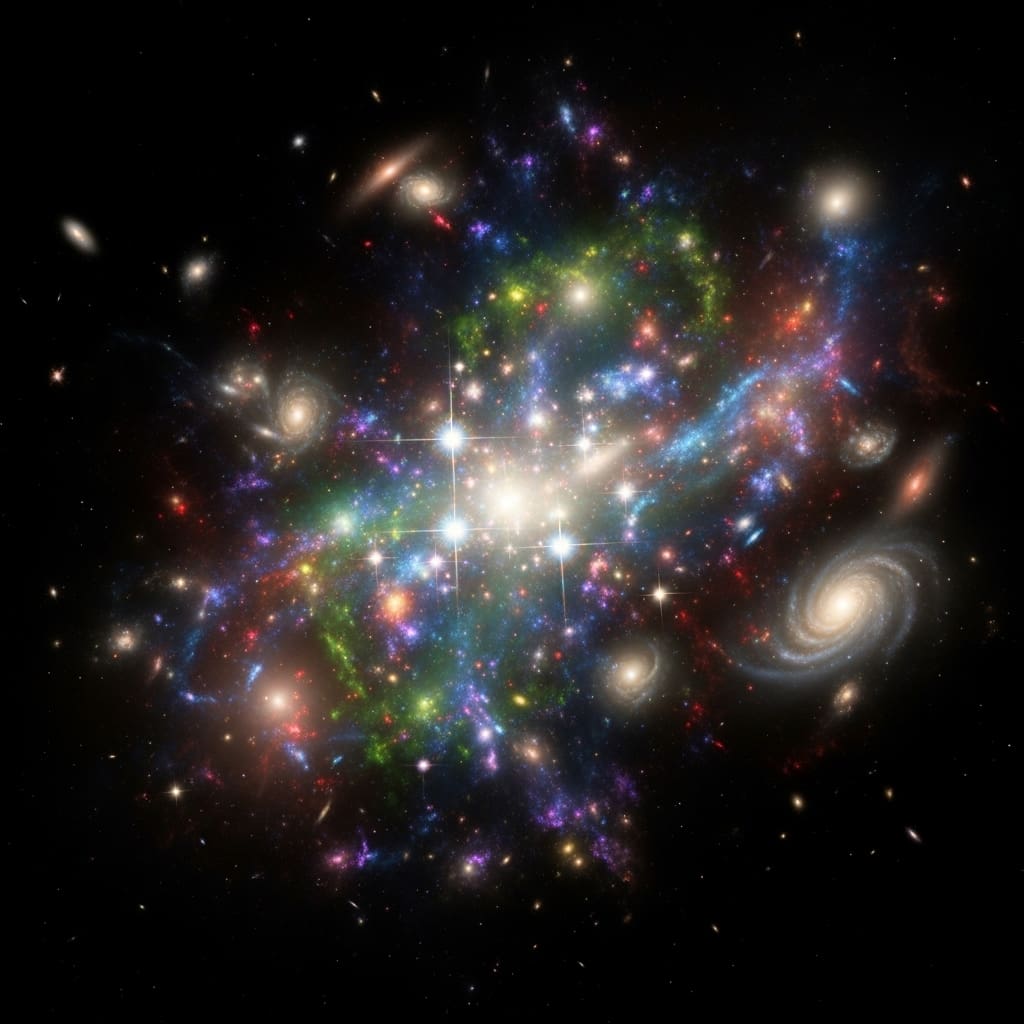
The unexpectedly high nitrogen content observed in distant galaxies is challenging current understanding of early galactic evolution. Sho Ebihara, Michiko S. Fujii, and Takayuki R. Saitoh, from the University of Tokyo and Kobe University respectively, alongside colleagues including Yutaka Hirai, Yuki Isobe and Chris Nagele et al., have investigated a potential source for this nitrogen enrichment: supermassive stars. Their research focuses on GN-z11, a galaxy at a redshift of 10.6, and explores whether nitrogen-rich stellar winds from these massive stars could account for the galaxy’s unusual chemical composition. By employing detailed galaxy formation simulations, the team demonstrates that pollution from a single supermassive star can successfully reproduce the observed nitrogen-to-oxygen ratio in GN-z11, offering a compelling explanation for the abundance patterns seen in these early galaxies. This work suggests that supermassive stars may have played a significant, and previously underestimated, role in seeding the early universe with heavy elements.
GN-z11 Nitrogen Boost From Supermassive Stars
This study investigates the nitrogen enhancement observed in the high-redshift galaxy GN-z11, proposing a scenario involving metal pollution from extremely massive stars. The research team employed stellar evolution models and chemical yield calculations to assess the impact of these stars on the interstellar medium. Results indicate that the observed nitrogen abundance in GN-z11 can be explained by the contribution of metals synthesised in supermassive stars during the early universe. To investigate this unusual chemical signature, the study pioneered a novel approach combining cosmological zoom-in simulations with detailed chemical evolution modelling. Researchers employed a simulation that tracked galaxy formation, incorporating contributions from rotating massive stars, supernovae, and asymptotic giant branch stars to model chemical enrichment. The core of the research involved simulating the formation of a supermassive star, with a mass ranging between 103 and 105 solar masses, within the existing galactic framework.
Scientists meticulously investigated the impact of this star’s ejecta on the overall abundance pattern of the galaxy, focusing on nitrogen, oxygen, carbon, and hydrogen. This technique allowed for a focused examination of the SMS pollution scenario, moving beyond simpler one-zone models. The simulation accurately reproduced the observed abundance pattern of GN-z11, including its carbon-to-oxygen and oxygen-to-hydrogen ratios, when the mass fraction of pollution from the SMS ranged between 10 and 30 per cent. The study determined that this level of pollution could realistically occur if the gas surrounding the SMS was ionized, achieving a density between 104 and 105 cubic centimetres, as calculated within a Strömgren sphere.
This precise quantification of gas density provides a critical constraint on the conditions necessary for SMS pollution to be a viable explanation for the observed nitrogen enrichment. Furthermore, the team extended their analysis to compare the abundance patterns of other high-redshift, nitrogen-enhanced galaxies, demonstrating that the SMS pollution model could plausibly explain the chemical composition of several of these distant systems. The innovative combination of cosmological simulations and post-processing of SMS ejecta represents a significant methodological advance, enabling researchers to explore the potential role of supermassive stars in shaping the chemical evolution of the earliest galaxies. This approach provides a powerful tool for interpreting JWST observations and understanding the processes that drove the formation of the first heavy elements in the universe.
Supermassive Stars Enrich Early Galaxy Nitrogen Abundance Observations
James Webb Space Telescope observations have revealed unexpectedly high nitrogen-to-oxygen ratios in young, compact, high-redshift galaxies, with GN-z11 at a redshift of z=10.6 being a prime example. Scientists have been investigating potential causes for this unusual abundance pattern, and recent work focused on the possibility of pollution from supermassive stars, hypothesising that nitrogen-rich stellar winds could explain the observations. The research team employed a cosmological zoom-in simulation, incorporating chemical evolution driven by rotating massive stars, supernovae, and asymptotic giant branch stars to test this SMS scenario. Experiments revealed that the inclusion of SMS ejecta significantly enhanced the N/O ratio within the simulated galaxy, successfully reproducing the observed abundance pattern of GN-z11.
Specifically, the model accurately matched the carbon-to-oxygen and oxygen-to-hydrogen ratios when the mass fraction of SMS pollution ranged between 10 and 30 per cent. This pollution fraction could realistically occur if the gas surrounding the SMS was heavily polluted, with a gas density between 104 and 105 cubic centimetres, as calculated within a Strömgren sphere. The study further investigated the viability of the SMS pollution model by comparing the simulated abundance patterns with those of other high-redshift galaxies exhibiting similarly enhanced N/O ratios. The team modelled SMSs with masses between 103 and 105 solar masses, carefully tracking the contribution of their ejecta to the overall chemical composition of the simulated galaxy.
Supermassive Stars Explain Early Galaxy Nitrogen
This research presents a detailed analysis of the chemical composition of high-redshift galaxies, specifically addressing the unexpectedly high nitrogen-to-oxygen ratios observed in galaxies like GN-z11. Through cosmological simulations incorporating standard stellar evolution alongside the potential contribution of supermassive stars, the team successfully reproduced the observed abundance patterns of GN-z11 by modelling pollution from SMS ejecta. A pollution fraction of between ten and thirty per cent, achievable under specific gas density conditions, was sufficient to explain the elevated nitrogen levels. Furthermore, the study extends beyond GN-z11, demonstrating that the SMS pollution scenario can also account for the chemical signatures of other nitrogen-enhanced, high-redshift galaxies. The models also successfully reproduce observed correlations between nitrogen-to-oxygen, helium-to-hydrogen, and oxygen-to-hydrogen ratios. Future work could explore a wider range of galactic environments and refine the understanding of SMS formation and their impact on early galaxy evolution.
👉 More information
🗞 Nitrogen enhancement of GN-z11 by metal pollution from supermassive stars
🧠 ArXiv: https://arxiv.org/abs/2601.04344

