
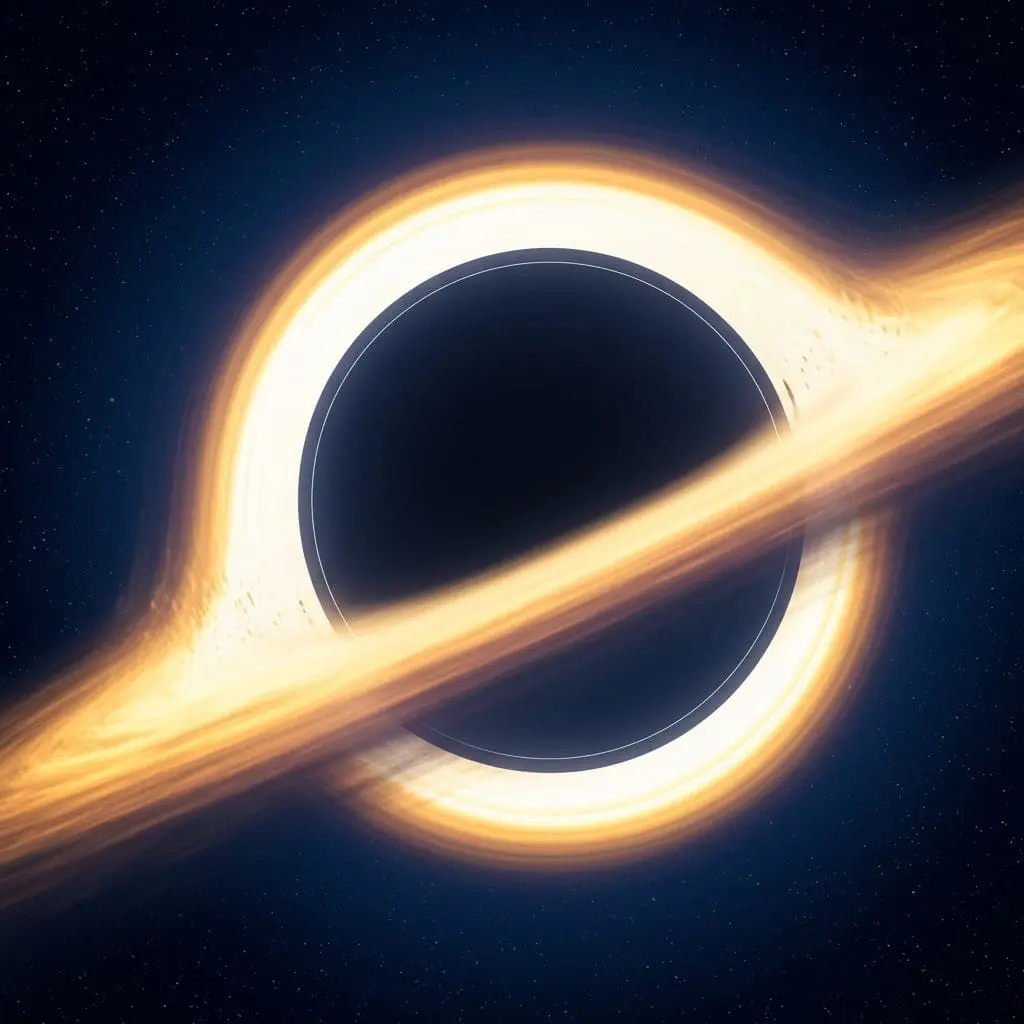
Direct imaging confirms supermassive black holes exist at galactic centres, validating Einstein’s general relativity. Observations suggest these black holes, potentially billions of solar masses, formed within the first billion years after the Big Bang, though their origins and co-evolution with galaxies remain unclear. Future telescopes like JWST and LISA may reveal clues to their formation.
The centres of most, if not all, large galaxies harbour supermassive black holes – entities with masses millions or even billions of times that of the Sun. Their existence, recently confirmed through direct imaging of their ‘shadows’, poses a fundamental question: how did these colossal objects form in the early universe? Current cosmological models struggle to explain the rapid assembly of such massive black holes within the first billion years after the Big Bang. A comprehensive review of the prevailing theories surrounding the origins of these ‘seed’ black holes, and the challenges in modelling their formation, is presented by Ke-Jung Chen (Institute of Astronomy and Astrophysics, Academia Sinica and Heidelberger Institut f¨ur Theoretische Studien) in a newly published article entitled ‘Origins of Supermassive Black Holes in Galactic Centers’. The work highlights potential observational tests utilising facilities such as the James Webb Space Telescope and the forthcoming Laser Interferometer Space Antenna (LISA).
The Genesis of Giants: Unveiling the Origins of Supermassive Black Holes
Direct imaging now confirms the presence of supermassive black holes (SMBHs) at the centres of galaxies, including our own Milky Way and M87. These observations validate predictions stemming from Einstein’s general relativity and reveal entities previously inferred only through indirect means. Current measurements indicate SMBHs possess masses ranging from millions to billions of times that of the Sun, with evidence suggesting that black holes exceeding a billion solar masses existed within the first billion years after the Big Bang. Contemporary research focuses on elucidating the origins of these SMBHs and understanding their co-evolution with their host galaxies, with a primary emphasis on the formation mechanisms of their initial ‘seed’ black holes.
Researchers are actively investigating several theoretical models for SMBH origins, each proposing a distinct pathway for seed black hole formation. These include the direct collapse of massive gas clouds, the remnants of exceptionally massive, short-lived stars (Population III stars), and the growth of intermediate-mass black holes through mergers and accretion. These models build upon foundational work in stellar structure, such as the analysis conducted by Chandrasekhar (1943), to understand the conditions necessary for black hole creation and refine existing theoretical frameworks. Observations of high-redshift quasars – extremely luminous active galactic nuclei (AGN) powered by supermassive black holes – provide crucial constraints on these models, allowing scientists to test theoretical predictions against observational evidence.
Recent studies by Kocevski et al. (2023) and Greene et al. (2024) are expanding our knowledge of the early existence and properties of SMBHs, offering observational evidence to characterise these early cosmic structures. Simultaneously, investigations into galaxy mergers, detailed by Hopkins et al. (2006), and the role of feedback from AGN, as highlighted by Di Matteo et al. (2005), reveal the complex interplay between SMBH growth and galaxy evolution. This demonstrates how these processes are interconnected; for example, energy released by an accreting black hole can regulate star formation within its host galaxy. Current research also emphasises the importance of understanding accretion processes – the inflow of matter onto black holes – as reviewed by King & Pounds (2015), and how this accretion fuels SMBH growth and influences the surrounding galactic environment. The rate and efficiency of accretion are critical parameters in determining the final mass of the SMBH.
Future facilities, including the James Webb Space Telescope (JWST) and the Laser Interferometer Space Antenna (LISA), promise to provide new observational signatures that will further refine our understanding of seed formation and the co-evolution of SMBHs and their host galaxies. These advanced instruments will allow scientists to probe the conditions that led to the formation of the first black holes and trace their growth over cosmic time. JWST’s unprecedented sensitivity and resolution will enable the detection of faint signatures of early seed black holes or their host galaxies, potentially revealing heavily obscured quasars powered by rapidly accreting seeds, and mapping the distribution of gas and stars in their vicinity.
LISA, a planned space-based gravitational wave observatory, will detect gravitational waves emitted by mergers of intermediate-mass and stellar-mass black holes, providing direct evidence for their existence and constraining their merger rates. Combining observations from JWST and LISA will provide a comprehensive picture of seed black hole formation and evolution. Scientists are actively developing sophisticated data analysis techniques to extract meaningful information from these observations and refine our understanding of the early universe.
Despite significant progress, challenges remain. Simulations require substantial computational resources to capture the relevant physics at sufficient resolution, and distinguishing between different seed formation scenarios observationally proves difficult, as the resulting SMBHs may exhibit similar properties. Nevertheless, ongoing research and the advent of new observational capabilities are poised to unlock the secrets of these enigmatic objects and their role in the evolution of the universe.
👉 More information
🗞 Origins of Supermassive Black Holes in Galactic Centers
🧠 DOI: https://doi.org/10.48550/arXiv.2505.19039