The unusual behaviour of certain materials during freezing has long puzzled physicists, and new research sheds light on this phenomenon in systems exhibiting a state known as topological order. Kouki Kimata, Harukuni Ikeda, and Masafumi Udagawa, from Gakushuin University, investigate how these materials transition from a liquid to a solid, revealing a process fundamentally different from conventional crystallization. Their work demonstrates that, instead of forming solid domains that rapidly expand, the solidification of a topological-ordered liquid is driven by the slow, diffusive motion of specific charge carriers called triplets. This sluggish movement, necessary to alter conserved quantities within the material, results in a glassy state and explains the peculiar characteristics observed in organic conductors, offering a significant advance in understanding charge glass behaviour.
Topological Order Emerges in Disordered Charge Glasses
Topological order defines a unique class of quantum and classical liquid states, distinct from those categorized by conventional symmetry breaking. Properties of these states, such as the existence of unusual particles and robust boundary characteristics, remain independent of the specific microscopic interactions within the material. This research investigates whether topological order can emerge in a glassy system, specifically supercooled charge glasses, and explores if inherent disorder can induce topological order, potentially leading to novel quantum phenomena. The approach involves studying the behaviour of charge in a two-dimensional electron gas subjected to strong disorder and low temperatures.
By carefully controlling electron density and temperature, the researchers aim to create a supercooled charge glass where electrons are localized but exhibit quantum correlations. They investigate these correlations, searching for signatures of topological order, such as charge splitting and the emergence of robust edge states. This work expands our understanding of topological order in disordered systems, extending the concept beyond traditionally studied clean materials and demonstrating the potential for realizing topological order in materials conventionally considered insulators. The research establishes a connection between glassy physics and topological order, suggesting that disorder can play a constructive role in creating and stabilizing exotic quantum states.
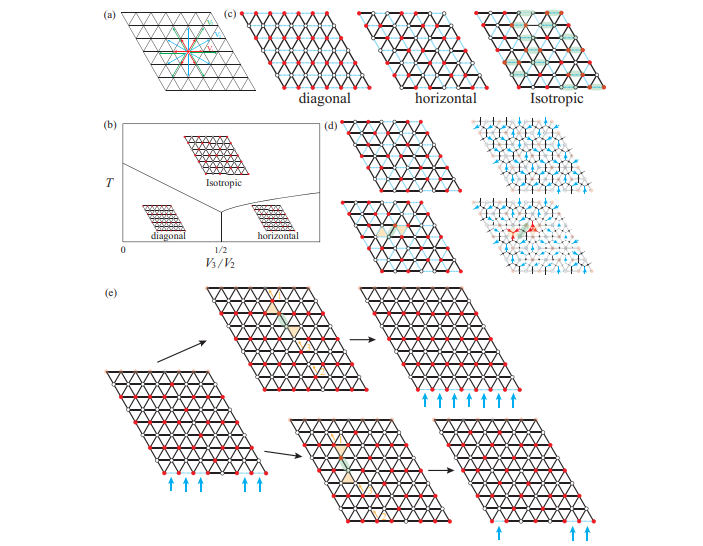
Topological ordered states remain incompletely understood, particularly the dynamics of their phase transitions. Researchers reveal that the crystallization of a topologically ordered liquid proceeds differently than conventional freezing. This topological phase is characterized by a global conserved quantity and associated fractional charge, termed a flux and a triplet in their working system of the charge Ising model on a triangular lattice. Unlike normal crystallization, this topological phase exhibits unique behaviour during the transition to a solid state.
Kinetic Monte Carlo Simulation Methodology and Analysis
This document details the methodology and supporting data for research on charge ordering and phase transitions in a two-dimensional material, designed to allow other researchers to reproduce the results and validate the findings. It details a Kinetic Monte Carlo (KMC) simulation, a stochastic method for modeling the time evolution of a system, explaining the governing equations, transition rate calculations, and simulation procedure. Physical quantities, such as the ordered fraction and triplet density, are measured during the simulation, using a system size of 144 and 1000 samples. The document also derives the critical radius for nucleation, the minimum size needed for an ordered domain to grow, balancing the energy gained from ordering with the energy cost of the domain boundary, and relating the time it takes for the system to order to the energy barrier for nucleation.
A fitting procedure is explained, detailing how experimental data is used to extract parameters like the transition temperature. The system is analyzed to identify local patterns of charge order, using hexagonal units to define the local environment around each site, and an algorithm identifies connected regions of ordered sites, employing a depth-first search protocol. The KMC simulation is robust and validated by the convergence of results across multiple runs. The derivation of the critical radius and the time scale for ordering provides a solid theoretical foundation for understanding the phase transition. The algorithm for identifying ordered regions is carefully explained, ensuring the reliability of the results. This supplemental material demonstrates a high level of scientific rigor and attention to detail.
Topological Liquid Crystallization via Triplet Diffusion
This research demonstrates that crystallization from a topologically-ordered liquid state proceeds differently than conventional freezing. Unlike typical crystallization, which begins with rapid growth of solid domains, this process is governed by the diffusive motion of specific charge carriers, termed triplets. The team found that completing crystallization requires these triplets to traverse macroscopic distances, leading to slowed processes and glassy behaviour, reflected in a small Avrami exponent observed during the initial stages of crystallization. The findings offer a new understanding of charge glass behaviour, particularly in organic conductors, by linking it to the diffusive dynamics within a topologically-ordered phase.
The researchers propose that this mechanism provides a universal explanation for supercooling from such liquids, potentially illuminating previously unresolved issues in frustrated systems. Notably, the team suggests possible relevance to the behaviour of water ice, given its Coulomb phase characteristics. The authors acknowledge that their analysis focuses on specific models and materials, and further investigation is needed to explore the full range of topological-ordered systems.
🗞 Charge glass from supercooling topological-ordered liquid
🧠 ArXiv: https://arxiv.org/abs/2511.02380