Detecting and converting high-frequency signals with precision remains a significant challenge in fields ranging from medical imaging to telecommunications, and researchers continually seek more sensitive and efficient methods. Beyza Zeynep Ucpinar, Sasan Razmkhah, and Mustafa Altay Karamuftuoglu, from the University of Southern California, along with Ali Bozbey from TOBB University of Economics and Technology, have now demonstrated a novel superconducting analog-to-digital converter (ADC) based on single flux quantum (SFQ) logic. This innovative ADC leverages the extreme sensitivity of superconducting interference devices, known as SQUIDs, to capture subtle variations in input signals and translate them into digital data with exceptional accuracy. By integrating majority circuits and advanced counter designs, the team achieves robust performance and simplifies the process of reading out the digital information, paving the way for fully integrated cryogenic readout systems and significantly enhancing the capabilities of high-frequency signal acquisition.
Digital SQUID Converts Flux to Digital Signals
This research presents a breakthrough in superconducting sensor technology, demonstrating a novel digital SQUID, a superconducting quantum interference device, capable of directly converting magnetic flux into a digital signal. The team successfully designed, fabricated, and tested a system that detects variations in current at high frequencies and translates them into single-flux-quantum (SFQ) pulse trains, simplifying downstream data processing. This innovative approach moves beyond traditional analog SQUIDs, which require complex room-temperature electronics for signal readout. The device achieves remarkable sensitivity, detecting magnetic flux variations as small as 10 -6 Φ 0 , where Φ 0 represents the magnetic flux quantum.
The device operates by counting individual flux quanta threading a superconducting loop, effectively performing analog-to-digital conversion of the magnetic signal. Crucially, the system eliminates the need for external feedback amplifiers or analog bias control, streamlining the readout process and reducing system complexity. The circulating current increment associated with a single flux quantum is directly related to the loop inductance, demonstrating the fundamental principle behind the device’s operation. To enhance robustness and minimize errors, the design incorporates a majority circuit and two counter types, asynchronous toggle flip-flop-based and synchronous cumulative-based, operating at cryogenic temperatures.
These counters collect the SFQ pulse train and convert it into a binary number, further simplifying digital readout. This achievement paves the way for fully integrated systems combining digital SQUID functionality with cryogenic readout circuits on a single chip, promising significant advancements in quantum sensing and high-speed data acquisition. The team’s work demonstrates a clear path toward compact, low-power sensors with broad dynamic range and simplified readout architectures.
Integrated Superconducting Analog-to-Digital Conversion Demonstrated
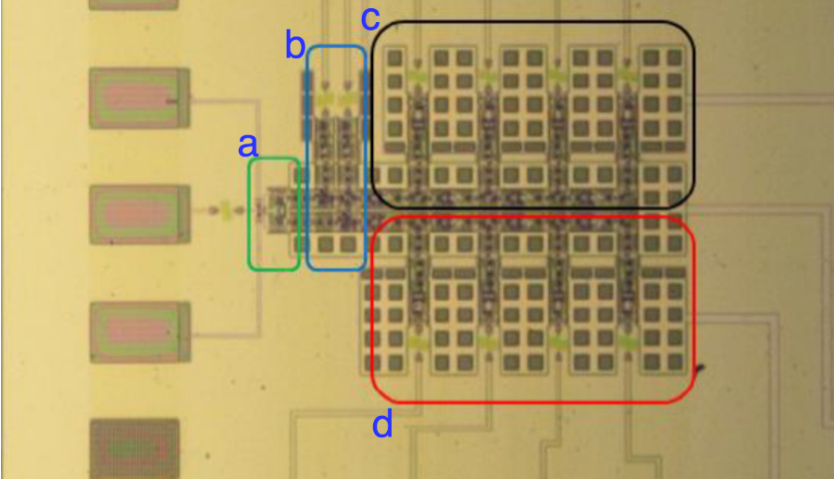
This work demonstrates a fully integrated superconducting analog-to-digital converter system built around digital SQUID modulators, achieving a significant advance in cryogenic electronics. Researchers successfully designed and fabricated a system capable of converting small analog current signals into digital outputs using superconducting circuits, a crucial step for high-precision sensing and computing at extremely low temperatures. The system incorporates two SQUID modulators with differing sensitivities, alongside both asynchronous and synchronous digital signal processing circuits, allowing for flexible operation prioritizing either speed or noise resilience. The team validated the integrated system, confirming the correct operation of all components and demonstrating the feasibility of their proposed architecture. A majority-voting circuit was implemented to further enhance signal reliability by mitigating noise, particularly at low input levels. This achievement establishes a low-noise, high-speed foundation for future superconducting analog-to-digital conversion, with potential applications in advanced cryogenic computing and sensing technologies.
Superconducting SQUID ADC Design and Validation
This research details the design, fabrication, and experimental validation of a fully integrated superconducting analog-to-digital converter (ADC) system. The core of the system revolves around digital Superconducting Quantum Interference Devices (SQUIDs) used to convert analog signals into digital representations. The system incorporates two SQUID modulators with differing sensitivities, alongside both asynchronous and synchronous digital signal processing circuits, allowing for flexible operation prioritizing either speed or noise resilience. A majority-voting circuit was implemented to further enhance signal reliability by mitigating noise, particularly at low input levels. The team validated the integrated system, confirming the correct operation of all components and demonstrating the feasibility of their proposed architecture. This achievement establishes a low-noise, high-speed foundation for future superconducting analog-to-digital conversion, with potential applications in advanced cryogenic computing and sensing technologies.
🗞 Experimental Demonstration of a Superconductor SFQ-Based ADC for High-Frequency Signal Acquisition
🧠 ArXiv: https://arxiv.org/abs/2510.14191