

Superconducting nanowire single-photon detectors (SNSPDs) represent a crucial technology for applications ranging from quantum communication to astronomical observation, relying on the detection of individual photons via the breaking of superconductivity in a nanowire. Recent research focuses on optimising these detectors, and a team led by Leif Bauer and Daien He, alongside colleagues at Purdue University and the University of Virginia, present a theoretical framework for a novel class of SNSPD, termed ‘type-1.5’. Their work, detailed in the article ‘Type-1.5 SNSPD: Interacting vortex theory of two bandgap superconducting single photon detectors’, explores the behaviour of these detectors which utilise two-bandgap superconductors, such as magnesium diboride (MgB2), and demonstrates how interactions between magnetic flux quanta, known as vortices, within the material can enhance detection efficiency and reduce unwanted noise, termed dark counts. This theoretical advance offers a pathway to improved single-photon detection capabilities.
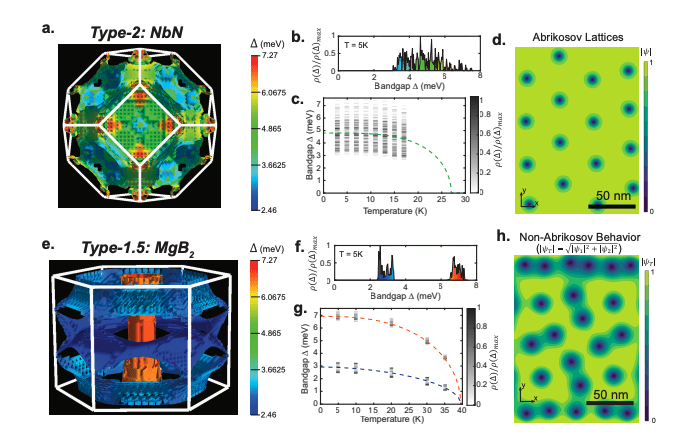
Recent investigations centre on magnesium diboride (MgB₂), a material exhibiting promising characteristics for advanced superconducting nanowire single-photon detectors (SNSPDs), with potential applications spanning quantum communication, remote sensing, and on-chip optical communication. These detectors function by registering individual photons, and their efficiency is critically dependent on the properties of the superconducting material used in their construction. MgB₂ distinguishes itself as a two-gap superconductor, possessing two distinct superconducting energy gaps which influence the behaviour of magnetic flux vortices within the material and ultimately impact detection performance. This research focuses on a novel type-1.5 SNSPD design, differing from conventional type-2 detectors and exploiting the specific vortex physics inherent to two-gap materials to achieve superior characteristics.
Experiments confirm the presence of two-gap superconductivity in MgB₂, utilising techniques such as specific heat measurements and scanning tunneling spectroscopy to characterise the material’s electronic structure. The existence of these two energy gaps significantly alters vortex behaviour, creating a unique operating regime for the SNSPD and enhancing its detection capabilities. Specifically, the absorption of a single photon initiates the formation of multiple vortices within a localised hotspot, a phenomenon not typically observed in conventional SNSPDs and contributing to improved sensitivity and efficiency. A vortex is a quantum of magnetic flux that penetrates a superconductor.
Theoretical modelling demonstrates that this type-1.5 regime effectively suppresses dark counts, spurious signals that limit detector performance and degrade signal-to-noise ratios. Dark counts arise from thermally excited charge carriers or other noise sources, and their reduction represents a significant advancement in SNSPD technology, enabling the detection of fainter signals and improving overall system performance. The interplay between the two energy gaps modulates vortex-vortex interactions, further enhancing detection efficiency. Researchers employ the Time-Dependent Ginzburg-Landau (TDGL) approach, a mathematical framework used to describe the dynamics of superconductivity, to simulate vortex dynamics and understand the underlying mechanisms governing detector performance, providing valuable insights into the complex interplay of superconductivity and photon detection.
Investigations into the impact of external factors, such as neutron irradiation, reveal the possibility of tailoring superconducting properties and optimising detector performance. Neutron irradiation modifies the two-gap behaviour, potentially driving a transition towards single-gap superconductivity, and offering a pathway to fine-tune the material’s characteristics for specific applications. This control over material characteristics opens avenues for optimising detector performance and exploring new functionalities, expanding the versatility of MgB₂ SNSPDs.
The research highlights the potential of two-gap superconductors to overcome limitations inherent in conventional SNSPDs and paves the way for developing highly sensitive and efficient photon detectors. By leveraging the unique vortex physics of MgB₂, researchers aim to create detectors with reduced dark counts, enhanced detection efficiency, and improved timing resolution, addressing critical challenges in various fields.
Researchers are actively exploring the fabrication and characterisation of MgB₂ SNSPDs, aiming to translate theoretical predictions and simulation results into practical devices. This involves optimising the material growth and nanofabrication processes, as well as developing advanced characterisation techniques to assess detector performance. Future research directions include investigating the effects of different material parameters, such as film thickness and composition, on detector performance. Additionally, researchers are exploring the use of novel nanofabrication techniques to create more complex and efficient detector structures.
This work represents a significant advancement in the field of superconducting single-photon detectors, demonstrating the potential of MgB₂ as a promising material for future applications. By leveraging the unique properties of two-gap superconductors and employing advanced theoretical and experimental techniques, researchers are paving the way for the development of high-performance detectors with enhanced sensitivity, efficiency, and timing resolution. This research has the potential to revolutionise various fields, enabling new scientific discoveries and technological advancements.
👉 More information
🗞 Type-1.5 SNSPD: Interacting vortex theory of two bandgap superconducting single photon detectors
🧠 DOI: https://doi.org/10.48550/arXiv.2507.01240


