Berkeley researchers have developed a new technique for fabricating superconducting devices that could lead to more powerful and efficient quantum computers. The method, which involves selectively etching silicon substrates, allows for the creation of suspended devices with high-quality factors and low stray capacitance.
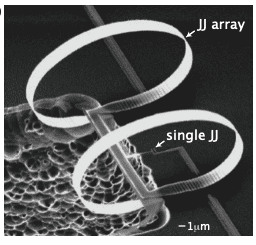
This is achieved by using XeF2 as a reactive etchant, which enables the individual lifting of Josephson junction arrays without damaging the surrounding material. The technique has been used to create resonators and qubits with high inductance elements, and could pave the way for developing novel types of qubits such as blochnium and the 0-π qubit.
Key individuals involved in the work include Christian Jünger and Trevor Chistolini. The research has implications for the development of more powerful quantum computers and could lead to breakthroughs in fields such as materials science and physics.
This research focuses on a novel approach to fabricating superconducting devices with partially suspended superinductors, key components in advanced quantum computing architectures. The primary objective is to minimize stray capacitance and maximize inductance while ensuring the method remains reliable and scalable.
The fabrication technique involves a proprietary cleaning method applied to a 6-inch intrinsic silicon wafer. The superinductor is constructed from an array of Josephson Junctions (JJs) using double-angle evaporation of aluminum (Al-AlOx-Al). A lithographically defined etch mask facilitates selective etching of the silicon substrate, enabling the JJ array to be individually lifted from the substrate. This innovation ensures precise device structure and functionality.
The study highlights several significant advancements. Suspended resonators exhibit a substantial reduction in parasitic capacitance to the ground, a crucial improvement for high-quality quantum devices. Moreover, the fluxonium device demonstrates an 87% increase in inductance compared to similar devices fabricated directly on the substrate. Additionally, the extracted self-Kerr coefficients of the suspended resonators align closely with theoretical predictions, indicating the high quality of these devices.
This method offers a promising path for scalable quantum computing. It enables the implementation of novel qubit designs requiring large inductance elements while effectively minimizing stray capacitance. Furthermore, the selective etching technique is versatile and compatible with various metals, allowing seamless integration into existing fabrication workflows without significant adjustments.
The research opens several avenues for further exploration. Optimizing the process could extend its application to other types of superconductors, enhancing their performance and scalability. Additionally, systematic studies of noise mechanisms, including dielectric loss, 1/f flux noise, and quasiparticle poisoning, could yield deeper insights into improving device reliability.
In summary, this study represents a substantial breakthrough in the fabrication of superconducting devices, with minimized stray capacitance and maximized inductance. Its implications for scalable quantum computing architectures and innovative qubit designs are profound, paving the way for further advancements in the field.
External Link: Click Here For More