

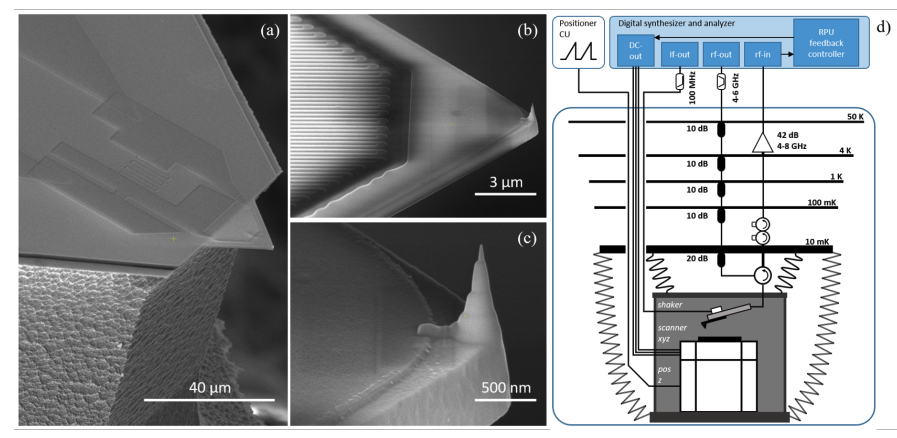
Atomic force microscopy (AFM) continually pushes the boundaries of materials characterisation, demanding increasingly sensitive methods for detecting minute forces at low temperatures. Researchers are now reporting a notable advance in AFM technology, utilising a superconducting microwave resonant circuit integrated with a microcantilever to detect deflection, a technique rooted in the principles of cavity optomechanics, where microwave photons interact with the mechanical motion of the cantilever. This approach offers a pathway to enhanced force sensitivity and reduced noise, crucial for investigating materials at the nanoscale. The work, detailed in a recent publication, comes from a collaborative effort led by Ermes Scarano, Elisabet K. Arvidsson, August K. Roos, Erik Holmgren, and David B. Haviland from KTH Royal Institute of Technology, alongside Riccardo Borgani and Mats O. Tholén from Intermodulation Products AB, and is titled “Low-temperature AFM with a microwave cavity optomechanical transducer”.
Atomic force microscopy (AFM) routinely investigates material surfaces at the nanoscale, but inherent limitations in force sensitivity often restrict the detection of subtle interactions. Conventional systems typically employ piezoelectric transducers to measure the deflection of a microcantilever, a tiny beam used to scan surfaces. Recent research details an AFM utilising a superconducting microwave resonant circuit integrated with a microcantilever, representing a significant advancement in nanoscale metrology and offering unprecedented sensitivity for force measurements.
The system’s performance relies on precise control of the cantilever’s oscillation and accurate measurement of its deflection, demanding sophisticated feedback and signal processing techniques. Researchers meticulously engineered the system to minimise noise and maximise signal strength, enabling the detection of extremely weak forces at the nanoscale. Superconducting circuits, which are materials exhibiting zero electrical resistance below a critical temperature, enhance sensitivity by reducing thermal noise —random fluctuations caused by the system’s temperature— and amplifying the signal. This is achieved by exploiting the quantum properties of superconductivity to create highly sensitive resonant circuits.
Researchers are actively exploring the use of this
Researchers are actively exploring the use of this superconducting AFM for studying a wide range of materials, including polymers, ceramics, and semiconductors. The high sensitivity of the system allows for the characterisation of materials with unprecedented precision, revealing subtle differences in their properties. This information is crucial for developing new materials with tailored properties for specific applications, such as advanced coatings or high-performance composites.
The integration of this superconducting AFM with other characterisation techniques, such as optical microscopy, which uses light to create images, and electron microscopy, which uses beams of electrons, will provide a more comprehensive understanding of nanoscale materials and phenomena. This multidisciplinary approach enables researchers to correlate structural, electronic, and optical properties, providing a holistic view of the material’s behaviour and facilitating a deeper understanding of its underlying mechanisms.
Future research focuses on optimising the cantilever’s geometry and material properties to further enhance its sensitivity and reduce its damping, the dissipation of energy that limits the duration of oscillation. Researchers are exploring the use of novel materials, such as carbon nanotubes, cylindrical molecules composed of carbon atoms, and graphene, a single layer of carbon atoms arranged in a honeycomb lattice, to fabricate cantilevers with improved mechanical properties. The development of automated data acquisition and analysis protocols will also streamline the experimental process and accelerate the pace of scientific discovery.
Expanding the scope of this research includes exploring applications in diverse fields, such as biology, chemistry, and materials science. The high sensitivity of the system makes it well-suited for probing biological molecules, studying chemical reactions, and characterising nanoscale materials. The development of new imaging modes and data analysis techniques will further expand the capabilities of the system, potentially enabling the observation of single molecules or the mapping of chemical bonds.
Researchers are actively collaborating with scientists from diverse
Researchers are actively collaborating with scientists from diverse fields to explore the full potential of this superconducting AFM. These collaborations will accelerate the pace of scientific discovery and drive innovation in various fields, fostering interdisciplinary research and facilitating the translation of fundamental discoveries into practical applications.
Researchers are actively exploring the use of this superconducting AFM for studying a wide range of phenomena, including friction, adhesion, and wear. This information is crucial for developing new materials and technologies with improved performance and durability, potentially leading to the design of more efficient lubricants or wear-resistant coatings.
This innovative approach opens new possibilities for exploring fundamental interactions and investigating novel materials with tailored properties. The potential applications of this technology are vast and far-reaching, promising significant advancements in various scientific and technological fields.
🗞 Low-temperature AFM with a microwave cavity optomechanical transducer
🧠 DOI: https://doi.org/10.48550/arXiv.2506.23338


