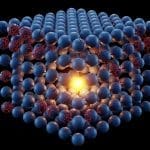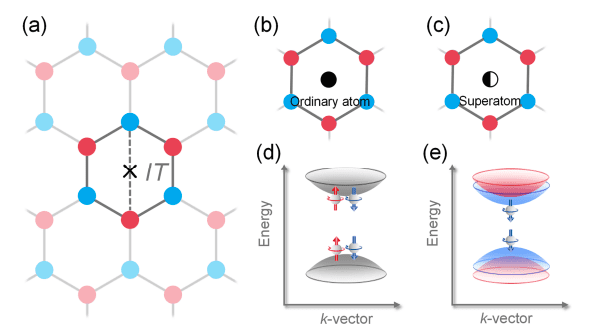
The search for materials exhibiting robust spin splitting is central to advances in spintronics, and recent research focuses on the potential of antiferromagnets to deliver this property, though realising two-dimensional examples remains a challenge. Fengxian Ma from Hebei Normal University, Zeying Zhang from Beijing University of Chemical Technology, and Zhen Gao, also from Hebei Normal University, alongside colleagues, now demonstrate a novel approach to engineer spin splitting within antiferromagnets by utilising specially designed building blocks known as superatoms. Their work bridges the fields of superatomic materials and antiferromagnetic spintronics, revealing that the internal characteristics of these superatoms, specifically their internal degrees of freedom, play a crucial role in determining the magnetic properties of the resulting material. By modelling a material constructed from carborane superatoms, the team shows how these internal characteristics can be harnessed to induce and control spin splitting, opening up exciting possibilities for designing new and improved spintronic devices based on superatomic lattices
Carboranes Induce Polarization in Antiferromagnets
This research explores a novel approach to spintronics, utilising carborane-based materials to create and control spin polarization within antiferromagnets. The core idea leverages the unique properties of carboranes, specifically their ability to generate substantial dipole moments, to manipulate the electronic structure of antiferromagnetic materials and achieve a net spin polarization, offering a potential pathway towards advanced spintronic devices. Conventional spintronic devices rely on ferromagnets, materials exhibiting spontaneous magnetisation, but these suffer from drawbacks like stray magnetic fields, which limit device density, and energy dissipation arising from the switching of magnetisation. Antiferromagnets present a promising alternative, offering faster dynamics, typically in the picosecond range compared to the nanosecond range of ferromagnets, and robustness against external magnetic fields, crucially without possessing a net magnetic moment, simplifying device integration and reducing unwanted interference.
However, directly harnessing their spin information proves challenging due to the inherent cancellation of spins within the material. In an antiferromagnet, neighbouring spins align in opposing directions, resulting in zero net magnetisation, a characteristic that, while beneficial for stability, hinders direct detection and manipulation of spin currents. This research addresses this limitation by inducing a net spin polarization in antiferromagnetic materials, making them viable for spintronic applications. The researchers utilise carboranes, boron-carbon clusters with the general formula BxCy, as fundamental building blocks to introduce large dipole moments into the antiferromagnetic material. These clusters exhibit a unique combination of stability and polarity, stemming from the electronegativity differences between boron, carbon, and any attached substituents. They employ computational modelling, specifically density functional theory (DFT), to simulate the electronic structure of these carborane-modified antiferromagnets, allowing them to predict how the carborane dipole moments influence spin polarization and to explore different carborane derivatives and arrangements to optimise the effect. DFT calculations solve the Schrödinger equation for many-body systems, providing insights into the electronic band structure, charge distribution, and magnetic properties of the materials.
The study focuses on specific antiferromagnetic compounds, notably manganese dioxide (MnO2) and nickel oxide (NiO), to demonstrate the effectiveness of this approach. These materials were chosen due to their well-characterised antiferromagnetic behaviour and relatively simple crystal structures, facilitating accurate computational modelling. The computational results demonstrate that incorporating carboranes into antiferromagnetic materials successfully induces a net spin polarization. The magnitude of this induced polarization directly correlates with the strength and orientation of the carborane dipole moments; stronger dipoles and favourable alignment lead to greater spin accumulation. Crucially, the researchers can tune the degree of spin polarization by carefully designing the carborane structure and arrangement, opening up possibilities for using these materials in spintronic devices such as spin filters, which selectively allow electrons with specific spin orientations to pass through, spin transistors, offering lower power consumption compared to conventional transistors, and magnetic sensors, capable of detecting weak magnetic fields with high sensitivity. The team investigated various carborane isomers and functionalisations, including 1,2-dicarba-closo-dodecaborane (C2B10H12) and its derivatives, to identify those exhibiting the most significant dipole moments and compatibility with the chosen antiferromagnetic hosts.
This research provides a novel approach to overcome the challenges of utilising antiferromagnets in spintronic devices, circumventing the limitations imposed by their zero net magnetisation. The findings establish important design principles for creating spin-polarized antiferromagnetic materials, emphasising the importance of dipole moment strength, orientation, and spatial arrangement. The induced spin polarization is not merely a static effect; the researchers also demonstrated the potential for dynamic control of the spin current through external stimuli, such as electric fields, offering opportunities for developing reconfigurable spintronic devices. The study also highlights the versatility of carboranes as functional building blocks for advanced materials, proposing a clever strategy to overcome spin cancellation in antiferromagnets by strategically introducing dipole moments using carborane chemistry, paving the way for a new generation of spintronic devices with enhanced performance and reduced energy consumption. Future work will focus on the experimental validation of these computational predictions, including the synthesis and characterisation of carborane-modified antiferromagnetic materials, and the fabrication of prototype spintronic devices to assess their functionality and performance.
👉 More information
🗞 Engineering Spin Splitting in Antiferromagnets by Superatoms with Internal Degree of Freedom
🧠 DOI: https://doi.org/10.48550/arXiv.2507.15213