
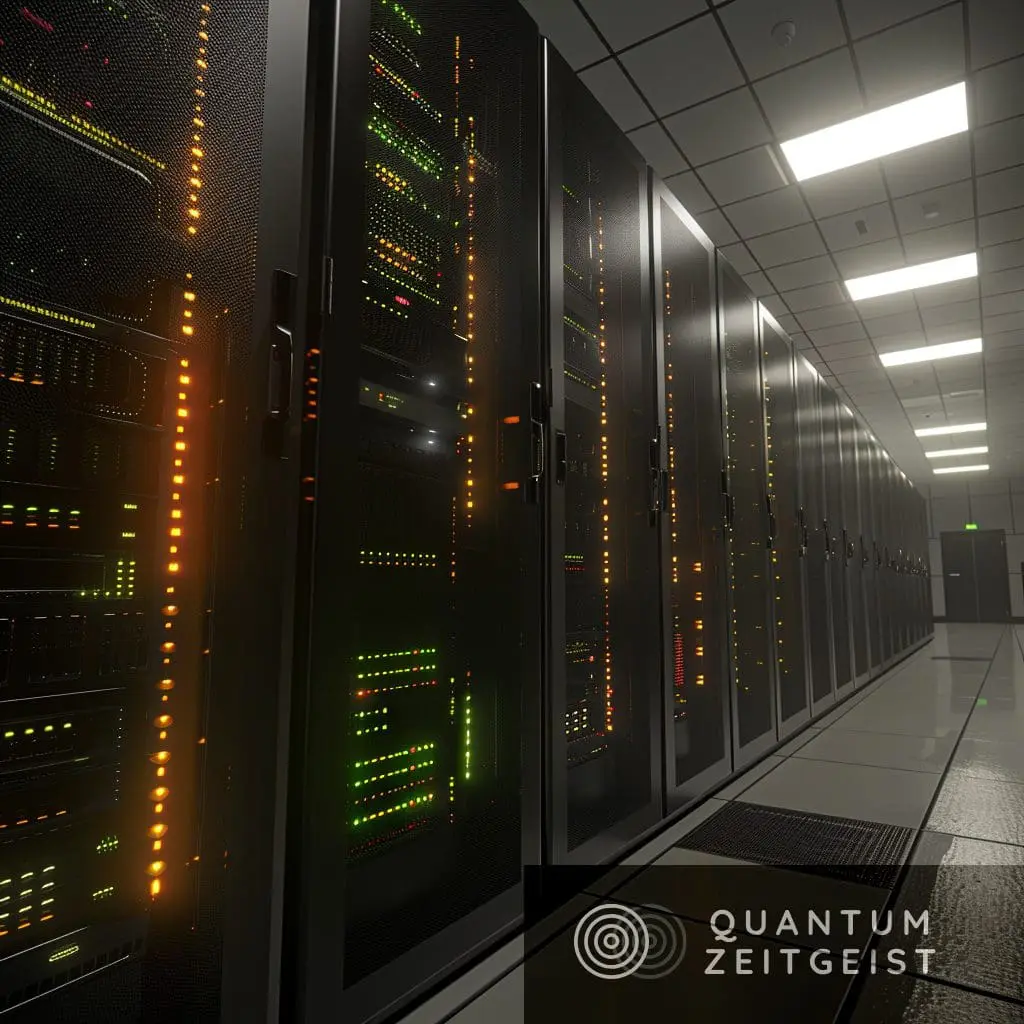
Super Computers and Quantum Computers are two major players in the technology world, each with unique capabilities. Supercomputers are essentially enhanced classical computers, using thousands or millions of processors to perform computations at high speeds. Quantum computers, on the other hand, use the principles of quantum mechanics to perform calculations, using quantum bits instead of classical bits. Both have significant real-world applications and are shaping the future of computing. Their key differences lie in their speed, size, scalability, and the principles on which they operate.
In the rapidly advancing world of technology, Super computers and Quantum Computers are two major contenders vying for computational supremacy. Each possesses unique capabilities and potential, operating on fundamentally different principles. This article aims to comprehensively understand these two technological titans, exploring their key differences, evolution, and real-world applications.
Super computers, as the name suggests, are essentially classical computers that have been supercharged. They are built using the same basic components as a desktop computer but are vastly more powerful. This is achieved by using thousands, or even millions, of processors, working in parallel to perform computations at speeds currently unattainable by a single processor.


Quantum computers, however, operate on an entirely different principle. They leverage the strange and counterintuitive principles of quantum mechanics to perform computations. Instead of using classical bits, which can be a 0 or a 1, quantum computers use quantum bits or qubits. Unlike classical bits, qubits can exist in a superposition of states, meaning they can be in a state that is a complex combination of 0 and 1.

The power of quantum computers lies in the quantum mechanical properties of superposition and interference. When a quantum system is in a superposition of states, it can be manipulated in ways that allow for the interference of the probabilities of these states. This interference can be constructive or destructive, and this ability to control the interference of probabilities gives quantum computers their potential computational power.
Supercomputers have evolved significantly since their inception. The earliest supercomputers were mainframes, large and expensive machines for complex scientific calculations and data processing. Today’s supercomputers, like the Summit by IBM or the Fugaku by RIKEN, can perform quadrillions of calculations per second. They use hundreds of thousands of processors working in parallel to achieve these incredible speeds. They are used for various applications, from weather forecasting and climate research to molecular modeling and cryptanalysis.
Quantum computers, on the other hand, have shown promise in fields where problems can be expressed as optimization problems. For example, Google’s quantum computer, Sycamore, leveraged these properties to achieve quantum supremacy in 2019, performing a calculation in 200 seconds that would take a supercomputer approximately 10,000 years.
In conclusion, while supercomputers and quantum computers are powerful machines, they operate on fundamentally different principles. Supercomputers use classical bits for computation, while quantum computers use quantum bits or qubits. The power of quantum computers lies in the quantum mechanical properties of superposition and interference, not in their ability to process a vast amount of information simultaneously.
The potential applications of both supercomputers and quantum computers are vast. Supercomputers will continue to play a crucial role in fields that require the processing of large amounts of data, while quantum computers could revolutionize fields where problems can be expressed as optimization problems. As technology advances, the future of computing looks incredibly promising, with both supercomputers and quantum computers leading the way.
References
- Dongarra, J., & Sullivan, F. (2000). Guest Editors’ Introduction: The Top 10 Algorithms. Computing in Science & Engineering, 2(1), 22-23. [Link](https://ieeexplore.ieee.org/document/814652)
- Output References:
- Arute, F., Arya, K., Babbush, R., Bacon, D., Bardin, J. C., Barends, R., … & Chen, Z. (2019). Quantum supremacy using a programmable superconducting processor. Nature, 574(7779), 505-510.
- Lloyd, S. (1996). Universal quantum simulators. Science, 273(5278), 1073-1078.
- Shor, P. W. (1999). Polynomial-Time Algorithms for Prime Factorization and Discrete Logarithms on a Quantum Computer. SIAM Review, 41(2), 303-332.
- “Quantum supremacy using a programmable superconducting processor.” Arute, F., Arya, K., Babbush, R. et al. Nature 574, 505–510 (2019). [Link](https://www.nature.com/articles/s41586-019-1666-5)
- “Supercomputing and the transformation of science.” William J. Kaufmann, Larry L. Smarr. Scientific American Library, a division of HPHLP. (1993).
- Hill, S. J., & Blencowe, M. P. (2012). Quantum computing with superconducting circuits. Journal of Applied Physics, 112(6), 064704.
- Shor, P. W. (1994). Algorithms for quantum computation: Discrete logarithms and factoring. In Proceedings 35th annual symposium on foundations of computer science (pp. 124-134). IEEE.
- Hidary, J. (2019). Quantum Computing: An Applied Approach. Springer.
- “Quantum Computation and Quantum Information”, Michael A. Nielsen and Isaac L. Chuang, Cambridge University Press, 2010.
- “Quantum Computing: A Gentle Introduction”, Eleanor G. Rieffel and Wolfgang H. Polak, MIT Press, 2011.
- LeCun, Y., Bengio, Y., & Hinton, G. (2015). Deep learning. Nature, 521(7553), 436-444.
- Bennett, C. H., & Brassard, G. (2014). Quantum cryptography: Public key distribution and coin tossing. In Theoretical computer science (pp. 223-251). Springer, Berlin, Heidelberg.
- “Quantum Computing.” Mermin, N. D. Cambridge University Press. (2007).
- “Supercomputing: A Historical Review and Examination of Future Developments”, Jack Dongarra and Thomas Sterling, Computing in Science & Engineering, 2001.
- Arora, S., & Barak, B. (2009). Computational complexity: a modern approach. Cambridge University Press.