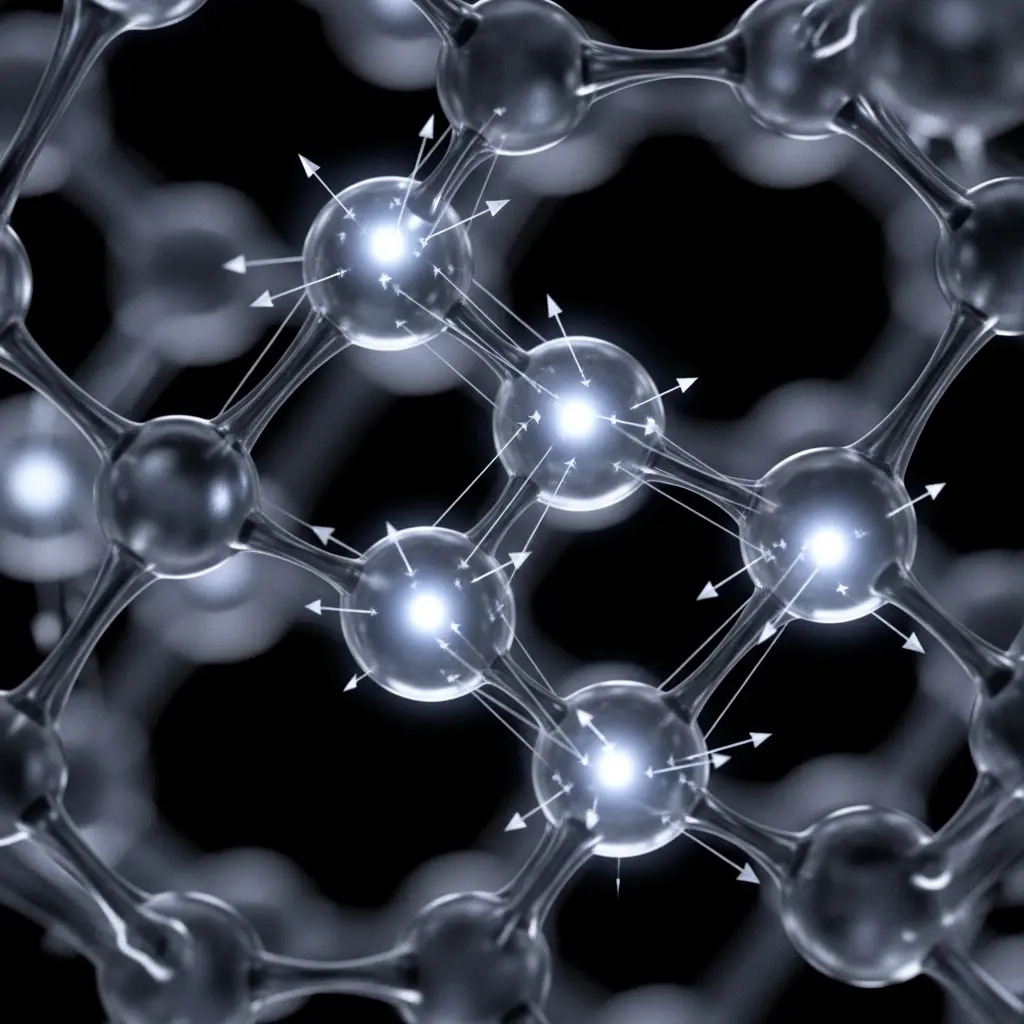
Researchers at Université Paris-Saclay, CNRS, Laboratoire de Physique des Solides, led by Y. Oubaid and S. Deng, have elucidated the ground state of barium iron sulfide (BaFe₂S₃) through a comprehensive study combining synchrotron infrared spectroscopy, theoretical calculations, and inelastic neutron scattering. This collaborative work, also involving colleagues at the same institution, NS. Dhami, M. Verseils, D. Bounoua, A. Forget, D. Colson, P. Foury-Leylekian, M. B. Lepetit, and V. Balédent, reveals a surprisingly complex interplay between the material’s crystal structure, vibrational modes (phonons), and magnetic behaviour. The team’s findings demonstrate that structural instability arises from short-range magnetic fluctuations, a mechanism previously observed in iron-pnictide materials but now discovered within a quasi-one-dimensional Mott system, thereby expanding our understanding of magnetoelastic coupling in iron-based compounds beyond conventional metallic scenarios.
Can subtle shifts in a material’s structure reveal how magnetism arises within it. Investigations into barium iron sulfide demonstrate that structural changes actually begin before static magnetism appears. This unexpected order suggests magnetism can drive changes in a material’s shape, even in systems where electrons aren’t flowing freely. Scientists are increasingly focused on understanding the complex interaction between a material’s atomic structure, its vibrational modes, and its magnetic properties.
Intriguing Phenomena in Iron-Based Superconductors
Recent investigations into iron-based compounds, materials known for their potential in high-temperature superconductivity, have revealed a wealth of intriguing phenomena including magnetism, orbital ordering, and even multiferroicity, the coexistence of multiple distinct orders. Research on barium iron sulfide (BaFe₂S₃) suggests a surprising connection between magnetism and structural changes at the atomic level.
This quasi-one-dimensional compound exhibits a structural transition around 125-130 K and magnetic ordering at approximately 95 K. To determine the precise symmetry of BaFe₂S₃ has proven challenging, with earlier studies suggesting a centrosymmetric structure. By examining how infrared light interacts with the crystal lattice, and comparing these observations with predictions from first-principles calculations, they established a lower symmetry than previously thought, consistent with a specific space group at low temperatures.
Detecting Coupling Through Lattice Vibrations
Several infrared-active phonon modes, characteristic vibrations of the crystal lattice, showed distinct anomalies coinciding with both the structural and magnetic transition temperatures. Calculations demonstrated that these affected modes involve atomic displacements that directly modulate the magnetic exchange pathways, the routes along which magnetic interactions occur between iron atoms.
Neutron scattering the magnetic order below 95 K is three-dimensional, long-ranged, and static, while active magnetic correlations exist between 95 K and 130 K before disappearing at higher temperatures. These findings highlight the central role of magnetoelastic coupling, the interaction between magnetism and lattice strain, in iron-based materials, even beyond the more commonly studied itinerant systems.
Growing Single Crystals of Barium Iron Sulfide
BaFe2S3 crystal growth via controlled thermal treatment and argon atmosphere
Single crystals of BaFe₂S₃ were grown utilising a self-flux method to investigate magnetoelastic coupling. Stoichiometric amounts of BaS (99.9%), Fe (99.9%). S (99.999%) powders, with a molar ratio of 1:2.05:3, were combined and pelletized — approximately 2g of this mixture was placed within a carbon crucible, sealed inside an evacuated quartz ampoule with a 300 mbar argon backfill. Subjected to a specific thermal profile.
The ampoule underwent heating to 1100°C for 24 hours to ensure complete homogenization of the materials. Then, a controlled cooling process implemented a decrease in temperature to 750°C at 6°C/h, followed by furnace cooling to room temperature. In turn, this procedure yielded rod-shaped crystals, naturally aligned along the c axis of the orthorhombic Cmcm structure. These crystals were approximately millimeter-sized and densely packed.
Prior to further analysis, the crystalline quality and bulk properties of the samples were confirmed through previous characterisation, verifying their structural and chemical homogeneity. Linearly polarised radiation generated using a polyethylene polariser, and absolute reflectivity determined through in situ gold evaporation for accurate reference measurements.
Spectra collected across a temperature range of 20-300 K. Inelastic neutron scattering experiments performed using the THALES cold-neutron triple-axis spectrometer at the Institut Laue-Langevin (ILL). Achieving a resolution better than 50 μeV.
The sample temperature controlled between 150 K and 10 K using an orange helium-flow cryostat. A single crystal, approximately 0.5 cm³, aligned in the (H, H, L) scattering plane. Lattice-dynamics analysis reveals the low-temperature space group is consistent with Pb21m, a deviation from previously proposed symmetry. Several infrared-active phonon modes display pronounced anomalies at both the structural transition temperature and the Néel temperature of 95 Kelvin.
Such affected modes predominantly involve displacements modulating magnetic exchange pathways, as shown by first-principles calculations. Neutron scattering magnetic order below 95 Kelvin is three-dimensional, long-ranged, and static. Between 95 and 130 Kelvin, the system exhibits three-dimensional short-range active magnetic correlations, which then disappear above 130 Kelvin.
As a result, the structural transition coincides with the onset of magnetic fluctuations, rather than static magnetic order establishing itself. BaFe2S3 exhibits weak polar distortions, crystallizing in a non-centrosymmetric space group even at room temperature, contrary to previous understanding. Recent work on barium iron sulfide reveals a surprising connection between magnetism and structural instability, offering a new perspective on a problem that has challenged condensed matter physicists for decades.
For years, establishing a clear link between active magnetic fluctuations and static structural changes has proved elusive. With many materials exhibiting one without the other. Here, this project, however, demonstrates that fleeting magnetic interactions can, in fact, be sufficient to trigger a measurable distortion in the arrangement of atoms. Understanding the precise mechanisms at play in quasi-one-dimensional systems like this barium iron sulfide compound presents unique difficulties.
Unlike many better-studied iron-based materials, this one doesn’t rely on freely moving electrons to mediate magnetism. In turn, to extend these findings to other quasi-one-dimensional systems will be essential to build a broader understanding of magnetoelastic coupling in iron-based materials.
🗞 Ground State of BaFe2S3 from Lattice and Spin Dynamics
🧠 ArXiv: https://arxiv.org/abs/2602.16899