

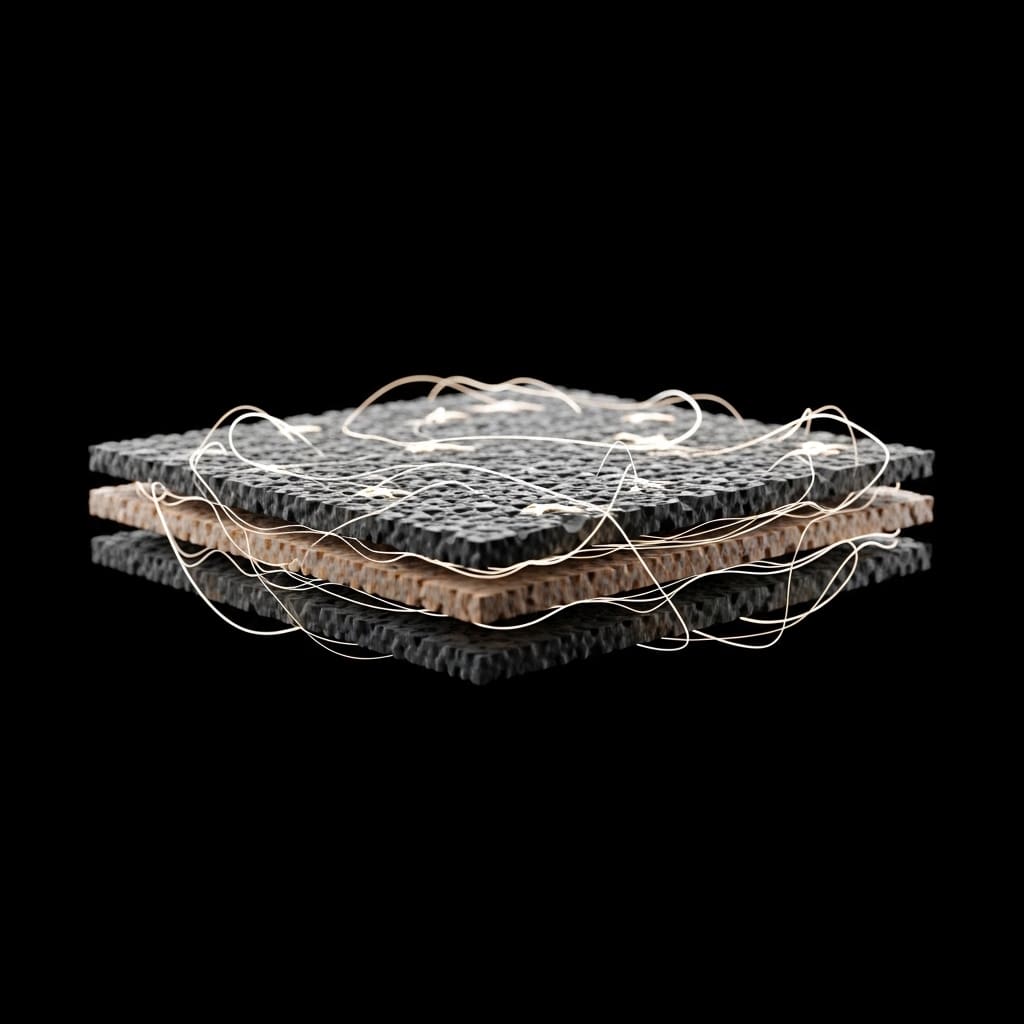
Researchers investigating high-temperature superconductivity in cuprates have long recognised the disparity between strong in-plane electronic behaviour and weak interlayer coherence. Now, E. Yu. Beliayev from the B. Verkin Institute for Low Temperature Physics and Engineering of the National Academy of Sciences of Ukraine, alongside Y. K. Mishra and I. G. Mirzoiev, and colleagues propose that even subtle vertical disorder, originating from factors such as interstitial-oxygen staging, twin boundaries, or strain fields, can significantly modulate interlayer tunneling. This work demonstrates that such modulations generate a complex electrodynamic response along the c-axis, explaining observed phenomena including Josephson plasma resonances and nonmonotonic resistivity. By establishing a framework where the organisation of disorder, rather than its intensity, dictates interlayer coupling, this research offers a unifying explanation for anomalies across multiple cuprate families and suggests a potential route for controlling dimensionality and enhancing coherence in these materials.
Because the bare interlayer coupling is intrinsically small, such modulations generate an effectively multichannel c-axis electrodynamic response, consistent with multi-component Josephson plasma resonances, nonmonotonic c-axis resistivity, redistribution of bilayer magnetic spectral weight, and field-enhanced vertical CDW correlations. Layered cuprate superconductors comprise electronically active CuO2 planes separated by comparatively inert spacer layers, resulting in extreme electronic anisotropy; while quasiparticle states within the CuO2 planes remain robust and strongly correlated, coherence along the crystallographic c axis is notably fragile. This fragility manifests in a broad range of experimental observations, including the Josephson plasma resonance, unconventional c-axis transport, field-induced three-dimensional charge-density-wave correlations, and the sensitivity of bilayer magnetic excitations to dilute planar impurities. Experimentally observed c-axis anomalies do not fit naturally into a single classification scheme; some cuprates exhibit multi-component or broadened JPR spectra, implying significant spatial variations in interlayer tunneling, whereas others display a single sharp resonance. In certain compounds, ρc(T) follows variable-range-hopping behaviour characteristic of strongly localized out-of-plane transport, while in others it evolves through non-monotonic crossovers. Magnetic fields can drive underdoped YBa2Cu3O6+δ into a three-dimensionally coupled CDW state, but Hg-based cuprates, among the structurally cleanest, support only short-range, essentially two-dimensional CDW correlations even under comparable conditions. Very small concentrations of planar impurities such as Zn or Ni can substantially modify the bilayer magnetic resonance in YBa2Cu3O6+x, altering its energy, spectral weight, and line shape while leaving in-plane superconductivity largely intact. A complementary transport-based perspective on disorder-driven crossovers and the emergence of coherence in low-doped La2-xSrxCuO4+δ was developed previously, where nonlinear transport regimes and percolative superconducting connectivity were analysed in detail. Researchers argue that many of these apparently unrelated phenomena can be understood within a common framework by recognising the role of vertically correlated disorder, forms of quenched disorder whose spatial organization extends coherently along the c axis. Although disorder in cuprates is frequently treated as a random, pair-breaking perturbation, structural studies demonstrate that interstitial oxygen and related defects can form vertically extended configurations persisting across multiple unit cells. At the same time, analyses of fluctuating stripe-like and nematic electronic textures indicate that correlated spatial organization of this kind can arise naturally from electronically driven self-organization. The interlayer tunneling amplitude t⊥ is intrinsically small and strongly dependent on local structural geometry, including the apical-oxygen position, the Cu, O, Cu bond configuration, and nematic distortions of the underlying electronic dispersion. The combination of weak interlayer coupling and vertically organized disorder, therefore, produces a layer-dependent tunneling landscape that can significantly affect c-axis electrodynamics, even in the absence of charge transfer or genuine three-dimensional electronic order. The central idea of this work is that the spatial organization of disorder, rather than its overall magnitude, can play a decisive role in shaping interlayer coupling in cuprates. To explore this notion, researchers introduce a minimal phenomenological description in which the effective tunneling amplitude varies from layer to layer as t⊥(z)=t0+δt(z), with δt(z) containing correlations that extend along the crystallographic c axis. In this picture, different vertically extended regions act as parallel tunneling channels, each contributing a distinct electrodynamic response. Such a multichannel structure naturally accommodates a variety of observed behaviours, including multi-component JPR spectra, sample-dependent forms of ρc(T), field-enhanced CDW stacking in YBa2Cu3O6+δ, and impurity-induced modifications of the bilayer magnetic resonance. The goal is not to construct a microscopic model for t⊥(z), but to identify the essential consequences of vertically organized disorder for interlayer electrodynamics. This framework provides a common language for discussing several experimental trends and may offer useful guidance for approaches involving controlled disorder, oxygen-order manipulation, or strain-based tuning of interlayer coherence. Interlayer electronic coupling in cuprate superconductors is intrinsically weak, strongly anisotropic, and extraordinarily sensitive to local structural conditions. Unlike conventional layered metals, cuprates exhibit no coherent c-axis band dispersion; out-of-plane transport instead proceeds via tunneling across spacer layers that contain apical oxygens, distorted CuO6 octahedra, and charge-reservoir blocks. Consequently, even subtle variations in Cu, O, Cu bond angles, apical-oxygen positions, or local strain can induce disproportionately large changes in the interlayer tunneling amplitude. This intrinsic sensitivity is further amplified by the pronounced electronic inhomogeneity within the CuO2 planes. Experiments indicate that each plane comprises nanoscale regions with distinct superconducting gaps, carrier densities, and ordering tendencies, and these features rarely align laterally from one layer to the next. A metallic region in one CuO2 plane may therefore overlap with a pseudogapped or insulating region in an adjacent plane, suppressing the coherence of the interlayer tunneling channel connecting them. As a result, c-axis transport can exhibit localization- or VRH behaviour, even while in-plane transport remains comparatively coherent, as observed in underdoped La2-xSrxCuO4. In lightly doped La2CuO4+δ, detailed transport studies have demonstrated that the variable-range-hopping regime exhibits a three-dimensional character, despite the strongly layered crystal structure. This observation implies that hole motion can involve interlayer pathways mediated by apical oxygen and defect configurations, reinforcing the notion that even nominally two-dimensional cuprates may sustain vertically extended transport networks under appropriate disorder conditions. Additional evidence for strong in-plane electronic inhomogeneity, capable of frustrating interlayer coherence, is provided by transport measurements in lightly doped LSCO that reveal self-organized anisotropic electronic textures. Interlayer components of collective electronic orders exhibit a comparable fragility. In La2-xBaxCuO4 near the 1/8 anomaly, the 90° rotation of stripe orientation between adjacent CuO2 layers frustrates interlayer Josephson coupling and leads to predominantly two-dimensional superconducting behaviour with negligible c-axis coherence. In YBa2Cu3O6+δ, charge-density-wave correlations remain essentially two-dimensional at zero magnetic field and develop genuine three-dimensional stacking only under strong fields that align otherwise misregistered CDW domains. In bilayer cuprates, even dilute planar impurities, such as Zn or Ni, can strongly modify interlayer coherence is among the most fragile elements of the cuprates’ correlated electronic structure. Its pronounced sensitivity to in-plane inhomogeneity, disorder, and local structural distortions makes the c-axis response a particularly informative probe of nanoscale electronic organization. At the same time, this susceptibility suggests that disorder, when spatially correlated rather than random, can reorganize interlayer coupling in structured and reproducible ways, enabling the emergent c-axis phenomena examined in the sections that follow. A wide variety of structural motifs in cuprate superconductors gives rise to disorder whose spatial distribution is not fully random but exhibits correlations extending along the crystallographic c-axis. Because the interlayer tunneling amplitude t⊥ is extremely sensitive to apical-oxygen height, Cu, O coordination geometry, and local octahedral tilts, vertically correlated disorder naturally imprints a structured modulation onto the effective interlayer coupling. Several experimentally established mechanisms can produce such vertical organization. One prominent example arises from interstitial-oxygen staging in La2CuO4+δ. Neutron and X-ray scattering studies have shown that excess oxygen does not occupy interstitial sites randomly, but forms periodically repeated oxygen-rich layers or domains with a characteristic c-axis periodicity. These vertically extended configurations distort the CuO6 octahedra across several adjacent planes, inducing correlated modulations in apical-oxygen displacement and octahedral tilt patterns and thereby generating corresponding variations in t⊥(z). Twin boundaries provide a second mechanism for vertically correlated structural disorder. In orthorhombic cuprates such as YBa2Cu3O7-δ, twin boundaries form during the tetragonal, orthorhombic transition and propagate as extended planar defects through large portions of the crystal. Low-temperature STM measurements directly reveal densely spaced, quasi-periodic streaks on cleaved YBa2Cu3O7 surfaces, consistent with twin boundaries extending over hundreds of nanometers. These defects generate long-range strain fields that alter local Cu, O coordination and thus can influence apical-oxygen displacement and interlayer tunneling pathways. Researchers employed transmission electron microscopy alongside x-ray diffraction to map interstitial oxygen defects and twin boundaries across multiple unit cells, characterising vertically correlated disorder. These techniques revealed that disorder is not uniformly distributed but instead forms extended, coherent configurations extending along the c-axis. This contrasts with conventional treatments of disorder as a purely random perturbation, and instead highlights the importance of spatial organization. The study focused on identifying structural motifs capable of generating these vertically correlated features, such as extended strain fields and defect-pinned charge textures, to understand their influence on interlayer coupling. To model the impact of this organized disorder, a phenomenological framework was developed, introducing a layer-dependent interlayer tunneling amplitude denoted as t⊥(z). This amplitude is expressed as the sum of a baseline value, t0, and a spatially correlated fluctuation, δt(z), acknowledging that tunneling probability varies between layers. The crucial innovation lies in treating δt(z) as possessing correlations extending along the c-axis, effectively creating multiple parallel tunneling channels. Consequently, the research team simulated the c-axis electrodynamic response arising from this multichannel tunneling landscape. Calculations were performed to predict how variations in δt(z) would manifest as broadened or multi-component Josephson plasma resonances, a key spectroscopic signature of cuprate superconductivity. Furthermore, the model was used to explore the influence of this modulated tunneling on c-axis resistivity, predicting non-monotonic temperature dependencies indicative of localized charge transport. By focusing on the organization of disorder, rather than its absolute magnitude, this work offers a novel perspective on the complex interplay between structure, correlations, and interlayer coherence in high-Tc superconductors. The study reveals a pronounced sensitivity of cuprate superconductivity to subtle variations in the vertical arrangement of atomic layers. Specifically, researchers demonstrate that weak, layer-dependent modulations of the interlayer tunneling amplitude, denoted as t(z), generate a multichannel electrodynamic response in the c-axis. This manifests as multi-component Josephson plasma resonances, a non-monotonic c-axis resistivity, and a redistribution of bilayer magnetic spectral weight, indicating a complex interplay between layers. Analysis of the data indicates that even minor vertically correlated disorder, originating from interstitial oxygen, twin boundaries, strain, or defect-pinned charge textures, can significantly alter the interlayer coupling. Because the inherent interlayer coupling is small, these modulations amplify into measurable effects. The work establishes that the organization of this disorder, rather than its absolute size, dictates the effective interlayer coupling and its associated electrodynamic characteristics. This framework successfully unifies previously disparate c-axis anomalies observed across multiple cuprate families, suggesting a common underlying mechanism. Furthermore, the research highlights enhanced vertical charge density wave correlations under applied magnetic fields. These correlations are not simply a consequence of increased field strength, but rather a direct result of the modulated interlayer coupling. The findings underscore how weak interlayer connections can amplify subtle organizational features of disorder into significant, experimentally observable phenomena, a principle potentially applicable to materials beyond cuprates. Detailed quantitative modelling of t⊥(z) in realistic disorder landscapes, alongside controlled manipulation of vertical disorder, are proposed as avenues for future investigation.
👉 More information
🗞 Vertically Correlated Disorder and Structured Interlayer Tunneling in Cuprates
🧠 ArXiv: https://arxiv.org/abs/2602.11014

