Silicon, a cornerstone of modern electronics, has long been hampered by its inability to efficiently emit light, hindering the development of practical silicon-based light sources and optoelectronic devices. Now, researchers led by Aleksei Noskov from the University of California, Irvine, and Alexander Kotlyar and Liat Katrivas from Tel Aviv University demonstrate a surprisingly simple and scalable method to overcome this limitation. By decorating a silicon wafer’s surface with gold or copper nanoparticles, the team achieves remarkably strong light emission, effectively bypassing silicon’s indirect bandgap. This breakthrough, which yields efficiencies comparable to direct bandgap semiconductors and represents a substantial increase in light output, challenges conventional understanding of silicon’s limitations and paves the way for high-performance silicon photonics.
Silicon’s inherent inability to efficiently emit light, due to its indirect bandgap, has long presented a challenge to developing practical silicon-based light sources. While strategies such as confining electrons and holes within nanoscale structures have shown promise, these often require complex fabrication techniques. This research demonstrates a conceptually simple and scalable approach: decorating a silicon wafer with gold or copper nanoparticles to enable light emission. Remarkably, the effect is nearly identical for both metals, with particle size proving to be the most important factor influencing the observed emission characteristics.
Hot Carriers and Two-Photon Luminescence Studies
This research explores the fundamental principles governing light emission, focusing on how materials generate and interact with light at the nanoscale. Key areas of investigation include photoluminescence, the process of light emission following excitation, and the behaviour of hot electrons and holes, high-energy charge carriers, within materials. Researchers also examine two-photon absorption, a process where a material absorbs two photons simultaneously, leading to excitation and luminescence. Understanding these processes is crucial for developing efficient light-emitting devices. The study delves into the behaviour of light at the nanoscale, exploring how plasmonics, the interaction of light with electrons at metal surfaces, can enhance optical phenomena.
Localized surface plasmons, confined to nanoscale metal structures like gold and silver nanoparticles, play a critical role in amplifying light emission. Researchers investigate how the shape and arrangement of these nanoparticles influence their optical properties, and how they can be used to create nanoscale optical cavities that confine light and enhance interactions. These investigations extend to techniques like near-field optics, which allow imaging and spectroscopy beyond the diffraction limit of light. The research also incorporates advanced computational methods, such as many-body perturbation theory and density functional theory, to model the electronic structure of materials and predict their optical properties. These calculations provide insights into the underlying mechanisms governing light emission and absorption, and help guide the design of new materials and devices.
Nanoparticles Boost Silicon Light Emission
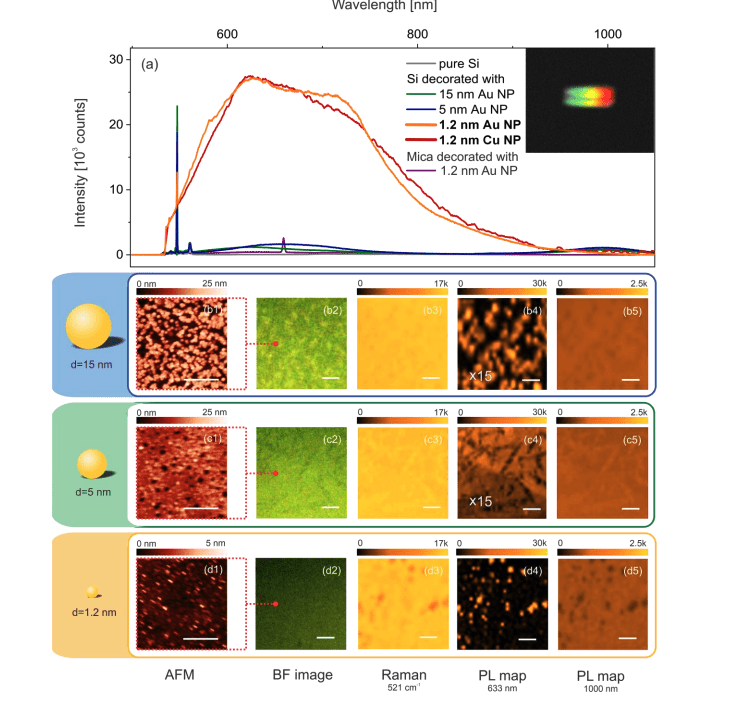
Silicon, traditionally a poor light emitter due to its indirect bandgap, has been transformed into a surprisingly efficient light source through a novel approach. Researchers have demonstrated that decorating a silicon wafer with gold or copper nanoparticles, each less than 2 nanometers in diameter, dramatically increases light emission, achieving efficiencies comparable to gallium arsenide, a direct bandgap semiconductor. This represents a significant breakthrough, as silicon’s inherent properties typically hinder efficient light production. The key to this enhanced emission lies in the creation of unique photonic states at the silicon surface.
By carefully controlling the size of the nanoparticles, researchers engineered a broadened distribution of photon momentum, effectively bypassing the limitations imposed by silicon’s indirect bandgap. This allows electrons to release energy as light, rather than losing it through other processes. The results demonstrate that particle size is the dominant factor, with the chemical identity of the metal, gold or copper, playing a minimal role. Remarkably, the enhanced silicon emission achieved an external quantum efficiency of approximately 0. 5, closely matching the 0.
This high efficiency translates to visible emission that is readily observable with the naked eye, a stark contrast to the typically dim light output of silicon. The increase in light intensity is approximately 100,000-fold greater than that of untreated silicon, demonstrating the substantial impact of this technique. This discovery challenges the long-held assumption that silicon’s optical properties are fundamentally limited by its indirect bandgap, and offers a pathway to practical, high-performance silicon-based light sources.
Nanoparticles Unlock Silicon Light Emission
This research demonstrates a novel method for enabling light emission from silicon, traditionally a poor light emitter due to its indirect bandgap. By decorating silicon wafers with nanoparticles of gold or copper, and crucially limiting particle size to below 2 nanometers, the team achieved strong luminescence across a broad spectrum of visible and near-infrared light. The effect appears largely independent of the metal used, with particle size being the dominant factor in determining emission efficiency. This suggests the nanoparticles create unique photonic states that bypass silicon’s usual limitations, allowing for radiative recombination of electrons and holes.
The observed light emission represents a substantial improvement, a hundred thousand-fold increase, in spectral intensity compared to typical silicon, bringing its performance closer to that of direct bandgap semiconductors. Measurements confirm that the emission originates from the silicon itself, not the nanoparticles, and that larger nanoparticles do not produce the same effect. While the team observed a reduction in the silicon’s Raman response with the smallest nanoparticles, indicating increased optical absorption, they acknowledge that further investigation is needed to fully understand the underlying mechanisms. Future work could focus on optimizing nanoparticle density and arrangement to further enhance light emission and explore potential applications in silicon-based optoelectronic devices. This research opens new avenues for developing efficient and cost-effective silicon-based light sources, potentially revolutionizing fields such as optical communications, sensing, and displays.
👉 More information
🗞 Overcoming the indirect bandgap: efficient silicon emission via momentum-expanded photonic states
🧠 DOI: https://doi.org/10.48550/arXiv.2507.19001