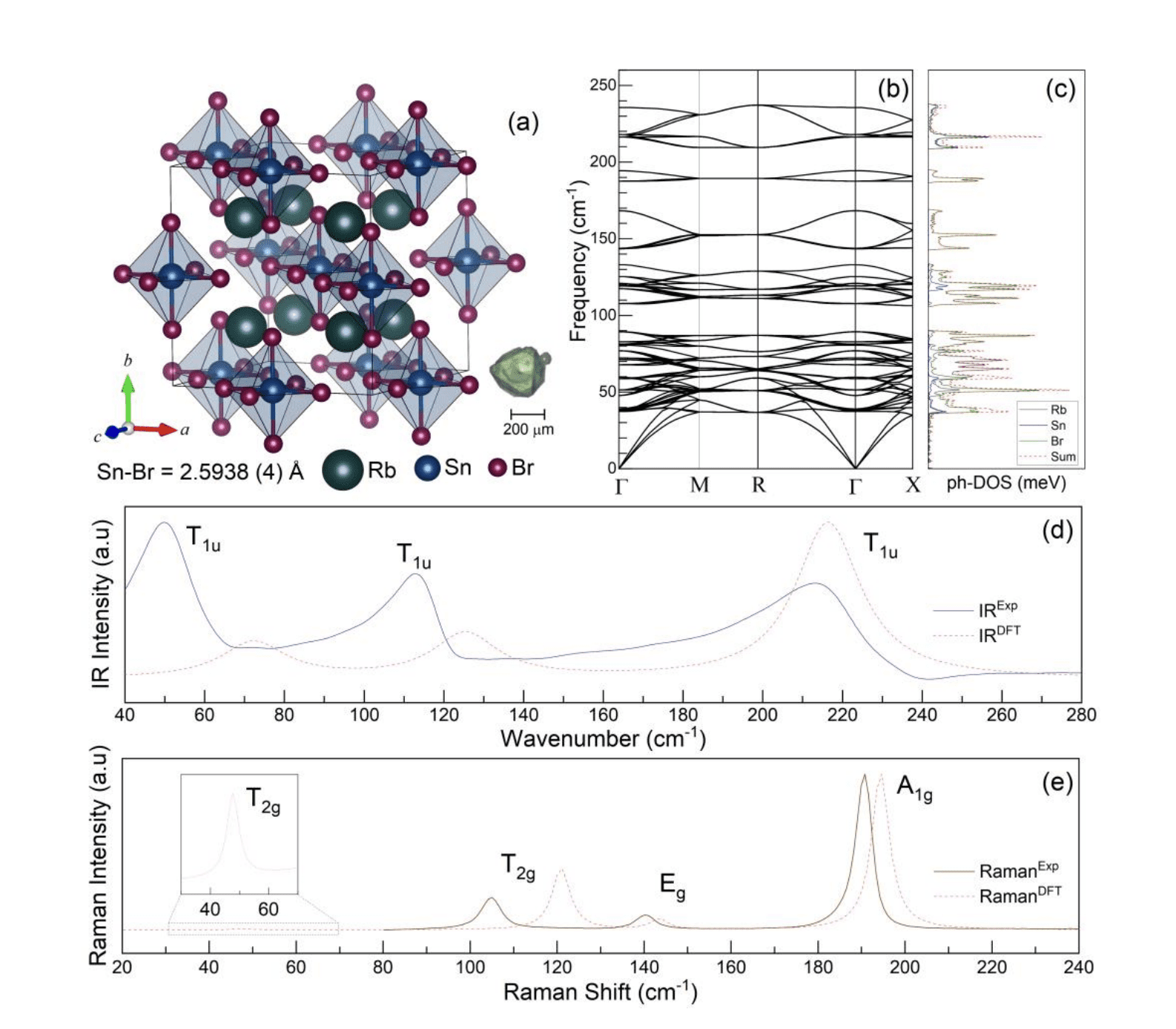
On April 14, 2025, researchers published a study titled ‘Electron-Phonon Coupling Mediated by Fröhlich Interaction in Rb2SnBr6 Perovskite,’ investigating how electron-phonon interactions influence self-trapped excitons in a zero-dimensional perovskite structure and revealing significant coupling strength with implications for light-harvesting applications.
The study investigates Electron-Phonon Coupling (EPC) in zero-dimensional Rb2SnBr6 perovskite, revealing a significant Stokes shift due to self-trapped excitons (STEs). Temperature-dependent photoluminescence measurements and theoretical calculations show that the Fröhlich mechanism, involving interactions between excitons and longitudinal optical phonons, drives emission broadening. The Huang-Rhys factor S=34 indicates strong EPC, while Fröhlich parameters α of 1.94 (electrons) and 4.73 (holes) highlight hole-polaron dominance in STE formation. These findings provide insights into EPC effects in 0D perovskites and their potential for light-harvesting applications.
At the core of quantum materials lies a fascinating phenomenon: self-trapped excitons. An exciton forms when an electron absorbs energy, moving to a higher state and leaving behind a hole. In some cases, these electrons and holes become trapped together due to lattice distortions caused by phonons—vibrations within the crystal structure.
The interaction between electrons and phonons is crucial in this process. This coupling creates distortions that trap excitons, akin to a synchronized dance where each step influences the next. Understanding this interaction is key to harnessing quantum materials for technological applications.
Self-trapped excitons have significant implications for optoelectronics. They can enhance light emission efficiency in LEDs and improve solar cell performance by better managing light absorption and energy conversion, thus offering potential advancements in these fields.
Recent studies, including a 2023 investigation on CsPbBr3, demonstrate strong electron-phonon coupling leading to self-trapped excitons. These findings underscore the potential of quantum materials in advancing optoelectronic devices, providing concrete evidence of their practical applications.
The discovery of self-trapped excitons opens new avenues for technology, promising more efficient solar cells and LEDs. As research continues, these quantum insights will likely drive future technological innovations, reinforcing the significance of quantum materials in shaping our energy landscape.
👉 More information
🗞 Electron-Phonon Coupling Mediated by Fröhlich Interaction in Rb2SnBr6 Perovskite
🧠 DOI: https://doi.org/10.48550/arXiv.2504.10292