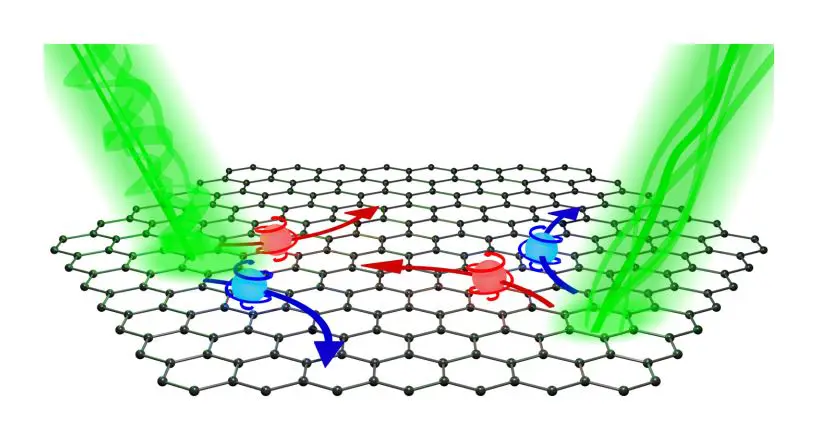
The ability to control electrical and spin currents using light represents a significant advance in materials science, and recent research explores how structured light fields can induce these currents in two-dimensional materials. A. A. Gunyaga, M. V. Durnev, and S. A. Tarasenko investigate the fundamental mechanisms behind these phenomena, demonstrating how light’s unique properties influence charge and spin-valley currents within these materials. Their work establishes a comprehensive kinetic theory describing how spatially patterned light, varying in intensity, polarization, and phase, drives these currents, revealing contributions from optical alignment, orientation, and a novel form of photon drag. This research provides crucial insights into manipulating photocurrents in materials like TMDC layers, paving the way for new optoelectronic devices and a deeper understanding of light-matter interactions at the nanoscale.
Researchers systematically study how structured optical fields inject and control these currents, focusing on the absorption of light within these materials. The work derives fundamental equations describing current density and the rate of carrier generation, providing a deeper understanding of how light manipulates charge and spin. This theoretical framework promises to guide the design of novel optoelectronic devices by predicting and controlling these currents.
Photoelectrons exhibit complex behaviour across momentum, coordinate, and spin-valley spaces. The research reveals mechanisms governing current formation, determined by both local and non-local contributions from the optical field. These mechanisms include aligning electron momenta with linearly polarized light, orienting them with circularly polarized light, and utilizing charge and spin-valley photon drag, which responds to the light’s phase and polarization. Scientists developed a kinetic theory, resulting in analytical equations describing the various current contributions driven by light with spatially varying intensity, polarization, and phase.
Photogalvanic Effects and Valleytronics in 2D Materials
A comprehensive collection of research papers details photogalvanic effects, valleytronics, and related phenomena in two-dimensional materials and semiconductors. The research focuses on generating direct current from light, known as the photogalvanic effect, with variations including circular, linear, and photon drag effects. These effects often occur at material surfaces and interfaces. Valleytronics, the use of valley degrees of freedom for information processing, is a central theme, alongside the interplay between spin and valley polarization. Research extensively explores two-dimensional materials like graphene, molybdenum disulfide, and tungsten diselenide, due to their unique electronic properties and strong spin-orbit coupling.
Studies also investigate topological insulators and quantum wells, highlighting the role of band structure topology in these effects. Key concepts include Berry curvature, a geometric property of the band structure, and symmetry breaking, which is often necessary to observe these effects. Spin-orbit coupling, essential for many observed phenomena, couples the spin and momentum of carriers. Research explores Dirac and massive Dirac fermions, unique electronic states in 2D materials, and the valley Hall effect, which separates carriers based on their valley index. Edge states, which carry current along material boundaries, also play a crucial role.
Future research directions include exploring new materials with enhanced spin-orbit coupling, developing methods to control valley and spin polarization with light, strain, or electric fields, and designing devices based on valleytronics principles. Investigating spin-valley interconversion, studying non-equilibrium carrier dynamics, and understanding interface effects in heterostructures are also promising avenues. Further research could explore the interplay between topology and photogalvanic effects, integrate these materials into existing technologies, and utilize advanced spectroscopic techniques to probe their electronic properties.
Structured Light Drives Charge and Spin Currents
This research presents a comprehensive theory describing how structured light influences charge and spin movement within two-dimensional materials. Scientists developed equations that explain the generation of electrical currents driven by light with spatially varying intensity, polarization, and phase. The analysis reveals that these currents arise from both local effects, determined by the light’s intensity and polarization, and non-local effects, which are sensitive to the light’s phase structure. Importantly, the spatial distribution of the electromagnetic field phase plays a crucial role in determining the magnitude and direction of these currents.
The team applied this theoretical framework to investigate charge and spin-valley currents in 2D Dirac materials, a class of materials exhibiting unique electronic properties. They showed how the interplay between light and the material’s band structure leads to the generation of these currents, considering both the energy spectrum and wave functions of electrons. The research clarifies the mechanisms governing the optical alignment and orientation of electron momenta, and how these processes contribute to the overall current flow. The developed theory provides a foundation for understanding and manipulating charge and spin in 2D materials using light, opening avenues for advanced materials design and applications.
🗞 Electric and spin-valley currents induced by structured light in 2D Dirac materials
🧠 ArXiv: https://arxiv.org/abs/2512.11677