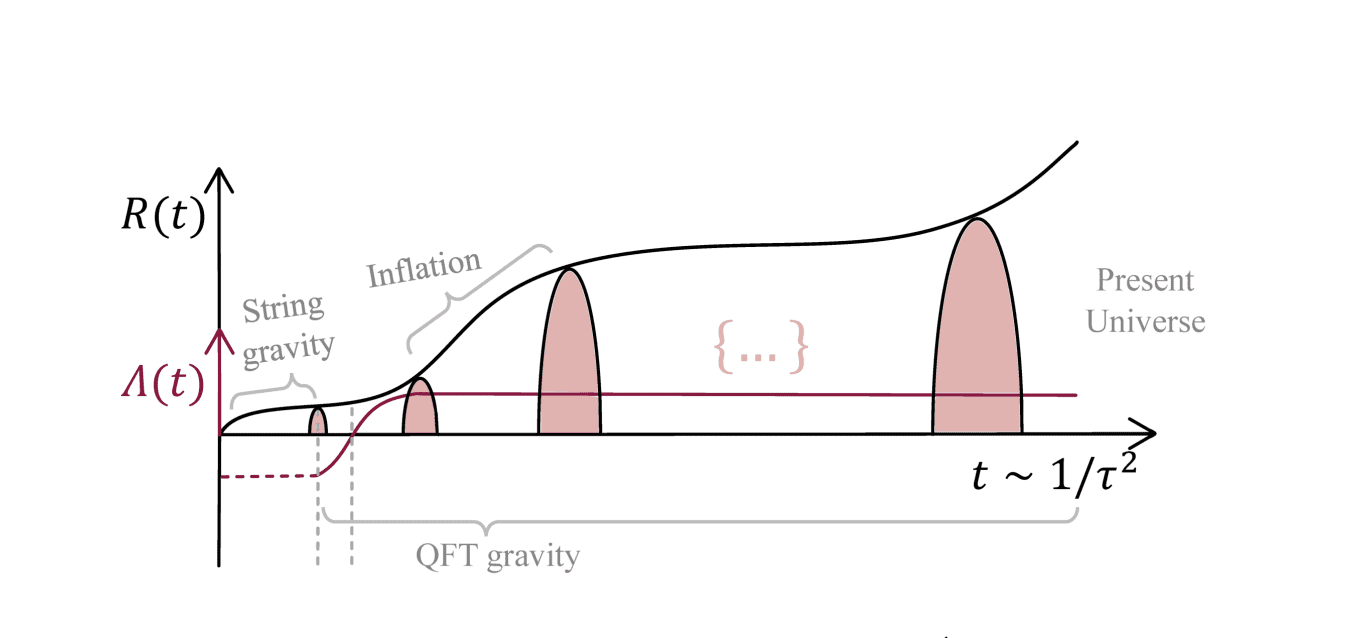
The persistent conflict between theoretical predictions and observational evidence regarding the cosmological constant, a measure of the universe’s expansion, has long challenged physicists, as string theory naturally predicts a negative value while observations demand a positive one. E. N. Nyergesy, I. G. Márián, A. Trombettoni, and I. Nándori propose a novel approach to resolve this discrepancy, building upon the framework of Asymptotically Safe string theory and incorporating the crucial role of temperature in the early universe. Their work introduces a modified thermal Renormalization Group method, where temperature is linked to the size of compactified time dimensions, similar to how spacetime is structured. The team demonstrates that this method successfully flips the sign of the cosmological constant, predicting a negative value at high temperatures relevant to string theory, and a positive value at lower temperatures consistent with current cosmological observations, offering a compelling pathway towards a unified understanding of the universe.
This approach suggests that gravity’s coupling constants remain finite even at very small distances, avoiding the need for radical changes to our understanding of gravity. Researchers employ the Functional Renormalization Group (FRG) as a primary tool, a method that investigates how the effective average action changes as the energy scale varies, incorporating quantum fluctuations to calculate physical properties. The study emphasizes the connection between ASG and the ADM formalism, a mathematical technique crucial for understanding the role of time in quantum gravity. Furthermore, the research draws connections between ASG and other areas of theoretical physics, such as finite-temperature field theory and phase transitions, suggesting that ASG may be part of a broader framework for understanding fundamental laws of nature. This technique links temperature to the running RG scale through a dimensionless parameter, contrasting with conventional methods which maintain a constant temperature. Researchers established a methodology where a dimensionless temperature, representing the physical temperature of the surrounding plasma, is held constant while simultaneously reducing both the temperature and the RG scale towards zero. This innovative step allows the temperature to vary with the RG scale, effectively treating it as a running cutoff for thermal fluctuations.
The team demonstrated that this modified approach yields real fixed points in the RG flow equations, crucial for determining critical behaviour and identifying different phases within the system. By linking temperature to the RG scale, scientists demonstrated a transition in the cosmological constant, shifting from a negative value at high temperatures, consistent with string theory, to a positive value at low temperatures, aligning with current cosmological observations. This technique overcomes limitations of previous methods, which struggled to produce fixed points and lacked a natural connection between early and late-time cosmologies.
String Theory Reconciles with Positive Cosmological Constant
Scientists have achieved a breakthrough in understanding the cosmological constant, resolving a long-standing conflict between string theory predictions and current cosmological observations. The team’s approach centers on a dimensionless temperature, defined as the ratio of the temperature to the RG scale. Crucially, researchers maintained a constant value for this dimensionless temperature while simultaneously reducing both the temperature and the RG scale towards zero, effectively establishing a connection between the ultraviolet and infrared regimes of the expanding universe.
Experiments revealed that applying this modified thermal RG method to AS quantum gravity models at high temperatures results in a negative cosmological constant, while at low temperatures, the cosmological constant transitions to a positive value. Measurements confirm that as the dimensionless temperature approaches infinity, a key parameter vanishes, and the cosmological constant becomes negative. This high-temperature behaviour is then followed by a thermal phase transition, driving the cosmological constant towards the observed positive value at lower temperatures. The team demonstrated this mechanism applies broadly, finding that any AS quantum gravity model studied exhibits a negative cosmological constant at high temperatures and a positive value at low temperatures, offering a natural solution to the sign problem of the cosmological constant.
Cosmological Constant Sign Flip at High Temperatures
This research presents a novel approach to resolving a long-standing conflict between string theory and cosmological observations regarding the cosmological constant, a measure of the universe’s expansion rate. String theory naturally predicts a negative value for this constant, while observations indicate a positive value driving the accelerated expansion of the present universe. Scientists addressed this discrepancy by employing a modified thermal Renormalization Group method, focusing on how the cosmological constant changes with temperature, a crucial factor in the early universe. The team demonstrated that, under their framework, an asymptotically safe gravity model predicts a negative cosmological constant at high temperatures, characteristic of the early universe, and a positive value at low temperatures, consistent with current observations.
This result was consistently found across multiple variations of a simplified quantum gravity model, suggesting a robust connection between the early and late-time cosmologies. The method crucially maintains a constant dimensionless temperature during the renormalization process, effectively integrating out temperature fluctuations in a manner analogous to quantum fluctuations. Future research will likely focus on testing these predictions against observational data from the early universe and refining the model to incorporate more complex physical scenarios.
👉 More information
🗞 From negative to positive through cosmological decreasing temperatures and its connection to spacetime foliation and string theory
🧠 ArXiv: https://arxiv.org/abs/2510.02244