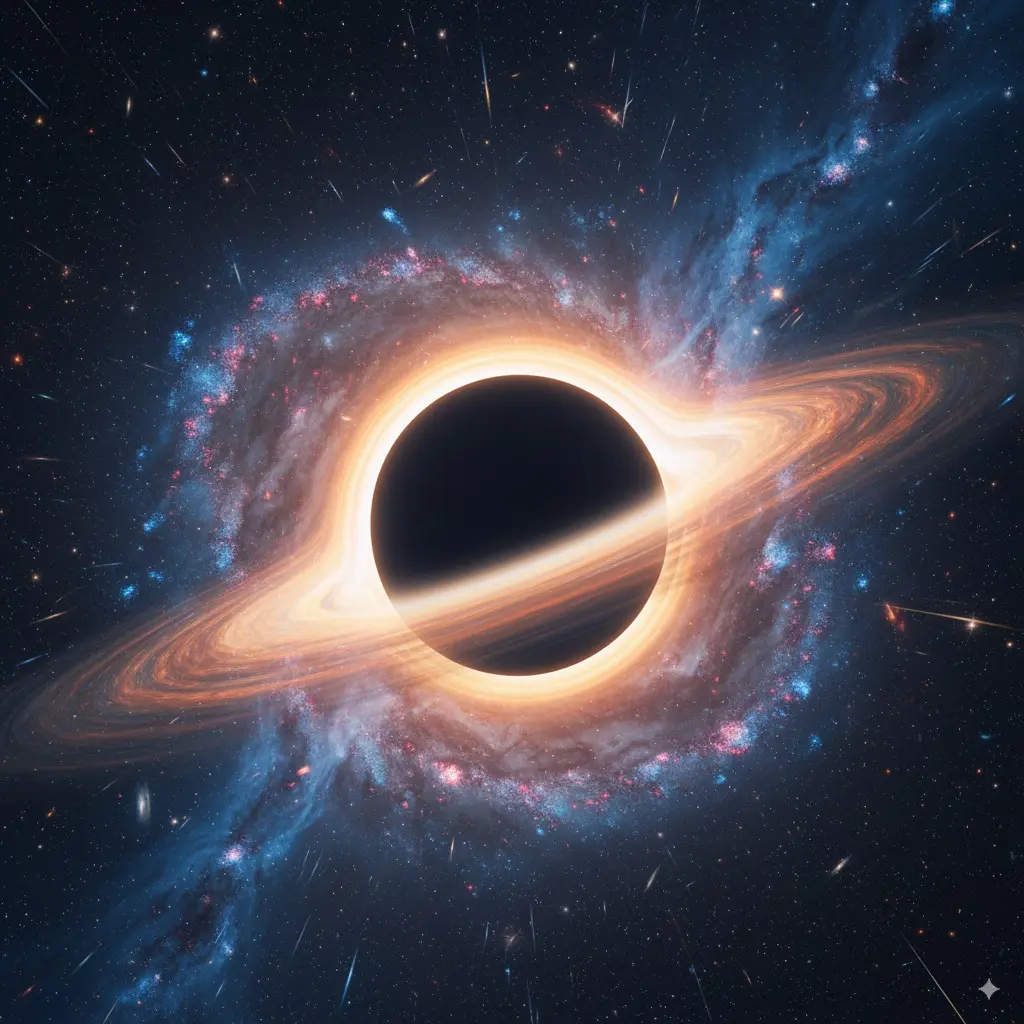
The way light bends around massive objects provides a powerful tool for probing the universe, and recent research delves into how modifications to black hole geometry affect this bending. Faizuddin Ahmed from Royal Global University and Shubham Kala from The Institute of Mathematical Sciences, along with their colleagues, investigate gravitational lensing around a black hole incorporating two theoretical effects: ‘holonomy correction’ and a surrounding cloud of strings. Their work demonstrates that these additions alter the path of light, creating unique patterns and measurable changes in the appearance of distant objects, and influencing the radiation emitted from material orbiting the black hole. By modelling these effects, the team reveals how observations of gravitational lensing and accretion disks could potentially detect these subtle modifications to our understanding of black holes and the fundamental nature of gravity.
Gravitational Lensing, Black Holes, and Cosmology
This extensive list of citations covers a broad range of topics in astrophysics, cosmology, and theoretical physics, with a strong emphasis on gravitational lensing, black holes, dark matter, dark energy, and general relativity. The collection also explores more exotic concepts like wormholes and modified gravity theories, indicating a focus on current research. The breadth of topics suggests a comprehensive review or research project, while the inclusion of recent publications highlights a focus on the latest developments in the field. Many citations are theoretical papers, demonstrating a strong emphasis on the mathematical foundations of astrophysics, alongside a significant number dealing with observational signatures, suggesting a connection to astronomical observations. This bibliography could serve as a starting point for a comprehensive literature review, a resource for a research project, or relevant material for a graduate-level course. Understanding the list’s purpose and selection criteria would allow for a more detailed analysis and extraction of meaningful insights.
Photon Spheres and Topological Black Hole Classification
Scientists are investigating how light behaves around black holes by modeling spacetime, incorporating both a cloud of strings and quantum corrections derived from loop quantum gravity. This study pioneers a new topological approach to characterize photon spheres, the region where light orbits, by calculating a total topological charge associated with these spheres. This method allows researchers to classify black hole solutions based on the presence and location of photon spheres, providing a powerful tool for understanding their properties. The team analytically derived expressions for how light bends in this modified spacetime, revealing that both the string cloud and quantum corrections significantly alter the expected light deflection compared to a standard black hole.
These calculations offer potential observational signatures of underlying quantum geometric and topological structures. Beyond analyzing light deflection, the study constructed a mathematical representation to explore the topological structure of the photon sphere, revealing how string clouds and quantum corrections impact its characteristics. This detailed analysis, combined with the equations describing light bending, provides a comprehensive framework for understanding gravitational lensing effects in this complex spacetime and establishes a foundation for future observational constraints on quantum gravity models.
Light Deflection Reveals Quantum Gravity Signatures
Scientists have investigated light deflection, gravitational lensing, and the structure of photon rings around black holes, considering both quantum gravity corrections and the presence of surrounding string clouds. Their theoretical work reveals how these factors modify the spacetime around black holes and impact the paths of light. The research demonstrates that both the string cloud parameter and the quantum correction parameter directly influence the deflection of light, offering potential observational signatures of underlying quantum gravity effects. The team modeled various gravitational scenarios and found that modifications to the standard black hole geometry, caused by the string cloud and quantum corrections, produce measurable deviations in gravitational lensing behavior.
Analysis of the photon sphere’s topology shows how string clouds and quantum corrections alter its structure. Furthermore, the study of thin accretion disks surrounding these modified black holes reveals significant influences on the disk’s radiation profile, temperature distribution, and spectral characteristics. Results demonstrate that the string cloud and quantum parameters significantly impact how light behaves near black holes, leaving measurable imprints on observed lensing effects. This research builds upon previous investigations of gravitational lensing by black holes surrounded by exotic matter, extending the analysis to include quantum gravity corrections.
String Clouds and Quantum Light Deflection
This research investigates light deflection, photon sphere topology, and accretion disk properties around a black hole modified by both quantum gravity effects and the presence of a surrounding string cloud. The team modeled a spacetime incorporating quantum corrections, arising from loop quantum gravity, and a cloud of strings, deriving equations to describe how light bends around this modified black hole. Results demonstrate that both the string cloud parameter and the quantum correction influence the deflection of light, offering potential observational signatures to test these theoretical modifications to general relativity. Furthermore, the study analyzes the structure of the photon sphere, the region where light orbits the black hole, and finds that its topology is also affected by the string cloud and quantum corrections. Analysis of a thin accretion disk surrounding the black hole reveals that the disk’s radiation profile, temperature distribution, and spectral characteristics are significantly altered by these parameters, suggesting measurable imprints on observed radiation. Future research could explore these effects in the strong-field regime and investigate the implications for astrophysical observations, potentially providing constraints on the parameters governing these modifications to black hole spacetime.
🗞 Gravitational Lensing and Topological Photon Sphere of Holonomy Corrected Schwarzschild Black Hole with a Cloud of Strings
🧠 ArXiv: https://arxiv.org/abs/2509.07686