Researchers from the Department of Physics, SUPA Strathclyde University, have explored the use of interspecies interactions between Rydberg dstates of rubidium and cesium to enhance multiqubit gate fidelities in quantum computation and simulation. The study, titled “Interspecies Förster resonances for RbCs Rydberg dstates for enhanced multiqubit gate fidelities”, identifies the Förster resonance channels that offer the strongest interspecies couplings. The findings suggest that dstate orbitals offer enhanced suppression of intraspecies couplings compared to sstates, making them suitable for use in large-scale neutral atom quantum processors. The research provides valuable insights for future advancements in the design and implementation of quantum processors.
What is the Significance of Interspecies Förster Resonances for RbCs Rydberg dstates?
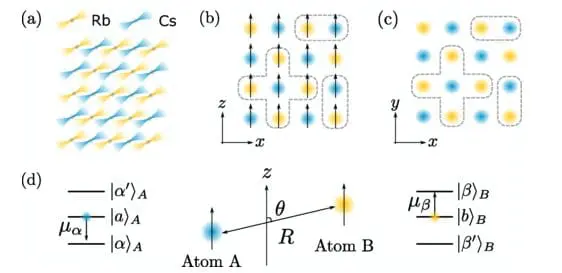
The research paper titled “Interspecies Förster resonances for RbCs Rydberg dstates for enhanced multiqubit gate fidelities” by P M Ireland, D M Walker, and J D Pritchard from the Department of Physics, SUPA Strathclyde University, Glasgow, United Kingdom, presents an analysis of interspecies interactions between Rydberg dstates of rubidium and cesium. The researchers identify the Förster resonance channels that offer the strongest interspecies couplings, demonstrating the viability for performing high-fidelity two and multiqubit CkZgates up to k4. This includes accounting for blockade errors evaluated via numerical diagonalization of the pair potentials.
The results show that dstate orbitals offer enhanced suppression of intraspecies couplings compared to sstates, making them well suited for use in large-scale neutral atom quantum processors. This research is relevant to teams working in both quantum computation and simulation and provides a guide to appropriate state choice and polarization when designing quantum processors.
How Does This Research Contribute to Quantum Computation and Simulation?
Neutral atom arrays provide a versatile platform for performing both programmable quantum simulation and quantum computation. Arrays of optical tweezers offer a scalable route to creating deterministically loaded, defect-free qubit registers in up to three dimensions. Interactions between qubits can be engineered using highly excited Rydberg states to perform high-fidelity two and multiqubit gate operations. This architecture for quantum simulation has enabled novel topological phases and quantum spin liquids to be observed.
However, most experiments have used only a single atomic species, introducing limitations in localized qubit readout due to crosstalk between atoms and in multiqubit gate operations where fidelities are limited by parasitic interactions between Rydberg states. The research by Ireland, Walker, and Pritchard addresses this limitation by exploring the use of dual species arrays, which naturally provides a separation in readout wavelengths to suppress crosstalk while allowing engineering of different inter and intraspecies couplings.
What is the Role of Dual Species Arrays in Quantum Computation?
Dual species arrays offer a route to universal quantum computation using globally driven pulses. Early work demonstrated two-qubit gates and arrays between different isotopes of rubidium (Rb), with recent developments showing continuous loading and measurement feedback onto a cesium (Cs)-Rb array. This same approach of using heterogeneous tweezers has enabled assembly of polar molecules, leading to first demonstrations of hybrid systems based on coupling a Rydberg atom to a polar molecule.
The research extends the dual species analysis to study interspecies interactions between Cs and Rb Rydberg atoms in the dstate orbitals. The researchers identify suitable Förster resonances for maximizing interspecies coupling strengths, carefully considering the angular dependence to address applications of performing two and multiqubit gates in neutral atom arrays for different quantization axis choices.
How Does This Research Enhance Multiqubit Gate Fidelities?
The researchers quantify blockade leakage errors for different Förster pair states and further evaluate the intrinsic gate errors based on the canonical three-pulse controlled phase gate protocol for CkZgates up to k4. They demonstrate enhanced fidelity for multiqubit operations compared to single-species approaches. The advantages of using dstate rather than sstate resonances are shown, due to the inherent reduction in intraspecies couplings.
This research provides a significant contribution to the field of quantum computation and simulation by demonstrating the potential of interspecies interactions between Rydberg dstates of rubidium and cesium for enhancing multiqubit gate fidelities. The findings offer valuable insights for teams working in these fields and provide a guide to appropriate state choice and polarization when designing quantum processors.
What are the Future Implications of This Research?
The research by Ireland, Walker, and Pritchard opens up new possibilities for the design and implementation of large-scale neutral atom quantum processors. By demonstrating the viability of using interspecies interactions between Rydberg dstates of rubidium and cesium for performing high-fidelity two and multiqubit CkZgates, the researchers provide a promising avenue for overcoming the limitations associated with using a single atomic species in quantum computation and simulation.
The findings also offer valuable insights for future research exploring dual species arrays and the use of Förster resonances for maximizing interspecies coupling strengths. As the field of quantum computation and simulation continues to evolve, this research provides a solid foundation for further advancements in the design and implementation of quantum processors.
Publication Date: 2024-03-18
Authors: Paul M. Ireland, D. M. Walker and Jonathan D. Pritchard
Source: Physical review research
DOI: https://doi.org/10.1103/physrevresearch.6.013293