

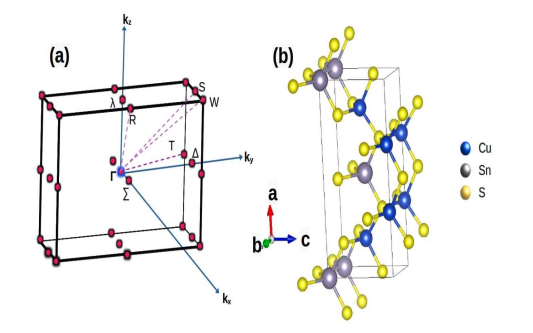
The electronic behaviour of copper tin sulphide (Cu₂SnS₄) undergoes significant modification with applied mechanical strain, transitioning between distinct topological phases. Prakash Pandey and Sudhir K. Pandey, both of the Indian Institute of Technology Mandi, demonstrate this tunability using ab-initio calculations, a method employing fundamental quantum mechanical principles to model material properties. Their research reveals that Cu₂SnS₄, previously proposed as a type-II nodal line semimetal – a material characterised by band structure crossings forming lines in momentum space and exhibiting unique electronic properties – exhibits a complex response to uniaxial, equi-biaxial, and equi-triaxial strain. The application of these strains alters the arrangement of nodal lines, sometimes creating multiple intersecting loops, or ‘topological gimbals’, and in other instances causing their complete disappearance, offering potential for materials design in anisotropic transport, thermoelectrics, and nonlinear optics.
Recent research investigates the behaviour of the Imm2-phase of Cu₂SnS₃, a material theoretically proposed as a type-II nodal line semimetal (NLSM), under various strain conditions. NLSMs are a class of topological materials exhibiting closed loops of band crossings – nodal lines – near the Fermi level, offering potential for applications in anisotropic transport, high-mobility electronics, and novel optical devices. This study employs ab initio calculations to determine how uniaxial, equi-biaxial, and equi-triaxial strains modulate the nodal line state within Cu₂SnS₃. Ab initio calculations are methods based on fundamental physical principles, without empirical parameters, used to model material properties.
The application of uniaxial compressive strain (UCS) along the a-direction causes the plane of the nodal line to rotate from kx-kz to ky-kz between 6% and 8% strain. Conversely, uniaxial tensile strain (UTS) maintains the nodal line within the kx-kz plane across the studied range. Equi-biaxial tensile strain (EBTS) along the a-b and a-c directions initially supports a single nodal ring up to 8% and 6% strain respectively, which then evolves into three and seven nodal rings respectively. Notably, EBTS along the a-c directions generates two sets of three mutually orthogonal, intersecting nodal loops, forming what are termed topological gimbals. Equi-biaxial strain is strain applied equally in two perpendicular directions.
Equi-biaxial compressive strain (EBCS) along the a-b and
Equi-biaxial compressive strain (EBCS) along the a-b and a-c directions also exhibits a single nodal ring up to 8% and 7% strain, but beyond these thresholds, the nodal line vanishes entirely. Equi-triaxial tensile strain (ETTS) initially presents a single nodal ring up to 6% strain, which then transforms into five nodal rings between 6% and 8% strain. Equi-triaxial strain is strain applied equally in all three directions. Finally, equi-triaxial compressive strain (ETCS), similar to EBCS, supports only one nodal line up to 6% strain, after which it also disappears completely.
These findings demonstrate a significant degree of tunability in the topological properties of Cu₂SnS₃ through the application of external strain. The ability to manipulate the nodal line configuration – including its plane, number of rings, and even the creation of gimbal-like structures – highlights the potential of this material for advanced device applications. A type-II NLSM is a specific classification of NLSM where the bands intersect linearly along the nodal line.
Strain-tunable type-II to type-III & Gimbal nodal line transition in Imm2-phase of Cu SnS : An ab-initio study
DOI: https://doi.org/10.48550/arXiv.2507.07618


