Controlling the behaviour of electrons in materials requires precise manipulation of their energy levels, and recent research demonstrates a novel approach to achieve this through strain engineering. Seung Gyo Jeong, Minjae Kim, and Jin Young Oh, alongside colleagues at their respective institutions, investigate how carefully designed strain can alter key electronic properties in layered strontium ruthenate materials. Their work reveals a method to induce a transition from an insulating to a metallic state, coupled with the emergence of ferromagnetism, a phenomenon not previously observed in conventional forms of this material. By manipulating strain, the team effectively tunes the energy and strength of specific electronic states, opening up new possibilities for controlling both the electronic and magnetic characteristics of these low-dimensional materials and establishing strain engineering as a powerful tool for future materials design.
Ruthenates And Strong Electron Correlations
Research focuses intensely on ruthenium oxides, including strontium ruthenate and calcium ruthenate, to understand their unusual electronic and magnetic behaviors. A central challenge lies in explaining how strong interactions between electrons dictate these materials’ properties, moving beyond traditional theories. Scientists investigate transitions between metallic and insulating states, the potential for superconductivity, and the origins of magnetism and the anomalous Hall effect, all influenced by the arrangement of electrons within different orbitals and the principles of Hund’s rule. Strain engineering, the deliberate application of mechanical stress, proves a powerful tool for tuning these materials’ characteristics.
A suite of computational methods supports these investigations. Dynamical Mean-Field Theory and Quantum Monte Carlo provide powerful ways to model strongly correlated electron systems, while Density Functional Theory serves as a foundational approach for calculating electronic structure. These computational techniques allow researchers to predict and interpret experimental observations. Recent studies reveal a deeper understanding of these materials, demonstrating precise control over material properties through strain and manipulation of the Berry curvature. Investigations extend to the behavior of atomically thin layers of strontium ruthenate, revealing unique properties at the nanoscale, and utilize in-situ techniques to tune calcium ruthenate. This comprehensive effort combines advanced computational modeling with experimental techniques to unlock the potential of these complex materials.
Strain-Induced Metal-Magnetic Phase Transition in Superlattices
Scientists engineered atomically precise superlattices composed of strontium ruthenate and strontium titanate to investigate the interplay between strain, electronic structure, and magnetism. They achieved a coupled insulator-to-metal transition and a simultaneous change to a ferromagnetic state, a phenomenon not observed in conventional strontium ruthenate materials. These structures were grown using pulsed laser epitaxy, carefully controlling deposition parameters to achieve precise layer-by-layer growth. Detailed analysis using X-ray techniques confirmed the superlattice structure, crystalline quality, and the presence of strain.
Theoretical calculations, combining density functional theory with dynamical mean-field theory, provided insights into the underlying physics. These calculations employed optimized crystal structures and accounted for the effects of strain on the electronic structure, enabling detailed analysis of the electronic structure and magnetic interactions within the superlattices. Further analysis using X-ray absorption spectroscopy probed the electronic structure, while electrical transport and magnetization measurements characterized the material’s electrical and magnetic properties.
Engineered Van Hove Singularities Drive Correlated Transitions
Scientists achieved a groundbreaking insulator-to-metal transition coupled with a ferromagnetic phase change in atomically designed strontium ruthenate superlattices, a phenomenon not previously observed in conventional three-dimensional strontium ruthenate systems. This work demonstrates the ability to engineer van Hove singularities, specific points in a material’s electronic structure, to control exotic electronic and magnetic behaviors. Theoretical calculations revealed that epitaxial strain effectively modulates both the strength and energy positions of these van Hove singularities in specific ruthenium orbitals, driving correlated phase transitions in the electronic and magnetic ground states. Experiments confirmed the anisotropic electronic structure of the quasi-two-dimensional strontium ruthenate, directly demonstrating modulation by epitaxial strain.
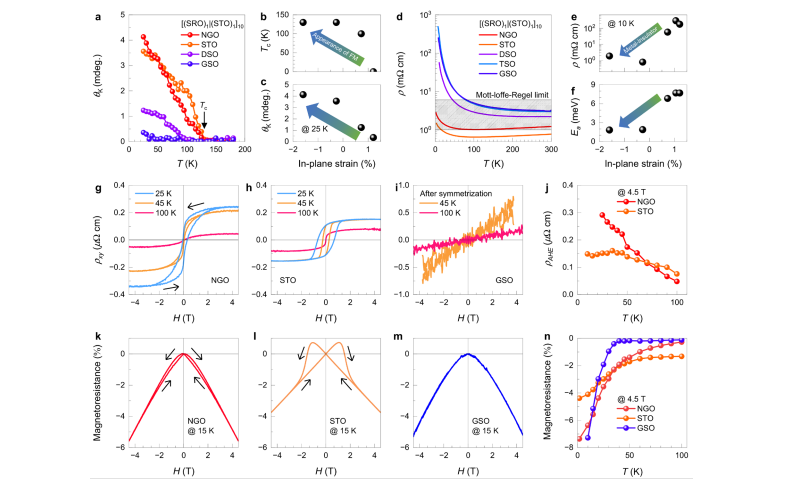
Magneto-optic Kerr effect and electrical transport measurements verified the modulated magnetic and electronic phases, while magneto-electrical measurements detected significant anomalous Hall effect signals and ferromagnetic magnetoresistance. These observations indicate the presence of magnetically coupled charge carriers within the two-dimensional metallic regime, confirming the critical role of van Hove singularities in determining the material’s properties. Researchers designed epitaxial superlattices consisting of alternating atomic monolayers of strontium ruthenate and strontium titanate, creating a quasi-two-dimensional system. Under compressive strain, the in-plane ruthenium-oxygen bond length decreased, increasing the energy level of specific orbitals and modifying their occupancy.
This shift brought the van Hove singularities closer to the Fermi level, increasing the density of states and enhancing ferromagnetic instability, as confirmed by calculations of ferromagnetic susceptibility. Conversely, tensile strain increased the crystal field splitting energy between orbitals, altering orbital occupancy and pushing the system toward a Mott-insulating state with predicted Néel-type antiferromagnetic behavior. Synthesized quasi-2D strontium ruthenate superlattices exhibited atomically sharp interfaces and high crystallinity, as evidenced by X-ray diffraction with observed Kiessig fringes and Laue oscillations. Systematic modulation of the out-of-plane lattice parameters, achieved through growth on various substrates, allowed for precise control of the epitaxial strain, ranging from −1. 60% to +1. 21%.
Strain-Tuned Van Hove Singularities Drive Phase Change
This study demonstrates the successful engineering of van Hove singularities in atomically designed strontium ruthenate superlattices, achieving a coupled insulator-to-metal transition and ferromagnetic phase change not previously observed in conventional three-dimensional strontium ruthenate systems. Researchers employed epitaxial strain to precisely control the energy and strength of these van Hove singularities, manipulating the electronic and magnetic properties of the material. Confirmation of these strain-induced changes came through detailed analysis using X-ray absorption spectroscopy, magneto-optical Kerr effect measurements, and electrical transport studies, revealing modulated orbital occupations and transitions between insulating and metallic states. Notably, the team observed a significant anomalous Hall effect and ferromagnetic magnetoresistance in the compressively strained superlattices, indicating the presence of magnetically coupled charge carriers. Theoretical calculations support these experimental findings, attributing the observed correlated phenomena to the strain-modulated van Hove singularities positioned near the Fermi level. This work establishes epitaxial strain as a powerful technique for tuning van Hove singularities and realizing correlated functionalities in low-dimensional materials, potentially paving the way for even higher temperature superconductivity than observed in related compounds.
🗞 Strain Engineering of van Hove Singularity and Coupled Itinerant Ferromagnetism in Quasi-2D Oxide Superlattices
🧠 ArXiv: https://arxiv.org/abs/2510.24465