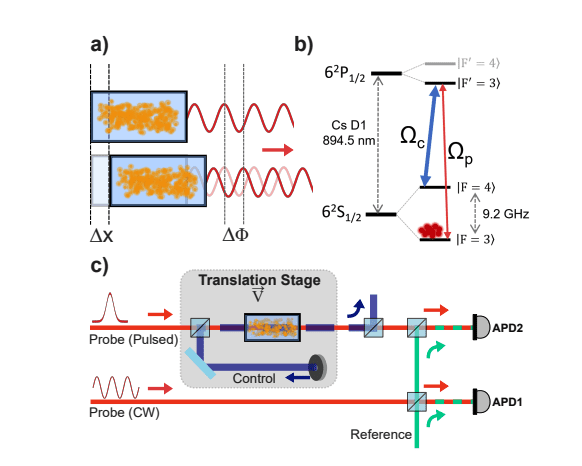
In their 2025 study titled Controlled Displacement of Stored Light at Room Temperature, researchers Arash Ahmadi and colleagues achieved the spatial translation of stored optical pulses over distances exceeding one wavelength at room temperature, paving the way for novel quantum sensing applications.
Researchers used an interferometric scheme to demonstrate spatial translation of an optical pulse at room temperature over distances exceeding one wavelength. They measured the average speed of linear translation, applying stopped-light techniques for highly sensitive velocity measurement. This extends memory applications beyond communication to novel methods of precise velocity sensing.
Recent advancements in quantum optics have enabled researchers to manipulate stored light with unprecedented precision. In their study titled Controlled Displacement of Stored Light at Room Temperature, Arash Ahmadi and colleagues from Humboldt-Universität zu Berlin, National Cheng Kung University, and Ferdinand-Braun-Institut demonstrate the spatial translation of an optical pulse over distances exceeding one wavelength at room temperature. By employing an interferometric scheme, they measured the average speed of this linear translation, showcasing a novel application of stopped-light experiments beyond traditional communication contexts. This work opens new avenues for high-sensitivity velocity measurements and expands the potential uses of light storage technologies.
Studies enhance quantum tech via improved transport and measurement.
The study by M. Xin et al., published in Physical Review Letters in 2019, focuses on transporting long-lived quantum spin coherence using photonic crystal fibers. This research is significant as it addresses the challenge of maintaining quantum states over distances, which is crucial for quantum communication and information processing. Photonic crystal fibers are highlighted for their efficiency in guiding light with low loss, making them ideal for transmitting quantum signals.
In contrast, M. Mičuda et al.’s work, published in Review of Scientific Instruments in 2014, introduces a highly stable polarisation-independent Mach-Zehnder interferometer. This device is pivotal in quantum optics, as it ensures the integrity of quantum states during interference experiments. Its polarisation independence enhances versatility, allowing it to handle various light polarisations without performance loss.
Both studies contribute to advancing quantum technologies by addressing key challenges: Xin’s team improves quantum information transport, while Mičuda’s team provides a reliable tool for manipulating and measuring these states. Their contributions are essential for overcoming technical barriers in quantum communication and computing.
Together, these papers underscore the progress in developing practical tools and methods for quantum applications, highlighting the importance of both efficient signal transmission and robust measurement devices in advancing the field.
Measure velocity via light phase shifts in atomic systems.
Integrating Fizeau’s light-dragging effect and electromagnetically induced transparency (EIT) in atomic optical memories presents a novel approach to motion sensing. This method leverages the phenomenon where light velocity changes when passing through a moving medium, as explained by Einstein’s special relativity. By combining this with EIT, which allows light pulses to be stored and retrieved in atomic systems, researchers have developed an innovative technique for detecting motion.
The process involves storing light pulses in an atomic medium, where movement induces a phase shift due to Fizeau’s effect. Upon retrieval, the phase difference between the original and retrieved light is measured using interferometry, providing information about the medium’s velocity. This approach also accounts for Doppler broadening, which affects the efficiency of light retrieval by altering the EIT window.
Applications of this method are promising in quantum networks, where maintaining coherence and adapting to environmental movements are crucial. The technique enhances quantum memories by incorporating motion sensing capabilities, potentially improving communication and navigation systems.
Despite its potential, challenges remain, including precision issues and the impact of environmental factors on accuracy. However, this approach offers advantages over technologies like laser Doppler velocimetry in specific applications, highlighting its potential for advancing precise motion tracking and quantum communication.
Motion detected via light phase shifts in moving media.
The paper presents an innovative method for motion sensing by leveraging Fizeau’s light-dragging effect in conjunction with atomic optical memories. This approach detects velocity changes through shifts in light frequency or phase when propagating through a moving medium, offering a novel platform for precise motion detection.
Integrating Fizeau’s effect with Doppler velocimetry enhances accuracy by measuring phase shifts using interferometric techniques such as Mach-Zehnder interferometers or self-mixing velocimeters. When the medium moves, it alters the stored light’s phase, which is then detected to calculate velocity, providing a robust method for motion sensing.
Potential applications of this system include navigation, metrology, and quantum networking. Advantages over traditional methods may include higher sensitivity and improved performance under specific conditions.
Examining cited works, such as Ahmadi et al.’s research and Fizeau’s original studies, can further explore this method’s potential and gain deeper insights into its capabilities and future applications.
Atomic optical memories hold promise for precise motion sensing, though challenges remain.
The study presents a novel approach to motion sensing utilising atomic optical memories, capitalising on the Fizeau light-dragging effect and Doppler shifts. Employing electromagnetically induced transparency (EIT) enhances sensitivity through prolonged light-medium interaction, enabling precise velocity determination via frequency measurements. This technique offers potential metrology, navigation, and non-invasive fluid velocimetry advantages.
However, challenges remain, including the need for experimental stabilisation against environmental noise and practical limitations such as medium size and portability. Integration with existing systems may require significant redesigns due to specific operational conditions like low temperatures.
Future research could explore applications in quantum networking, further sensitivity improvements, and integration with other quantum technologies. Testing under real-world conditions will be crucial to evaluate the method’s robustness and precision compared to traditional techniques.
🗞 Controlled Displacement of Stored Light at Room Temperature
🧠 DOI: https://doi.org/10.48550/arXiv.2505.02774