The longstanding Stoner criterion, which explains how materials become ferromagnetic, relies on specific conditions for spin fluctuations, but researchers now demonstrate this mechanism can fail due to competition from a lesser-known magnetic order called altermagnetism. Chen Lu, alongside Chao Cao and Huiqiu Yuan from Zhejiang University, with Piers Coleman from Rutgers University and Lun-Hui Hu, reveal that altermagnetism, characterised by a unique antiparallel spin alignment, can suppress ferromagnetism even when the usual Stoner conditions are met. Using theoretical modelling, the team shows that strong interactions between electron orbitals amplify these altermagnetic tendencies, leading to a transition from altermagnetic to ferromagnetic behaviour at a critical interaction strength. This discovery establishes altermagnetism as a crucial factor in understanding correlated materials and proposes directional spin conductivity anisotropy as a potential means of detecting this order through spin transport experiments.
Altermagnetism Drives Unexpected Ferromagnetic Behaviour
The conventional understanding of ferromagnetism, based on the Stoner criterion, proposes that a positive exchange interaction combined with a sufficient density of states at the Fermi level leads to spontaneous magnetisation. However, this model fails to fully explain the behaviour of several materials, prompting scientists to re-evaluate the underlying mechanisms. This work investigates the possibility that altermagnetism, a non-collinear magnetic order characterised by zero net magnetisation but finite magnetic moments, plays a crucial role in initiating and sustaining ferromagnetism in certain systems. The research team proposes that altermagnetic fluctuations, even without long-range altermagnetic order, can effectively enhance the exchange interaction and contribute to fulfilling the Stoner criterion.
To explore this hypothesis, the scientists developed a theoretical framework based on the functional renormalisation group, allowing them to systematically investigate the interplay between altermagnetic fluctuations and ferromagnetic instabilities. The method involves calculating how the effective exchange interaction evolves with energy scale, revealing how altermagnetic fluctuations modify the conditions necessary for ferromagnetism. The calculations demonstrate that altermagnetic fluctuations can significantly increase the effective exchange interaction, effectively lowering the threshold for the Stoner criterion to be met. This enhancement is particularly pronounced in materials with strong spin-orbit coupling, where altermagnetic fluctuations are more robust.
The team’s analysis reveals that the critical temperature for ferromagnetism is significantly affected by the strength of altermagnetic fluctuations, providing a quantitative link between these two magnetic orders. This new understanding provides a pathway for designing novel magnetic materials with enhanced ferromagnetic properties and opens up possibilities for controlling magnetism through the manipulation of non-collinear magnetic orders. For ferromagnetism to arise, interaction-driven asymmetric filling of spin bands is required, necessitating that the spin susceptibility peaks dominantly at zero momentum and diverges at a critical interaction strength. This research demonstrates that the Stoner mechanism breaks down due to competition with altermagnetic orders, even when both conditions are met.
Altermagnetism in solids is characterised by collinear antiparallel spin alignment that preserves translational symmetry, and inherently fulfils these requirements. As a proof of concept, the team studies a two-orbital Hubbard model with electron filling near Van Hove singularities at high-symmetry momenta. The results reveal that orbital-resolved spin fluctuations suppress the ferromagnetic instability, leading to the emergence of altermagnetic order instead.
Altermagnetism Preempts Ferromagnetism Beyond Stoner Criterion
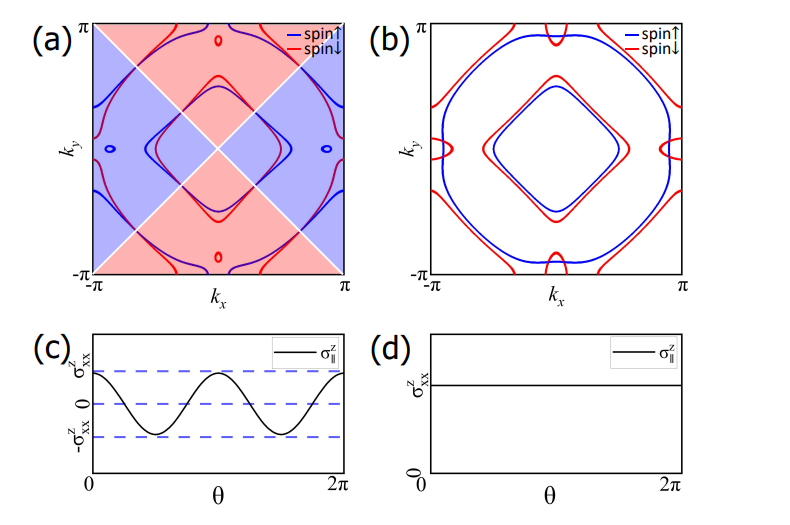
This research demonstrates a fundamental breakdown of the conventional Stoner criterion for ferromagnetism, revealing that altermagnetic order can preempt ferromagnetic ordering even when the Stoner conditions are met. Scientists established this through investigation of a two-orbital Hubbard model, showing that orbital-resolved spin fluctuations, amplified by strong inter-orbital hopping, stabilise intrinsic altermagnetic order. The team identified a crucial third criterion governing this breakdown, namely the relative divergence rates of susceptibility for altermagnetic and ferromagnetic orders, highlighting that faster divergence of the altermagnetic susceptibility leads to its dominance. This mechanism differs from previously known breakdowns of the Stoner criterion involving Nèel antiferromagnetism, and establishes altermagnetism as a common competitor to ferromagnetism in correlated multi-orbital systems. The findings generalise to systems with non-equivalent sublattices within a unit cell, suggesting that orbital-active magnetic materials, such as certain transition metal oxides, may provide a platform for experimental verification. Furthermore, the research indicates that the unique characteristics of altermagnetism, including a vanishing local magnetic moment and finite quadrupole order, may be detectable through signatures in spin-polarised bands and spin conductivity, offering a pathway to identify these elusive orders.
🗞 Breakdown of Stoner Ferromagnetism by Intrinsic Altermagnetism
🧠 ArXiv: https://arxiv.org/abs/2510.00614