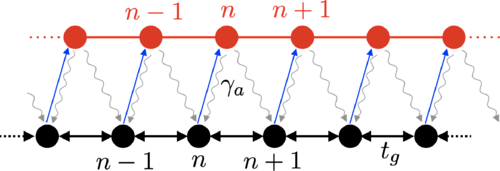
Researchers from Stockholm University’s Department of Physics have explored the impact of fluctuation-induced criticality on non-Hermitian skin effect and quantum sensors. The study, led by Clement Ehrhardt and Jonas Larson, compared the results predicted by non-Hermitian quantum mechanics with a more comprehensive description that considers environment-induced fluctuations. The team found that these phenomena can undergo a breakdown when environmental fluctuations are prominent, resulting in a nonequilibrium phase transition. The research also delved into the interpretations and implications of non-Hermitian quantum mechanics, aiming to broaden understanding of these phenomena and their potential consequences.
What is the Impact of Fluctuation-Induced Criticality on Non-Hermitian Skin Effect and Quantum Sensors?
In a recent paper by Clement Ehrhardt and Jonas Larson from the Department of Physics at Stockholm University, the researchers explore the impact of fluctuation-induced criticality on non-Hermitian skin effect and quantum sensors. The study compares the results predicted by non-Hermitian quantum mechanics with a more comprehensive description that considers environment-induced fluctuations. The researchers highlight inaccuracies in the non-Hermitian model and investigate the non-Hermitian skin effect and sensor in the Hatano-Nelson model, contrasting it with a more precise Lindblad description.
The researchers’ analysis reveals that these phenomena can undergo breakdown when environmental fluctuations come to the forefront, resulting in a nonequilibrium phase transition from a localized skin phase to a delocalized phase. Beyond this specific case study, the researchers engage in a broader discussion regarding the interpretations and implications of non-Hermitian quantum mechanics. This examination serves to broaden our understanding of these phenomena and their potential consequences.
What is the Resurgence of Non-Hermitian Quantum Mechanics?
In recent years, the field of non-Hermitian quantum mechanics has experienced a remarkable resurgence. This renaissance can be traced back to the intriguing discovery that PT-symmetric Hamiltonians, not necessarily Hermitian, can yield real spectra. A pivotal moment in this revival occurred with the introduction of biorthogonal quantum mechanics, which ignited debates about the fundamental nature of quantum mechanics. It challenged the long-held notion that observables must be represented solely by Hermitian operators.
The focus of non-Hermitian quantum mechanics has evolved to explore novel phenomena that emerge when we relax the constraints of Hermiticity and unitarity. One of the most extensively studied phenomena is the non-Hermitian skin effect, which renders extreme sensitivity to nonlocal perturbations. For certain non-Hermitian local Hamiltonians with open boundary conditions, all left-right eigenvectors localize to one of the edges, offering intriguing possibilities for detection of weak signals.
How Does Non-Hermitian Quantum Mechanics Serve as an Effective Description of Open Quantum Systems?
Non-Hermitian quantum mechanics often serves as an effective description of open quantum systems, typically arising from the interaction with an external environment. However, this approach raises questions about the treatment of fluctuations and the potential violation of well-established quantum theorems.
In this paper, the researchers adopt a different perspective by employing the Lindblad master equation as a foundational framework to analyze quantum systems exposed to losses. Unlike non-Hermitian quantum mechanics, they do not neglect fluctuations, thus avoiding concerns related to quantum jumps. They also explore the implications and interpretations of non-Hermitian theories in greater detail.
What is the Role of Fluctuations in Non-Hermitian Quantum Mechanics?
The researchers’ study focuses on a specific example where fluctuations qualitatively alter the physics of the system. They investigate a Lindblad master equation that reduces to the Hatano-Nelson model in the absence of quantum jumps, revealing a breakdown of the non-Hermitian skin effect in favor of a delocalized phase. They discuss how such nonequilibrium criticality relates to earlier models in the context of optical bistability.
Their findings offer a perspective that complements existing research, especially by identifying a phenomenon of fluctuation-induced criticality which qualitatively alters the physical properties. Providing a more detailed understanding of the role of fluctuations in non-Hermitian quantum mechanics will help shed light on the applicabilities of the theory in the quantum regime.
What is the Structure of the Paper?
The paper is structured as follows: In the next section, the researchers provide an in-depth discussion of nonunitary time evolution with a particular focus on its description within the Lindblad master equation. They emphasize the importance of completely positive trace-preserving maps and use them to argue why eigenvectors of a Liouvillian should not be considered as physical states.
In the subsequent sections, they introduce the model system, the Hatano-Nelson model, and its Lindblad master equation realization. Their main findings are presented in the following section, beginning with an exploration of the non-Hermitian skin effect and then a discussion of how this translates to applications in sensing. They conclude with a discussion in the final section.
What is the Evolution Generated by the Lindblad Master Equation?
In the paper, the researchers discuss the evolution generated by the Lindblad master equation. It is important to note that the Liouvillian, which is responsible for governing time evolution within the Lindblad master equation framework, is not represented by an observable. This distinction leads to significant differences compared to Hamiltonian systems. For instance, the eigenvectors of the Liouvillian do not typically represent physical states.
With this in mind, using the term non-Hermitian Hamiltonian as the generator of time evolution for open quantum systems is misleading. The risk is that one borrows without deeper reflections the terminology of traditional Hermitian quantum mechanics such as eigenstates and energies. Having addressed these formal issues, the subsequent section explores a concrete example as they apply their knowledge to the non-Hermitian model.
What is the Lindblad Master Equation?
In the paper, the researchers provide a more detailed description of open quantum systems. They state that their system, denoted as S, is weakly coupled to its surrounding environment. This inevitably implies that the system is exposed to losses and fluctuations. The Lindblad master equation is used as a foundational framework to analyze these quantum systems. Unlike non-Hermitian quantum mechanics, the Lindblad master equation does not neglect fluctuations, thus avoiding concerns related to quantum jumps.
Publication Date: 2024-05-06
Authors: Clement Ehrhardt and Jonas Larson
Source: Physical review research
DOI: https://doi.org/10.1103/physrevresearch.6.023135