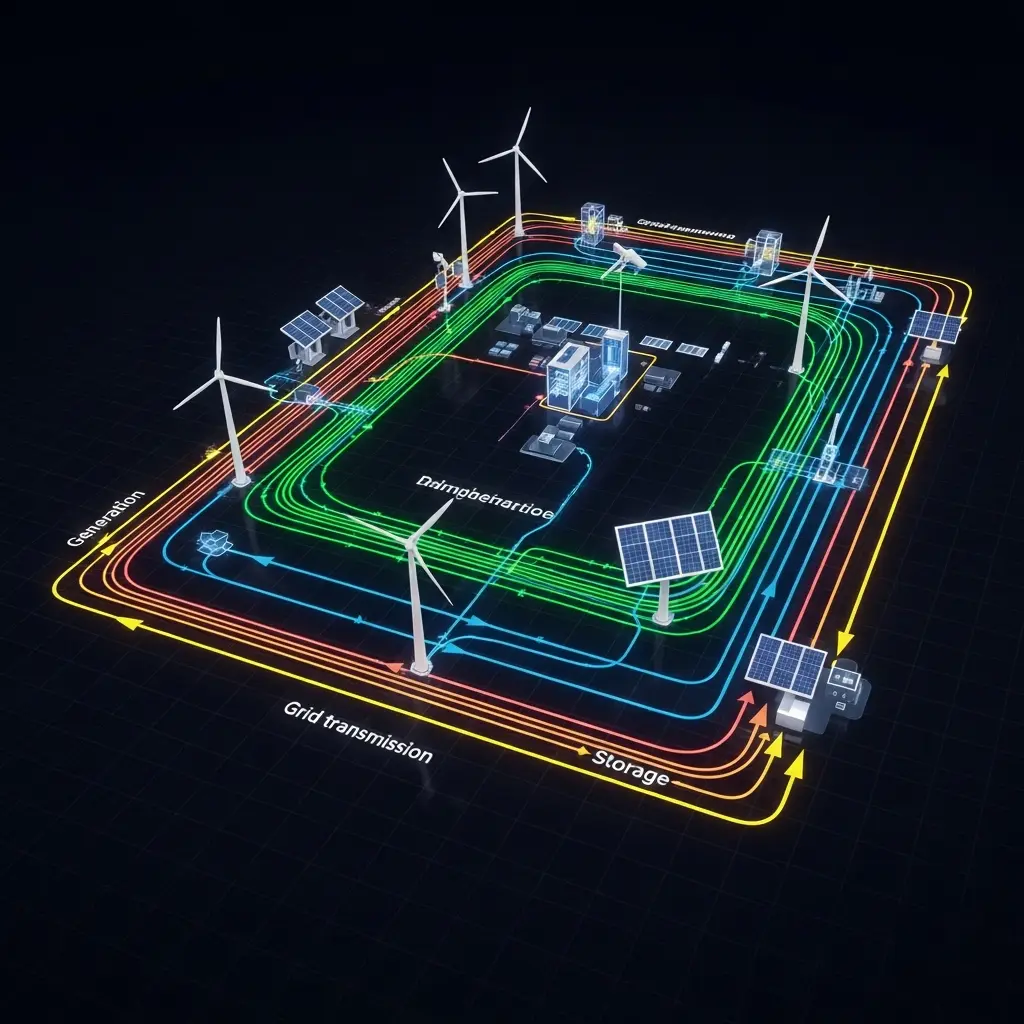
Scientists are tackling the challenge of 24/7 carbon-free energy (CFE) provision with a new stochastic optimisation framework. Natanon Tongamrak, Kannapha Amaruchkul, and Wijarn Wangdee from Chulalongkorn University, alongside Jitkomut Songsiri, present a model designed to minimise costs while ensuring continuous, clean power for Thailand’s energy system. Their research distinguishes itself by focusing on near real-time operations , using 15-minute resolution , and explicitly incorporating flexible CFE compliance targets, unlike many long-term planning studies. By integrating deep learning forecasts and optimising battery usage alongside diverse energy procurement, this work demonstrates a viable route towards achieving carbon-free energy operations and represents a significant step forward for sustainable energy markets.
Thailand’s Carbon-Free Energy System Optimisation is a critical
Unlike conventional long-term planning studies, the team achieved near real-time operations with a high-resolution 15-minute timeframe, enabling dynamic and responsive energy management. By simultaneously optimizing battery usage and procurement from multiple sources, the proposed system establishes a feasible pathway for transitioning to carbon-free operations in emerging energy markets. Experiments demonstrate the system’s ability to navigate fluctuating renewable energy availability and demand, ensuring a consistent supply of carbon-free power while minimizing overall costs. This work establishes a robust methodology for managing complex energy systems, moving beyond annual renewable energy targets to address the critical need for hourly carbon-free operation.
The formulation accounts for variables including green and non-green energy purchasing status, battery charging and discharging profiles, and the state-of-charge, all optimized within the defined time resolution. The research proves the effectiveness of a two-stage stochastic approach, incorporating both day-ahead planning and real-time adjustments to respond to unforeseen fluctuations in renewable generation and electricity demand. This detailed optimization process considers import and export rates, renewable energy and load profiles, and charging/discharging ramp rate limits, ensuring a comprehensive and practical solution. Furthermore, the study’s framework allows for the flexible definition of CFE targets, accommodating varying levels of stringency and enabling adaptation to different regulatory requirements.
By integrating advanced forecasting models and stochastic optimization techniques, the team achieved a significant improvement in the reliability and cost-effectiveness of carbon-free energy operations. The research opens new avenues for developing intelligent energy management systems capable of supporting a fully decarbonized electricity grid, paving the way for sustainable and resilient energy infrastructure in Thailand and beyond. This breakthrough reveals a practical and scalable solution for achieving 24/7 CFE compliance, contributing significantly to global efforts to combat climate change.
Thai 24/7 Carbon-Free Energy System Optimisation
The research employed a high-resolution, 15-minute operational timescale, unlike previous long-term planning studies, to address near real-time energy management challenges. The. Load data, encompassing electrical appliances and laboratory equipment with a peak demand of approximately 35 kWp, and solar power generation data with a capacity of 15 kWp, formed the foundation of the experimental setup. A 100 kWh battery energy storage system (BESS) with a usable capacity ranging from 20, 80% State of Charge (SoC) was integrated into the microgrid. Experiments were conducted using a year’s worth of data, spanning June 2024 to May 2025, aligning with the evaluation period of the forecasting models.
The team varied the daily CFE compliance level from one to seven days within seven-day batches, utilizing point forecasts from the best-performing LightGBM model for deterministic planning. Results demonstrated that the optimizer strategically selected days with the smallest net load as CFE days when targeting one day of compliance, relying on battery power and purchased green energy. As the target increased to five days, the system intelligently designated days with higher net load for conventional energy sourcing, maximizing cost-effectiveness. To validate the approach, the scientists implemented both deterministic and stochastic energy management systems (EMS) with a daily rolling horizon.
The ideal EMS, utilizing actual power measurements, established a theoretical cost lower bound, while the deterministic EMS employed point forecasts and the stochastic EMS generated 20 scenarios using the method in (30). Real-time adjustments were implemented only through second-stage variables, ensuring strict adherence to pre-committed CFE day requirements and enabling additional green power purchases only during previously scheduled green energy hours, a crucial step towards feasible carbon-free operations. Thai Energy System Achieves 24/7 Carbon-Free. Tests prove the model accurately represents net power exchange using auxiliary variables, P+net(t) and P−net(t), representing total power purchased and exported, respectively.
The battery model constraints limited charging and discharging rates, with the difference in power between consecutive 15-minute intervals constrained by Pchg,ramp and Pdchg,ramp, ensuring stable battery operation. Scientists recorded that the state-of-charge (SoC) dynamic of the battery was updated every 15 minutes, maintaining the SoC within a defined range (SoCmin ≤SoC(t) ≤SoCmax) to preserve battery lifespan, and setting the terminal SoC at the end of each day to a desired value. Furthermore, the power balance equation (Pnet(t) = Pload(t) + Pchg(t) −Prenew(t) −Pdchg(t)) accurately reflects the interplay between load, generation, and battery storage, utilizing forecasts for renewable power and electrical load. The formulation also enforced constraints on imported and exported power, ensuring that purchased green and non-green power align with their respective status variables (εx(i) g (t) ≤P (i) g (t) ≤Mx(i) g (t)). This breakthrough delivers a powerful tool for energy system operators seeking to achieve ambitious CFE goals while minimizing costs and maximizing grid stability,
Thailand’s 24/7 Carbon-Free Energy System Design
By simultaneously optimizing battery usage and multi-source energy procurement, the proposed system demonstrates a viable pathway towards carbon-free energy operations in dynamic markets, results indicate cost reductions of 6.4-7.2% compared to deterministic approaches across various CFE targets. The authors acknowledge a limitation inherent in rolling-horizon energy management systems: the execution of only the first-day decisions before replanning may lead to deviations from the initially planned carbon-free status. Future research could explore methods to mitigate these deviations and improve the robustness of the planning process, potentially through enhanced forecasting or adaptive control strategies.
👉 More information
🗞 Stochastic EMS for Optimal 24/7 Carbon-Free Energy Operations
🧠 ArXiv: https://arxiv.org/abs/2601.15135