The generation of intense light relies on understanding how light interacts with matter, and recent research explores this interaction through the lens of quantum mechanics and statistical fluctuations. Philipp Stammer, from ICFO, Institut de Ciencies Fotoniques and the Barcelona Institute of Science and Technology, along with Philipp Stammer from Atominstitut, Technische Universität Wien, and colleagues, investigate the quantum behaviour of light emitted from a driven cavity interacting with its environment. Their work extends existing models of high harmonic generation by incorporating a detailed analysis of random fluctuations, revealing a surprising connection between this process and the behaviour of a non-linear antenna. This discovery not only bridges the gap between established techniques in high harmonic generation and the more complex realm of open quantum systems, but also provides a means to calculate the maximum power emitted from these fluctuating sources, potentially paving the way for new designs in light-emitting technologies.
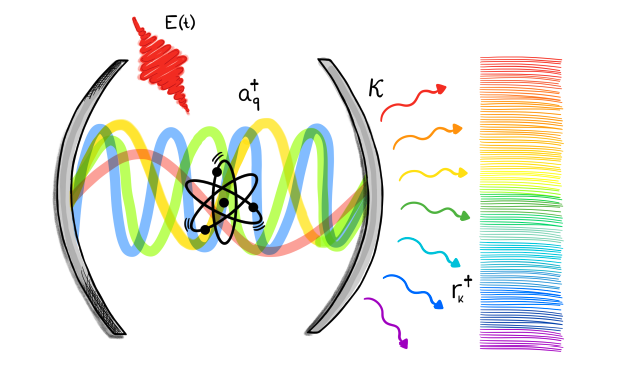
In system dynamics, researchers solve the quantum Langevin equation for a non-linear driven cavity coupled to its surroundings. This work demonstrates that, for an environment without memory, the way light is emitted from this cavity mirrors the process of high harmonic generation and the behaviour of a non-linear antenna. This connection is established using the quantum regression theorem, which allows researchers to determine the maximum power emitted due to fluctuations within the system. This approach connects current quantum optical methods for high harmonic generation with descriptions of open systems and driven-dissipative systems operating in non-linear regimes.
Driven Non-linear Emitter Quantum Noise Analysis
This document presents a theoretical exploration of the quantum optical properties of a driven, non-linear emitter. The core focus is understanding the quantum noise and correlations arising from the emitter’s fluctuations and how these affect the emitted light. Researchers investigate the generation of squeezed states of light and entanglement through the interaction of a strong driving field with an emitter exhibiting a non-linear response. Key concepts include non-linear optics, where a material’s response to light is not proportional to the light’s intensity, and quantum optics, which treats light as consisting of discrete energy packets called photons.
Squeezed states of light, where quantum fluctuations are reduced in one direction at the expense of increased fluctuations in another, and entanglement, a quantum phenomenon where particles become correlated regardless of distance, are central to this work. The quantum regression theorem provides a tool for calculating correlations between quantum properties. At the same time, the master equation and Langevin approach describe the evolution of the quantum system and account for environmental effects. The research highlights the role of fluctuations in the emitter’s dipole moment as a source of quantum noise and the importance of understanding these correlations for potential applications in quantum information processing.
Cavity Dynamics Mirror High Harmonic Generation
Researchers have established a new theoretical framework linking high harmonic generation, a process used to create high-frequency light, with the behaviour of light and matter in open quantum systems. By modelling the dynamics of a non-linear cavity interacting with its environment using the quantum Langevin equation, they have revealed a surprising connection: the behaviour of this driven cavity is mathematically equivalent to the process of high harmonic generation and the function of a non-linear antenna. This isomorphism allows researchers to apply concepts from open quantum systems, which traditionally deal with systems exchanging energy with their surroundings, to understand and potentially control the generation of high harmonics. The analysis also provides an upper limit on the power of the emitted light, offering a crucial constraint on the efficiency of the process.
Under specific conditions, such as an unstructured environment lacking memory, the mathematical complexity of the problem simplifies, allowing the application of the quantum regression theorem and providing insights into the fluctuations of the light-emitting material. The team’s calculations demonstrate that the average number of photons generated within the cavity depends on both the driving input and the fluctuations of the emitting material, highlighting the importance of understanding these fluctuations for optimising harmonic generation. This new framework not only deepens our understanding of high harmonic generation but also opens avenues for exploring novel designs for light sources and potentially improving their efficiency.
Harmonic Generation and Open Quantum Systems
This research demonstrates a fundamental connection between high harmonic generation, non-linear driven resonators, and non-linear antennas, revealing they share an underlying isomorphic relationship. By applying a quantum stochastic analysis, the team successfully modelled the dynamics of a non-linear cavity interacting with its environment, allowing them to derive an upper bound for the radiated power originating from fluctuations within the system. This approach bridges the gap between traditional high harmonic generation models and the description of open quantum systems, paving the way for a more comprehensive understanding of these phenomena. The findings establish a framework for investigating high harmonic generation within the context of open system descriptions, extending its reach beyond semi-classical and conventional quantum optics. While the study focused on unstructured environments and Markovian dynamics, the authors acknowledge that extending the analysis to structured environments and incorporating more complex quantum noise requires further theoretical development. Future research directions include exploring spectroscopy methods leveraging high harmonic generation and quantum Langevin approaches, as well as investigating thermodynamic relationships in coherently driven non-linear systems, ultimately broadening the scope of high harmonic generation research and potentially connecting it to areas like analog quantum simulation.
🗞 Quantum stochastic analysis of non-linear driven light emission
🧠 ArXiv: https://arxiv.org/abs/2508.09049