Nitrogen-vacancy (NV) centres in diamond represent a powerful tool for material characterization, yet fully realising their potential demands methods capable of analysing large numbers of these defects efficiently. Jason Shao, Richard Monge, Tom Delord, and Carlos A. Meriles, all from CUNY-The City College of New York and the CUNY-Graduate Center, now demonstrate a statistical imaging technique that optically resolves and monitors hundreds of individual NV centres across expansive areas with resolution beyond the diffraction limit of light. Their work reveals that NV centres do not distribute randomly within diamond grown using chemical vapour deposition, but instead form unexpectedly frequent, closely spaced clusters. This discovery suggests that the mechanisms governing NV centre formation are more complex than previously understood, and importantly, provides a scalable method for identifying naturally occurring NV clusters which hold promise for advanced quantum technologies and highly sensitive sensing applications.
Wide-field imaging overcomes serial bottleneck in defect studies
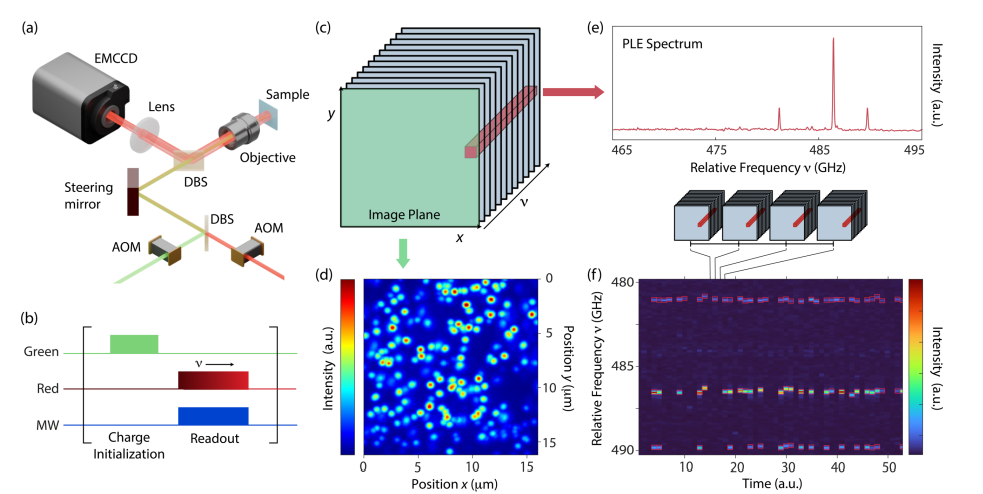
Traditional studies of color centers in solids rely on confocal microscopy, limiting throughput due to its serial nature. This work addresses this limitation by developing a wide-field imaging technique capable of simultaneously characterizing thousands of individual color centers, significantly increasing throughput and enabling new insights into defect properties and interactions. The method involves illuminating a sample with a focused laser beam and collecting emitted photons with a high-efficiency camera, facilitating statistical analysis of defect populations and identifying correlated behavior inaccessible with traditional methods, ultimately paving the way for more complex quantum devices and advanced sensing technologies.
Recent advances in wide-field and spectrally selective imaging now enable characterization of solid-state quantum systems at scale. By combining spatial and spectral resolution, these approaches accelerate data acquisition and enable new types of analysis, particularly statistical inference of the spatial and spectral distributions of embedded quantum defects, revealing the population of color centers as an object of study.
NV Center Clustering Reveals Defect Origins
This supplementary material details the algorithms and metrics used to analyse statistical imaging data of NV centers in diamond, extending beyond simple localization to identify clusters, suggesting non-random distribution and revealing information about defect formation mechanisms. The core challenge is distinguishing true co-localization from spurious co-localization arising from measurement noise, drift, or imaging system limitations. Researchers address this challenge using statistical methods to assess the likelihood that detected optical resonances originate from the same physical emitter.
A distance-based metric estimates the probability that two optical resonances detected close together originate from the same NV center, serving as a crucial first step in distinguishing true co-localization. This method employs a Bayesian approach, combining prior knowledge about NV density with the likelihood of observing the measured displacement between the resonances, using Gaussian distributions to model uncertainty in displacement measurements and calculating a probability score reflecting the likelihood of the observed data.
A time-dynamic metric assesses the probability that two optical resonances originate from the same NV center based on their temporal behavior. NV centers exhibit random blinking, and correlated blinking suggests a common emitter. This method also uses a Bayesian approach, using blinking correlation as key evidence, calculating likelihood functions to estimate the probability of observing a specific sequence of on and off states, and outputting a Bayes factor reflecting this likelihood.
The merging algorithm combines the distance-based and time-dynamic metrics to infer correct groupings of optical resonances. It is an iterative process that merges resonances based on their pairwise Bayes factors, starting with individual resonances, identifying the pair with the highest Bayes factor, merging them, recalculating Bayes factors, and repeating until no Bayes factor exceeds a threshold, leveraging the strengths of both metrics for accurate identification of true co-localization.
To account for sample drift during imaging, which can introduce spurious co-localization, the algorithm employs a drift correction method. It identifies a stable, high-signal-to-noise ratio resonance, tracks its position over time, fits a polynomial function to its trajectory, and subtracts the drift from the positions of all other resonances, ensuring the accuracy of the results.
In summary, this supplementary material describes a sophisticated set of algorithms and metrics for analysing statistical imaging data of NV centers. The key idea is to use Bayesian inference to combine spatial and temporal information to distinguish true co-localization from noise and spurious effects. This approach allows researchers to go beyond simple localization and gain insights into the mechanisms of defect formation in diamond.
🗞 Statistical imaging of NV centers reveals clustered defect formation in diamond
🧠 ArXiv: https://arxiv.org/abs/2511.03411