

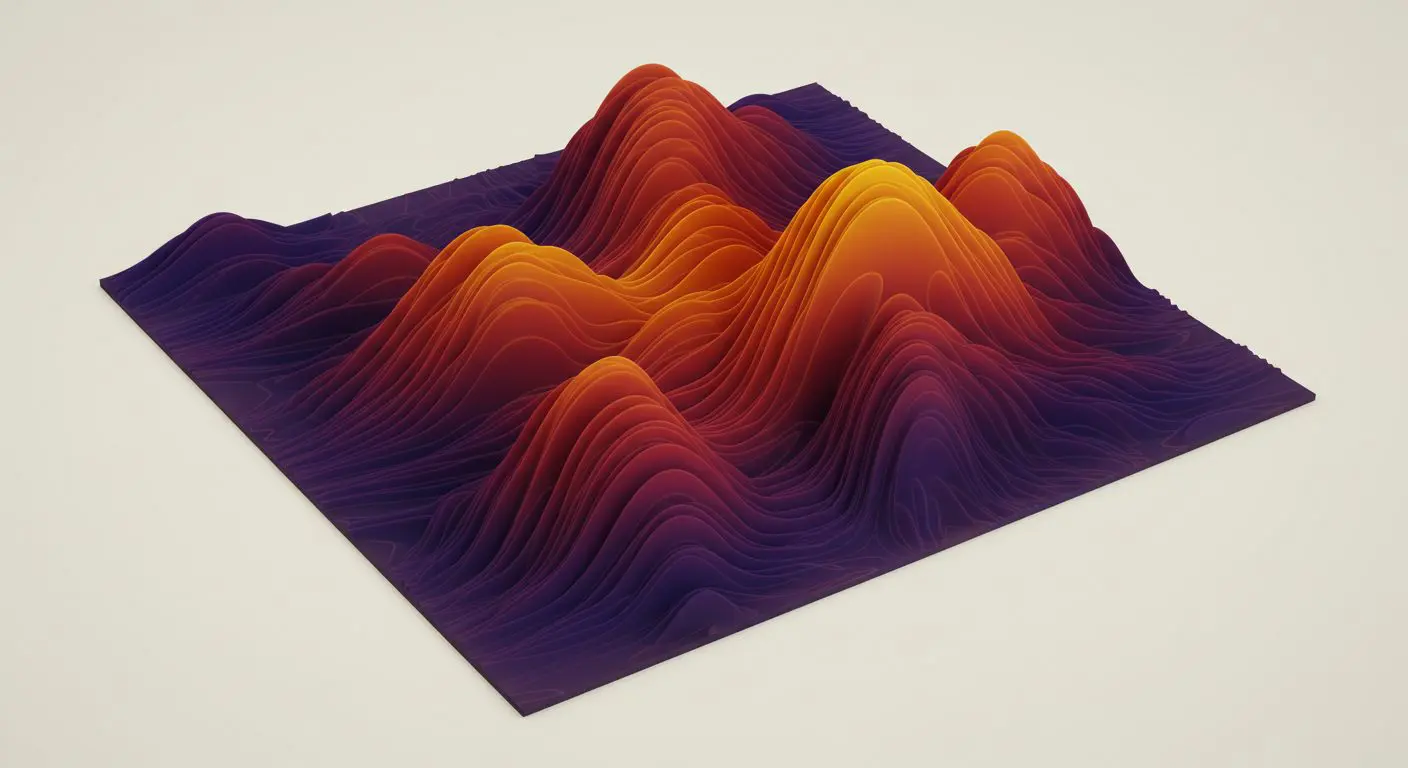
Variational quantum algorithms promise to unlock the potential of quantum computers, but their performance is often hampered by a phenomenon known as the barren plateau, where gradients vanish during optimisation, effectively halting the learning process. Le Bin Ho from Tohoku University, alongside Jesus Urbaneja and Sahel Ashhab et al., investigate these barren plateaus using a novel statistical approach, identifying three distinct types of landscape features that contribute to the problem. Their work reveals that while certain types of barren plateaus exist in simplified models, the commonly used hardware-efficient and random Pauli ansätze in variational quantum eigensolvers predominantly exhibit a uniformly flat landscape, making optimisation particularly challenging. Significantly, the team demonstrates that carefully reshaping the cost function landscape using a genetic algorithm can mitigate these barren plateaus, offering a promising route to improve the scalability and reliability of quantum computation.
They employ Gaussian function models to characterise optimisation landscapes, identifying three distinct types of barren plateaus, each with unique characteristics and potentially requiring different mitigation strategies. Localized-dip barren plateaus occur in mostly flat landscapes with a single point of large gradient, while localized-gorge barren plateaus exhibit a more pronounced and constrained region of high gradient.
Three Barren Plateau Landscape Types Identified
Researchers have identified and characterised three distinct types of barren plateaus, challenging regions in optimisation landscapes, using statistical methods and Gaussian function models. These plateaus represent areas where gradients vanish, hindering the ability of algorithms to find optimal solutions. The first type, termed localized-dip barren plateaus, features a single point of large gradient within an otherwise flat landscape. A second type, localized-gorge barren plateaus, is similar but exhibits an elongated, narrow region of steeper gradient. The third, everywhere-flat barren plateaus, presents a uniformly flat landscape with almost no discernible gradients, posing the most significant optimisation challenge.
The team’s analysis reveals that the prevalence of these different types of barren plateaus depends on the specific characteristics of the optimisation problem, and that everywhere-flat plateaus consistently dominate in the context of variational quantum algorithms. To address the issue of barren plateaus, researchers employed a genetic algorithm to reshape the cost function landscape within variational quantum algorithms, enhancing optimisation efficiency and improving scalability. They also developed a statistical tool based on Chebyshev’s inequality to rigorously detect barren plateaus, quantifying the variance of gradients and identifying flat landscapes.
Genetic Algorithms Suppress Barren Plateaus in Circuits
This research presents a statistical framework for analysing barren plateaus, a significant challenge in variational quantum algorithms. The team identified three distinct types of barren plateaus within cost function landscapes: localized dips and gorges, where gradients are small but informative, and everywhere-flat regions, which severely impede optimisation. Applying this framework to commonly used quantum circuits revealed that only the everywhere-flat barren plateaus were present in the examples studied. To address this issue, the researchers developed a genetic algorithm to optimise the design of the random circuits, effectively reshaping the cost function landscape and leading to improved training efficiency, even with larger quantum systems.
🗞 Statistical analysis of barren plateaus in variational quantum algorithms
🧠 ArXiv: https://arxiv.org/abs/2508.08915


