

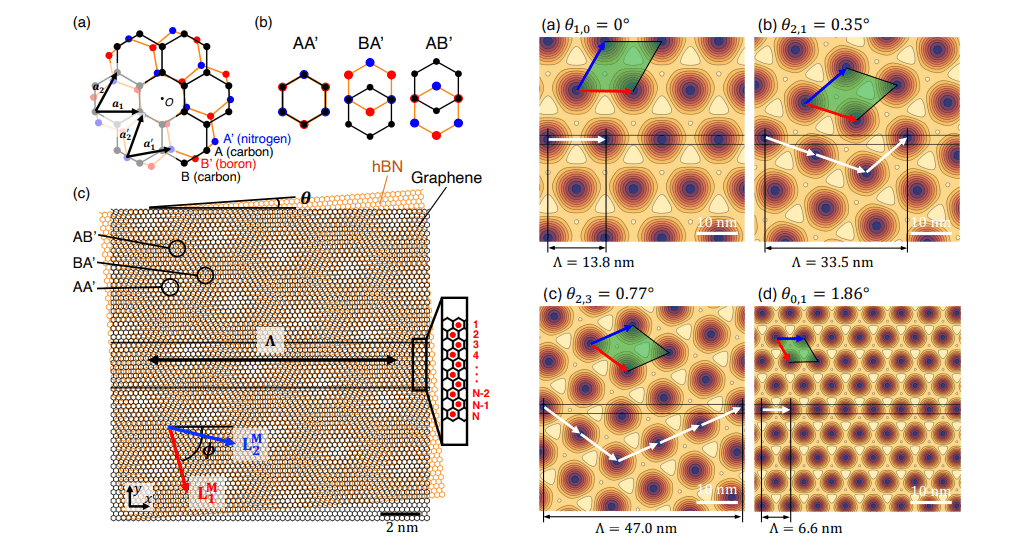
The interplay between two-dimensional materials creates exciting opportunities for nanoscale engineering, and researchers are now exploring how to precisely control the properties of graphene nanoribbons placed on hexagonal boron nitride. Ryosuke Okumura, from Osaka University, Naoto Nakatsuji of Stony Brook University, and Takuto Kawakami, along with Mikito Koshino and colleagues at Osaka University, investigate the structural and electronic effects of aligning these materials with a specific twist. Their work demonstrates that this ‘moiré engineering’ creates a unique, wavy pattern within the graphene, locally altering its electronic structure and forming arrays of quantum-confined states, effectively creating a versatile platform for designing novel one-dimensional nanodevices and advancing electronic structure control at the nanoscale. The team’s findings reveal a pathway to harness moiré patterns for building advanced electronic components with tailored properties.
Researchers investigated how a zigzag graphene nanoribbon behaves when placed on an hBN substrate, focusing on the emergence of moiré patterns and their influence on electron behaviour. The work demonstrates that the one-dimensional moiré potential, arising from the periodic modulation of the substrate, significantly alters the electronic properties of the ribbon, leading to the opening of band gaps and the emergence of novel electronic states.
A computational model, based on the principles of elasticity, calculates the relaxed atomic structure of the ribbon/substrate system for various twist angles and ribbon widths. This relaxation process gives rise to a characteristic one-dimensional domain structure consisting of alternating regions and two distinct types of domain boundaries. At finite twist angles, the ribbon adopts a wavy shape, locally tracing the hBN zigzag direction but occasionally shifting to adjacent atomic rows.
Graphene Heterostructures And 2D Material Properties
A comprehensive body of research explores the properties of two-dimensional (2D) materials, particularly graphene and related structures, and their behaviour in heterostructures, such as those made with hexagonal boron nitride (hBN). This research encompasses fundamental properties of graphene, theoretical methods for modelling 2D materials, and the influence of edges, defects, and strain. The studies reveal how these materials behave when combined, forming heterostructures with unique characteristics. Core research establishes the electronic structure and potential of graphene, covering topics like band structure and density of states.
Theoretical methods, including tight-binding calculations and density functional theory, are employed to model these materials, accounting for edge effects and defects. Understanding how edges influence electronic and transport properties is a central theme, alongside the ability to modify properties through strain engineering. A major focus of the research lies in heterostructures and moiré phenomena. Studies investigate twisted bilayer graphene, where flat bands emerge and correlated insulating/superconducting states are observed. The combination of graphene with hBN is a common platform, with hBN acting as a dielectric substrate and creating potential landscapes in graphene.
The formation of moiré patterns due to lattice mismatch dramatically alters electronic properties. Research also explores correlated electron physics, including superconductivity and magnetism, in these heterostructures. Further research delves into transport properties and device physics, including the quantum Hall effect in graphene, which provides insights into its electronic structure and carrier mobility. Scanning tunneling microscopy and spectroscopy are used to probe the local density of states in 2D materials and heterostructures. Understanding electron transport along the edges of graphene nanostructures is important for device applications, and the potential for ballistic transport is a key area of research.
Defect engineering, strain-induced effects, and functionalization are also explored, demonstrating how modifying 2D materials can alter their properties. Tight-binding models and density functional theory are powerful methods for calculating the electronic structure and properties of these materials, while molecular dynamics simulations study their structural and dynamic properties. This research suggests a focus on understanding correlated electron physics in twisted bilayer graphene and other moiré heterostructures, exploring the interplay between lattice structure, electronic structure, and transport properties, and developing new theoretical and computational methods for modelling these materials. In summary, this body of research comprehensively covers 2D materials, with a strong emphasis on moiré heterostructures and correlated electron physics. It reflects a research program deeply involved in both theoretical modelling and experimental investigation of these fascinating materials.
Graphene Moire Pattern Creates Tunable Subbands
This research demonstrates that placing a zigzag graphene nanoribbon on a hexagonal boron nitride substrate creates a unique moiré pattern with significant implications for electronic structure engineering. By carefully controlling the twist angle between the ribbon and the substrate, scientists have achieved a characteristic one-dimensional domain structure consisting of alternating regions and distinct boundaries. This structural relaxation results in a wavy ribbon shape that locally follows the substrate’s zigzag direction, but occasionally shifts to adjacent atomic rows. The resulting moiré potential strongly modulates the electronic structure of the nanoribbon, creating densely packed subbands within the aligned regions and sharply localized states at the domain boundaries.
These features realize tunable, one-dimensional arrays of quantum-confined electronic states, offering a versatile platform for designing novel nanodevices. The team’s calculations reveal that both the structural and electronic properties can be precisely engineered through controlled twisting and substrate selection. Future work could explore the potential of these moiré structures for creating advanced electronic devices, such as highly sensitive sensors or low-power transistors, and investigate the influence of different substrate materials on the observed phenomena.
👉 More information
🗞 One-dimensional moiré engineering in zigzag graphene nanoribbons on hBN
🧠 ArXiv: https://arxiv.org/abs/2510.21166

