

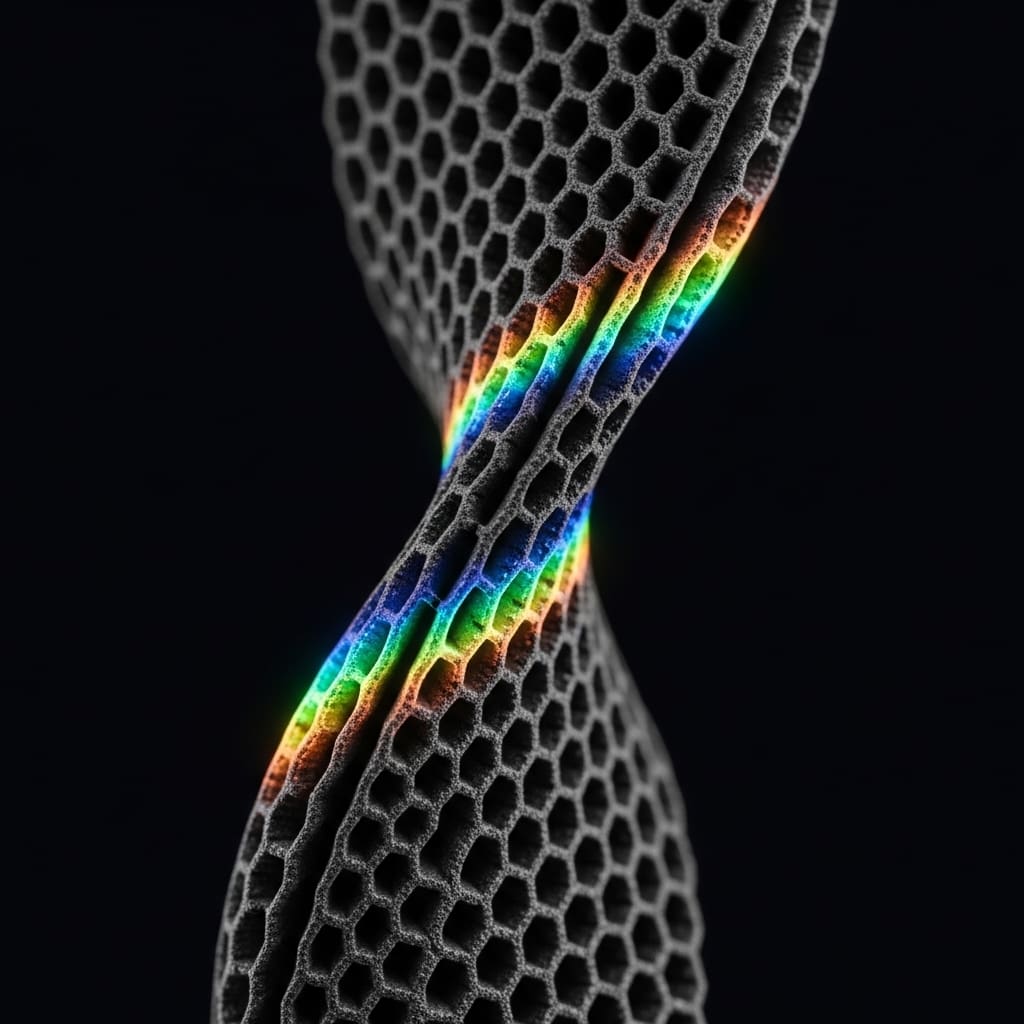
The pursuit of stable, two-dimensional flat-bands, crucial for realising novel correlated electron states, often encounters challenges with fragility and precise fabrication requirements. Yalan Wei from Xiangtan University, Shifang Li, and Yuke Song, also of Xiangtan University, alongside Chaoyu He, now demonstrate an alternative pathway to achieving these states through the unique properties of twisted graphite. Their work reveals that introducing specific atomic arrangements within twisted graphite generates robust, two-dimensional flat-bands at relatively large twist angles, avoiding the need for extremely precise “magic angle” tuning. This breakthrough unlocks a series of moiré-diamond structures exhibiting flat conduction of valence bands, where electrons remain highly mobile in certain directions while being confined in others, paving the way for the design of new quantum materials with tailored electronic properties and enhanced stability.
Robust Flat-Bands via Twisted Graphite Hybridization
Two-dimensional flat-bands emerge within moiré structures formed by twisting graphite layers, offering a promising pathway to explore correlated electron behavior. This research demonstrates that introducing sp3 hybridization within twisted graphite reliably generates robust flat bands, offering a more practical route to investigate correlated phenomena than the precise angular alignment required in magic-angle graphene. The investigation reveals exceptionally flat bands near the Fermi level, suggesting strong potential for realizing correlated electronic states.
Moiré Diamond Structures From Twisted Bilayer Graphene
Scientists pioneered a computational approach to identify and stabilize novel moiré-diamond structures within twisted graphite, circumventing the need for the extremely precise “magic angles” typically required for flat-band formation. The study involved constructing models of stacked graphene layers, systematically varying the twist angle and interlayer bonding to generate a diverse range of structures. Researchers focused on supercells containing fewer than 50 atoms, limiting the computational demands of the simulations. To explore the structural landscape, the team systematically listed moiré supercells, calculating the twist angle between layers.
A random coloring strategy was then implemented to generate buckled configurations, utilizing an algorithm to determine the symmetry of each structure. These structures were refined by constraining the smallest carbon rings to five-membered rings, excluding high-energy configurations. Successfully established structures underwent preliminary optimization to adjust bond lengths and angles, followed by high-precision optimization using advanced computational methods. Simulations utilized a high cutoff energy and a fine k-point grid, ensuring convergence to a high degree of accuracy. Dynamical and elastic stability were assessed using density functional perturbation theory, yielding 180 moiré-diamond structures, which were then analyzed for their stability and properties.
Twisted Graphite Structures and Stability Analysis
This document summarizes supporting information for research on Moiré diamonds formed from twisted graphite. The research investigates the potential for creating novel materials by twisting layers of graphite, aiming to identify stable structures with interesting electronic properties. The supporting information details the computational methods used to explore a large number of possible twisted structures. The researchers employed a high-throughput computational approach to explore a vast configuration space of twisted graphite structures. They used an algorithm to generate and sample different twisted configurations, and density functional theory calculations to determine the stability and electronic properties of each structure.
A tight-binding model was used to calculate the electronic band structures, providing insights into their potential conductivity and other electronic characteristics. The supporting information consists of detailed data for 180 different Moiré diamond structures, including crystal structure visualization, symmetry, energy, volume, band structure, band gap, band extrema, and band fluctuations. This data allows other researchers to verify the results and explore the properties of these novel materials in more detail.
Hybridization Stabilizes Flat Bands in Graphite
Scientists have discovered a new route to creating flat electronic bands in twisted graphite structures, offering a potentially more robust alternative to the “magic-angle” approach used in graphene. Their work demonstrates that introducing sp3 hybridization in twisted graphite generates flat bands at relatively large twist angles. These newly discovered flat bands are formed through reconstructions that create substantial energy barriers, protecting them from external disturbances and enhancing their stability. The team systematically designed and investigated a range of these “moire-diamond” structures using computational methods, revealing that interlayer hybridization can reliably produce robust two-dimensional flat bands across a variety of twist angles.
Analysis of the most stable structure indicates that electrons are confined to a plane but remain able to move freely in a perpendicular direction, resulting in anisotropic conductivity. This discovery establishes moire diamonds as a versatile platform for engineering flat-band physics beyond graphene, potentially enabling the exploration of novel electronic properties and strongly correlated phenomena in three-dimensional carbon materials. Future research will focus on further enhancing the stability of these bands and exploring their potential for realizing specific electronic functionalities.
👉 More information
🗞 Two-dimensional flat-bands in Moire-diamonds
🧠 ArXiv: https://arxiv.org/abs/2510.10908

