The search for materials that conduct electricity along their edges without losing information is driving innovation in quantum technologies, and a new study explores how to achieve this robust transport in a particularly promising system. Yu-Hao Wan, Peng-Yi Liu, and Qing-Feng Sun, all from the International Center for Quantum Materials at Peking University, investigate the behaviour of electrons in thin films of topological insulators when combined with a unique magnetic order known as altermagnetism. Their work demonstrates that this combination induces a change in the material’s electronic structure, creating special edge states that carry current without the need for time-reversal symmetry, a property often crucial for maintaining these states. This discovery is significant because it establishes a new material platform for developing devices based on these robust, helical edge currents, potentially overcoming limitations in existing topological materials and opening avenues for more resilient quantum technologies.
Altermagnetic materials possess a unique form of magnetism where magnetic moments align non-collinearly, influencing the electronic structure of topological insulators. The research focuses on understanding how the interplay between altermagnetic order and a Wilson mass term, resulting from structural asymmetry, affects the topological properties of these systems. Specifically, the study demonstrates the emergence of helical edge states even without time-reversal symmetry, a crucial characteristic for potential spintronic applications. The investigation explores the conditions under which these edge states are robust and how their properties can be tuned by manipulating the altermagnetic order and the strength of the Wilson mass.
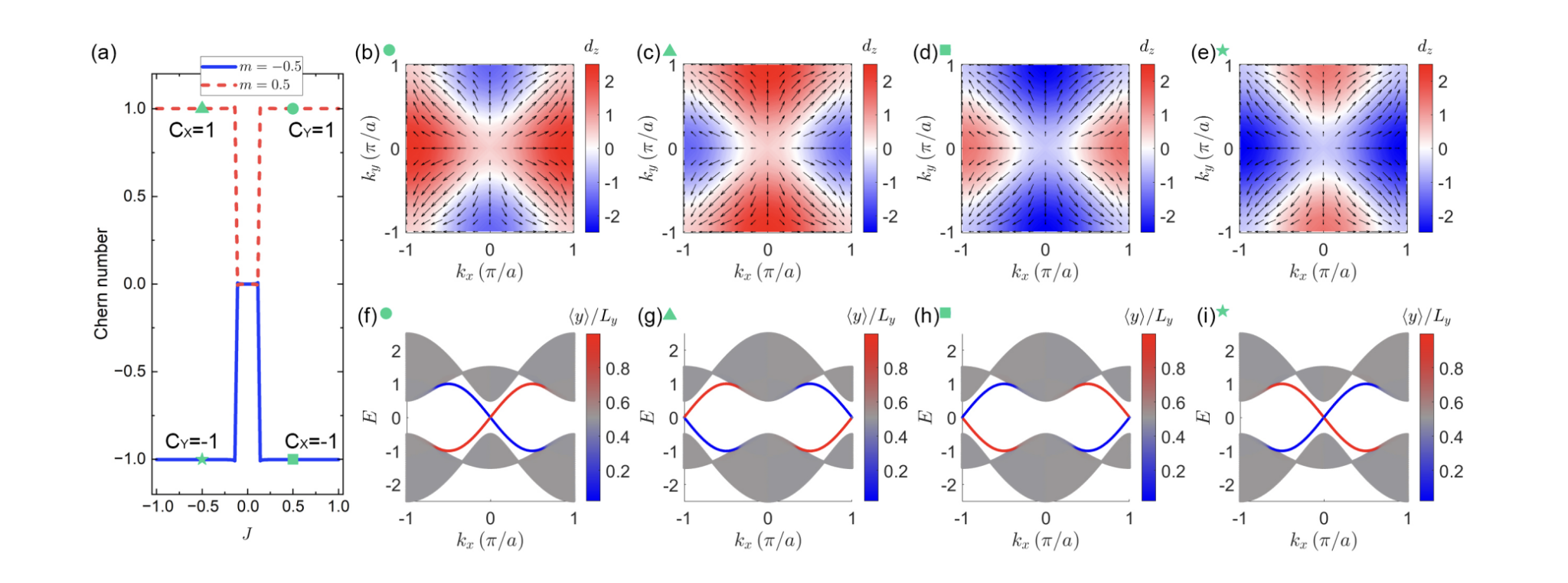
The team elucidates how the Wilson mass and altermagnetic mass interact, fundamentally altering the band topology and boundary modes. They demonstrate that coupling a topological insulator thin film to an altermagnetic material induces a topological phase transition, resulting in topological helical edge states. These states arise from opposite Chern numbers at different points within the material and are distinct from both the chiral edge states of the quantum anomalous Hall phase and the helical edge states of the conventional quantum spin Hall effect.
Altermagnetism and Kramers Degeneracy Lifting
This extensive research collection focuses on altermagnetism, topological materials, and related quantum phenomena. Studies directly address the discovery and characterization of altermagnetic materials, such as chromium antimonide and ruthenium dioxide, experimentally observing altermagnetic order and identifying the lifting of Kramers degeneracy as a key signature. Analyses of band structures confirm the splitting and reveal the role of symmetry in enabling altermagnetism. Another large group of papers explores topological insulators, quantum anomalous Hall effects, and related phenomena, investigating materials like bismuth telluride and mercury telluride quantum wells, realizing and controlling the quantum anomalous Hall state, characterizing conducting edge and surface states, and exploring the quantized thermal Hall effect as a signature of topological order.
Several papers present theoretical calculations and modeling of band structures, topological properties, edge state behavior, transport properties, and the interplay of symmetry, magnetism, and topology. Other studies focus on transport phenomena and device applications, investigating magnetoresistance effects, the spin-valley Hall effect, nonlocal transport, Andreev reflection, and thermal switches. This collection suggests several exciting research directions, including the potential for altermagnetic materials to provide a new platform for realizing topological states without relying on conventional time-reversal symmetry breaking. Engineering topological states with altermagnetism, understanding disorder effects in these materials, and developing spintronic devices based on altermagnetic topological materials are all promising avenues for future research.
Papers by Krempasky and colleagues, and Fedchenko and colleagues, are foundational in establishing the experimental observation of altermagnetism. Wan and colleagues’ work is crucial for understanding the theoretical implications of altermagnetism for topological states. Xiao and colleagues demonstrate the realization of the axion insulator state, while Jiang and colleagues present early work on topological insulators and the quantum spin Hall effect. Reimers and colleagues provide direct observation of altermagnetic band splitting.
Robust Helical Edge States in Altermagnetic Films
This research investigates the emergence of novel topological phases in thin films combining three-dimensional topological insulators with materials exhibiting altermagnetic order. By examining the interplay between inherent material properties and the induced effects of altermagnetism, the team demonstrates a topological phase transition resulting in the formation of unique helical edge states. These states, distinct from those found in conventional quantum Hall systems, arise from specific symmetry properties and are characterized by opposite Chern numbers at different points within the material. Importantly, the study reveals that these helical edge states exhibit robust, quantized nonlocal resistance, even when subjected to significant potential and magnetic disorder. This resilience suggests the potential for practical applications in future quantum devices, offering a platform for engineering and detecting unconventional edge states.
🗞 Interplay of Altermagnetic Order and Wilson Mass in the Dirac Equation: Helical Edge States without Time-Reversal Symmetry
🧠 ArXiv: https://arxiv.org/abs/2509.03969