The pursuit of materials with precisely controllable magnetic properties represents a significant challenge in modern condensed matter physics, and recent work by Jinyoung Kim, Minjae Kim, and Donghan Kim, along with colleagues at Seoul National University and Jeonbuk National University, demonstrates a novel approach to achieving this goal. The team investigates strontium ruthenate ultrathin films, revealing how reducing the material’s dimensionality creates a unique electronic environment where magnetism becomes exceptionally sensitive to external influence. By carefully adjusting the concentration of electrons within the film, researchers successfully tune the material between non-magnetic and ferromagnetic states, directly observing the resulting changes in its electronic structure and magnetic behaviour. This achievement establishes a new principle for engineering magnetism through control of the material’s density of states, paving the way for the development of advanced magnetic devices with tailored properties.
Ionic Gating Controls Magnetism in Ultrathin Films
This research investigates how to manipulate the electronic and magnetic properties of ultra-thin films of Strontium Ruthenate (SrRuO3) using ionic gating, a technique involving the movement of ions within the material. Researchers can reversibly control the number of charge carriers, the arrangement of electronic energy levels, and the magnetic behaviour of the SrRuO3 film by applying a voltage. This control extends to both inducing and suppressing ferromagnetism, and even tuning the strength of the anomalous Hall effect, a phenomenon linked to the material’s magnetic structure. The study demonstrates a pathway to electrically control magnetism in a material already known for its interesting electronic and magnetic characteristics.
Strontium Ruthenate is a perovskite oxide, a complex material with interactions between electrons, magnetism, and the potential for superconductivity. It is a valuable material for fundamental research and potential applications in spintronics, a field focused on exploiting electron spin for new technologies. Traditional methods of controlling magnetism, such as using magnetic fields or changing temperature, often lack the speed, scalability, and energy efficiency needed for practical devices. Ionic gating offers a promising alternative, where ions are used to accumulate or deplete charge carriers at a material’s surface, enhancing the effect of surface charge accumulation for more efficient control.
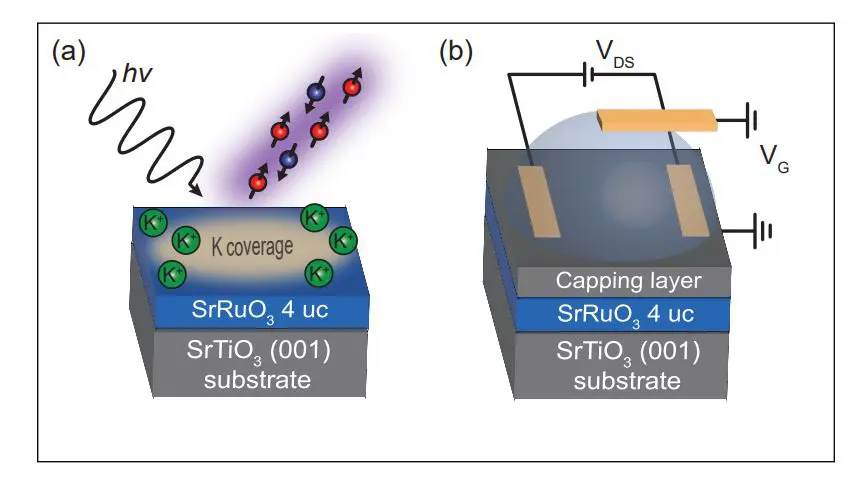
Researchers grew high-quality SrRuO3 films on supporting substrates using pulsed laser deposition, allowing precise control over film thickness and composition. A solid-state electrolyte was deposited on top of the SrRuO3 film, and applying a voltage caused potassium ions to accumulate or deplete at the SrRuO3 surface. Techniques including angle-resolved photoemission spectroscopy, resistivity measurements, magnetometry, anomalous Hall effect measurements, scanning transmission electron microscopy, and X-ray diffraction were employed to characterize the film’s properties. The researchers demonstrated that the applied voltage effectively modulates the carrier density in the SrRuO3 film, with positive voltages accumulating electrons and negative voltages depleting them.
Angle-resolved photoemission spectroscopy measurements revealed that the gate voltage alters the electronic band structure of the film, including shifts in the Fermi level and changes in the shape of the bands. Crucially, the gate voltage can induce ferromagnetism in the SrRuO3 film, with a clear ferromagnetic signal emerging at certain voltages, indicating the alignment of electron spins. The strength of the anomalous Hall effect also changes with the applied voltage, demonstrating a clear link between electron doping and the emergence of ferromagnetism. This research demonstrates a novel and potentially powerful way to control magnetism in materials.
The ability to electrically control magnetism could lead to new spintronic devices with improved performance and energy efficiency. The reversible switching between different magnetic states could be used to create non-volatile memory devices, and the ability to tune the electronic and magnetic properties of materials could be used to create neuromorphic computing devices that mimic the human brain. This research provides new insights into the interplay between electronic interactions, magnetism, and charge transport in complex materials. This research paper presents a significant advance in the field of materials science and spintronics. The demonstration of electrically controlled magnetism in SrRuO3 films opens up new possibilities for the development of advanced electronic devices and provides valuable insights into the fundamental physics of complex materials. The use of ionic gating as a control mechanism is a promising approach that could be extended to other materials as well.
Electron Doping Controls Ruthenate Magnetism
This study investigates the control of magnetism in a strontium ruthenate (SRO) ultrathin film by tuning its electronic structure through electron doping. Researchers grew four-unit-cell thick SRO films using pulsed laser deposition, allowing precise control over film thickness and composition. Potassium atoms were utilized as electron donors to modify the film’s electronic structure, with potassium coverage quantified in monolayers. Angle-resolved photoemission spectroscopy (ARPES) was used to directly visualize the spin-split band structure and its influence on both magnetic and transport characteristics.
ARPES measurements were conducted at 6 Kelvin with varying potassium coverage levels, allowing researchers to map the evolution of the Fermi surface. These Fermi surface maps revealed changes in the electronic band structure as potassium doping increased, specifically tracking the behaviour of Ru 4d t2g bands relative to the Fermi level. The team carefully analyzed the gamma band near the X point, noting its transformation from electron-like to hole-like behaviour with increasing doping, indicative of a shift in the van Hove singularity across the Fermi level. Researchers performed high-symmetry cuts through the band structure and extracted peak positions using momentum distribution curves (MDCs). By fitting Lorentzian functions to these MDCs, they precisely determined the distance between the spin-majority and spin-minority alpha bands, demonstrating a clear correlation between potassium coverage and the degree of band splitting. This meticulous analysis provides compelling evidence for the controlled tuning of magnetism through precise manipulation of the film’s electronic structure, supported by complementary transport measurements using an ionic-liquid gating method.
Electron Doping Controls Ultrathin Film Magnetism
Scientists demonstrate precise control of ferromagnetism in ultrathin films of strontium ruthenate (SRO), establishing a pathway for designing tunable magnetic materials. The research focuses on a four-unit-cell thick SRO film, positioned at a critical crossover between non-magnetic and bulk ferromagnetic states, allowing for manipulation of its magnetic properties through electron doping. Using a combination of spin- and angle-resolved photoemission spectroscopy, transport measurements, and theoretical calculations, the team systematically altered the film’s electronic structure by introducing electrons. Experiments reveal a direct correlation between the density of electronic states and the emergence of ferromagnetism. The team observed that increasing electron doping enhances the density of states.
🗞 Low-dimensionality-induced tunable ferromagnetism in SrRuO ultrathin films
🧠 ArXiv: https://arxiv.org/abs/2512.09320