The search for novel magnetic states in quantum materials drives advances in fundamental physics and potential technological applications, and recent research focuses on the intriguing behaviour of spin-1 Heisenberg diamond chains. Azam Zoshki, Hamid Arian Zad, and colleagues at P. J. ˇSaf ́arik University, along with Katarina Karlova and Jozef Strecka, investigate the magnetic and thermodynamic properties of this system, revealing a wealth of unconventional states including cluster-based Haldane phases and bound-magnon crystals. Their work demonstrates that these exotic magnetic configurations not only exhibit a significant magnetocaloric effect, enhancing potential cooling technologies, but also suggest the possibility of highly efficient energy conversion, potentially enabling near-optimal performance in Stirling engine designs. This discovery expands our understanding of frustrated magnetism and opens new avenues for designing materials with tailored thermodynamic properties and advanced functionalities.
In systems with weak magnetic frustration, the model exhibits a quantum ferrimagnetic phase, displaying magnetic characteristics similar to those observed in the nickel-based compound [Ni3(OH)2(C4H2O4)(H2O)4] · 2H2O. This includes a flat minimum in the temperature dependence of magnetic susceptibility and an intermediate magnetization plateau. When magnetic frustration is stronger, researchers uncover a rich variety of unconventional quantum phases, including uniform and cluster-based Haldane states, a fragmented phase consisting of isolated magnetic units and pairs, and bound-magnon crystals. Analysis of the temperature change and magnetic response reveals an enhanced magnetocaloric effect near transitions between these exotic quantum phases.
Diamond and Octahedral Chain Magnetism Explored
This work focuses on understanding frustrated quantum magnetism in low-dimensional materials, specifically those with diamond-like and octahedral chains of magnetic ions. These materials exhibit unusual magnetic behaviour because the arrangement of magnetic interactions prevents simple, ordered magnetic states from forming. The research explores several compounds, including azurite, various potassium-copper sulfates, and nickel fumarate compounds, to understand these complex phenomena. Key quantum phenomena investigated include frustration, spin liquids, the Haldane phase, cluster-based Haldane states, quasi-fractionalization, and bound-magnon crystals. These concepts describe the unusual behaviour of spins in these materials, where they can become entangled, form localized excitations, or split into fractionalized particles. The team employs theoretical tools such as density matrix renormalization group, quantum Monte Carlo simulations, and statistical mechanical approaches to model these materials and understand their properties.
Diamond Chain Reveals Exotic Magnetic Phases
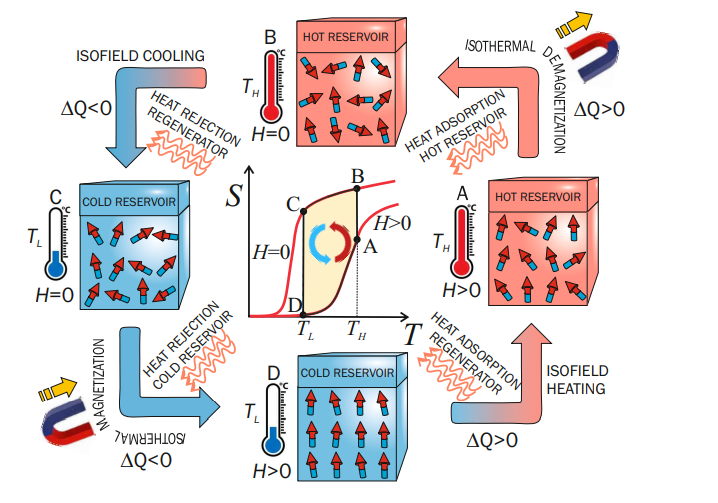
This research presents a comprehensive investigation of the magnetic and thermodynamic properties of a spin-1 Heisenberg diamond chain, employing a combination of analytical calculations and numerical simulations. The team discovered a diverse range of quantum phases within the system, including a ferrimagnetic state, uniform and cluster-based Haldane states, a fragmented phase consisting of isolated magnetic units and pairs, and bound-magnon crystals. These findings demonstrate the versatility of the spin-1 diamond chain as a platform for exploring field-induced quantum phase transitions and exotic magnetic behaviours. Notably, the study reveals an enhanced magnetocaloric effect, the tendency of a material to change temperature in response to a changing magnetic field, near the transitions between these unconventional quantum phases. Furthermore, the researchers demonstrate the potential for this frustrated spin chain to function as an efficient working medium in a Stirling engine, achieving near-optimal performance when driven through these unique states. While current experimental materials favour the ferrimagnetic ground state, the team highlights the desirability of realizing the highly frustrated regime to fully exploit the potential for both magnetocaloric refrigeration and quantum heat-engine technologies.
🗞 Fingerprints of cluster-based Haldane and bound-magnon states in a spin-1 Heisenberg diamond chain
🧠 ArXiv: https://arxiv.org/abs/2510.18447