Moiré superlattices exhibit a fascinating range of correlated electronic behaviours, including exotic insulating states, but accurately modelling these complex systems proves challenging. Xin Lu, Yuanfan Yang from ShanghaiTech University, and Zhongqing Guo from ShanghaiTech University, alongside Jianpeng Liu et al., now present a new theoretical framework that significantly improves our understanding of these materials. Their approach combines detailed calculations of electron interactions with a method for incorporating the dynamic relationships between electrons, going beyond simpler approximations. Applying this framework to rhombohedral pentalayer graphene aligned with hexagonal boron nitride, the team achieves remarkable agreement with experimental observations of the material’s electronic properties and how they change with applied electric fields, offering a systematic and versatile tool for investigating a wide range of moiré systems.
Graphene Moiré Superlattices and Correlated Electrons
Scientists are unraveling the complex behavior of electrons in moiré superlattices, structures formed by twisting layers of graphene and other two-dimensional materials. These twists create repeating patterns that dramatically alter the material’s electronic properties. Researchers focus on understanding how electrons interact with each other, a phenomenon known as correlation, crucial for accurately predicting the material’s behavior and identifying exotic states of matter, such as fractional Chern insulators. The team employs sophisticated computational techniques, starting with Hartree-Fock calculations to establish a baseline understanding of the electronic structure.
They then incorporate more advanced methods, like Random Phase Approximation (RPA) and GW approximation, to account for complex electron interactions. These calculations reveal how electron correlation affects the material’s electronic bands, reducing their gaps and bandwidths, ultimately influencing its transport properties. This work builds on established theoretical frameworks, including many-body perturbation theory and density functional theory, to provide a comprehensive understanding of these complex materials. Scientists are systematically refining these methods to improve their accuracy and predictive power, ultimately aiming to design and create novel materials with tailored electronic properties for future technological applications.
Correlated Topological States in Graphene Moire Superlattices
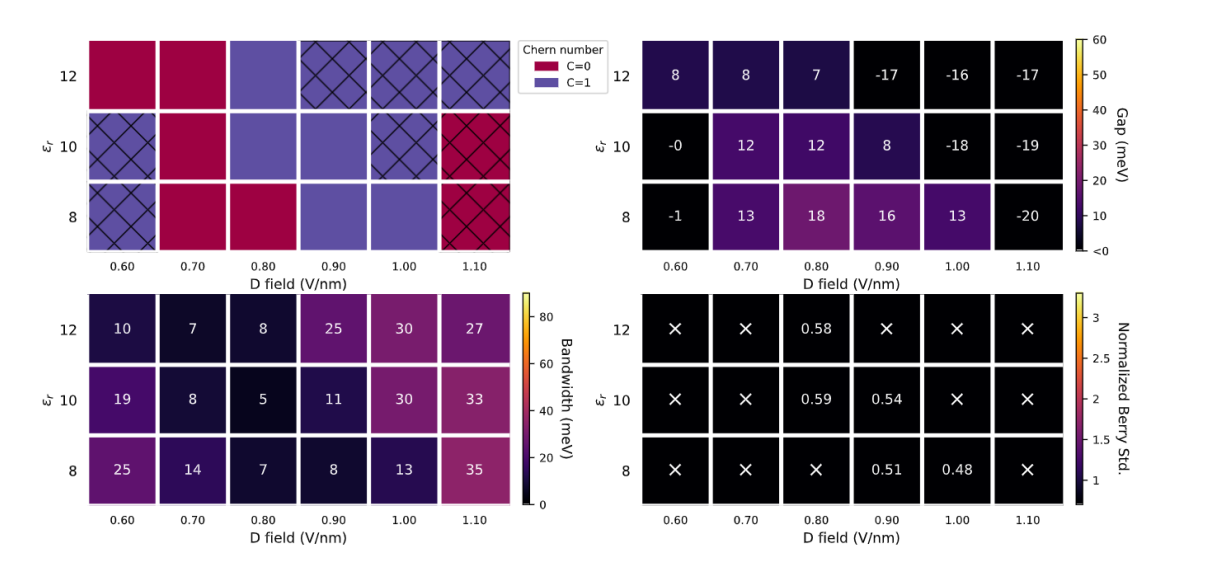
Scientists have developed a comprehensive computational framework to investigate correlated topological states in moiré superlattices, addressing limitations of simpler calculations. The team focused on rhombohedral pentalayer graphene aligned with hexagonal boron nitride, a system where small twists between layers create unique electronic behavior. Detailed Hartree-Fock calculations, incorporating all relevant electronic components, established a baseline understanding of the material’s properties. Researchers integrated Random Phase Approximation (RPA) correlation energies into the Hartree-Fock framework, systematically accounting for complex electron interactions and achieving quantitative agreement with experimental measurements of transport properties.
Further refinement involved employing GW quasiparticle corrections to refine the single-particle bands, revealing a more realistic representation of the material’s electronic structure. Analysis of the quasiparticle weights confirmed that the ground state is well-described by a simplified model, validating the chosen approach. This versatile framework provides a powerful tool for studying a wide range of moiré systems, offering insights into the interplay between topology and strong electron correlations. The research pioneers a method for systematically incorporating correlation effects into the modeling of moiré superlattices, enabling more accurate predictions and a deeper understanding of their exotic properties.
Moiré Graphene Correlated States Explained by Theory
Scientists have developed a new computational framework to understand correlated topological states in moiré superlattices, achieving quantitative agreement with experimental measurements of transport properties. The work centers on rhombohedral pentalayer graphene aligned with hexagonal boron nitride, a system where small twists between layers create unique electronic behavior. Researchers performed detailed Hartree-Fock calculations, incorporating all relevant electronic components to establish a baseline understanding of the material’s properties. By augmenting these calculations with Random Phase Approximation (RPA) correlation energies, the team achieved quantitative agreement with the evolution of transport properties across varying electric fields.
The resulting quasiparticle bands exhibited significantly reduced gaps and bandwidths compared to the initial Hartree-Fock results, indicating a strong influence of electron interactions. Crucially, measurements of quasiparticle weights consistently approached unity, confirming that the ground state is well-described by a simplified model, validating the chosen approach. This versatile framework systematically incorporates beyond-simplified approximations, offering a pathway to accurately model generic moiré systems. The team’s approach addresses limitations of previous methods by including all moiré bands and fully accounting for the material’s electronic properties. The calculated RPA correlation energies accurately predict the balance between exchange and correlation effects, enhancing the quantitative accuracy of theoretical predictions and providing insights into the strength of electron interactions within these complex materials.
RPA Improves Moiré Superlattice Calculations
This work presents a new computational framework for understanding the complex behavior of electrons in moiré superlattices, structures formed by twisting two-dimensional materials. Researchers developed a method combining detailed calculations of electronic structure with many-body perturbation theory, specifically Hartree-Fock calculations enhanced with Random Phase Approximation (RPA) correlations. Applying this approach to rhombohedral pentalayer aligned with hexagonal boron nitride, the team achieved quantitative agreement between calculated transport properties and experimental observations, demonstrating the method’s accuracy in predicting system behavior. The results reveal that incorporating RPA correlations significantly improves the description of electronic bands, reducing their gaps and bandwidths compared to simpler Hartree-Fock calculations.
Importantly, the calculated quasiparticle weights, which indicate the character of the electronic excitations, were found to be close to unity, suggesting that the simplified approach, commonly used to study these systems, provides a surprisingly accurate qualitative description. This framework, adaptable to various moiré superlattices, offers a systematic way to move beyond simplified approximations and provides a valuable tool for future investigations. While further refinement, specifically by incorporating GW quasiparticle calculations into the RPA framework, remains a possibility, this work establishes a robust method for accurately modelling correlated electron systems in moiré materials, offering insights into their unusual electronic properties and paving the way for the design of novel quantum devices.
👉 More information
🗞 A General Many-Body Perturbation Framework for Moiré Systems: Application to Rhombohedral Pentalayer Graphene/hBN Heterostructures
🧠 ArXiv: https://arxiv.org/abs/2509.19764