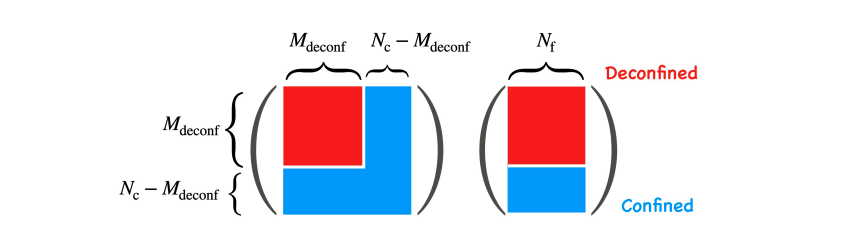
Understanding the behaviour of chromodynamics (QCD) at extreme temperatures and densities is fundamental to unlocking the secrets of both heavy-ion collisions and the cores of neutron stars. Masanori Hanada from Queen Mary University of London, Jack Holden from Yau Mathematical Sciences Center at Tsinghua University, and Hiromasa Watanabe from Keio University, alongside their colleagues, now reveal a surprisingly complex landscape of phases within QCD matter. Their work demonstrates that the transition from confined to deconfined quarks and gluons isn’t simply a switch between two states, but involves a more nuanced progression with multiple intermediate stages of partial deconfinement. This research identifies four distinct phases, complete confinement, complete deconfinement, and two forms of partial deconfinement, and offers a unified framework for understanding dense QCD matter, potentially reshaping our understanding of the elusive QCD critical point and the conditions within the most extreme astrophysical environments.
While the transition from the confined phase to the deconfined phase has been extensively studied, recent theoretical work suggests the existence of intermediate phases exhibiting partial deconfinement, where only a subset of the colour degrees of freedom is deconfined. This research investigates the generalization of partial deconfinement in quantum chromodynamics (QCD) within a specific theoretical limit, revealing that the partially deconfined phase possesses a finer structure, leading to the identification of four distinct phases in QCD.
Holographic Deconfinement and Gauge Theory Transitions
This document explores the nature of deconfinement transitions in strongly coupled gauge theories, particularly Quantum Chromodynamics (QCD) and Super-Yang-Mills theories. It investigates these transitions using theoretical tools, including holographic duality, which maps problems in the strongly coupled gauge theory to calculations in a gravitational theory. Black hole physics plays a central role, as black holes in a specific spacetime model the deconfinement transition. Matrix models, which describe the dynamics of gauge theories, and eigenvalue statistics are also employed to understand the behaviour of the system.
The research connects extended objects in the gravitational theory, termed giant gravitons, with solutions in the matrix model, known as eigenvalue instantons, to further illuminate the structure of the transition. The study focuses on the deconfinement transition, the shift from a state where quarks and gluons are bound within particles to one where they are free. Holographic duality proposes that a strongly interacting system is equivalent to a weakly interacting one in a higher-dimensional space, allowing scientists to calculate properties that would be impossible to determine directly in the strongly coupled system. The formation of a black hole in this higher-dimensional space is interpreted as the holographic representation of the deconfinement transition, with the black hole’s properties reflecting the characteristics of the transition. Matrix models provide a mathematical framework for describing the dynamics of gauge theories, particularly in scenarios with a large number of colours, and the distribution of eigenvalues within these models is linked to the degrees of freedom of the gauge theory. The research also explores supersymmetric gauge theories, which simplify calculations and offer additional insights into the transition.
Four Phases of Quark Deconfinement Revealed
Scientists have refined the understanding of how matter transforms at extremely high temperatures and densities, relevant to both the cores of neutron stars and the conditions created in heavy-ion collisions. This research reveals a surprisingly complex structure to the transition between confined and deconfined states of quarks and gluons, the fundamental constituents of matter. The team discovered that this transition involves four distinct phases: complete confinement, complete deconfinement, and two intermediate phases of partial deconfinement. This refined picture arises from a detailed examination of a specific point in the theory, signifying the opening of a gap in the distribution of certain quantities, and is caused by either the condensation of strings or the condensation of baryons.
The results demonstrate that the interplay between these condensation processes leads to a richer phase structure than previously understood. Importantly, the research indicates the emergence of a critical point in the phase diagram of Quantum Chromodynamics (QCD), arising from the combined effects of baryon condensation and partial deconfinement. While acknowledging the computational challenges inherent in studying these extreme conditions, specifically the ‘fermion sign problem’, scientists have established a unified theoretical framework for understanding dense QCD matter. This framework not only clarifies the structure of the phase diagram but also offers new perspectives on the location and nature of the QCD critical point, paving the way for future investigations into the behavior of matter under the most extreme conditions in the universe.
Four Phases of Quantum Chromodynamics Revealed
This research expands understanding of the phases of matter existing at extremely high temperatures and densities, relevant to both heavy-ion collisions and the interiors of neutron stars. The study demonstrates that, beyond simple confinement and deconfinement, quantum chromodynamics (QCD) exhibits a more complex structure with four distinct phases: complete confinement, complete deconfinement, and two kinds of partial deconfinement. This refined picture arises from a detailed investigation of how colour charges behave under varying conditions, revealing that subsets of colour degrees of freedom can become deconfined independently. A key finding is the connection between the opening of a gap in the distribution of certain quantities and both baryon condensation and partial deconfinement. The research suggests that the interplay between these phenomena may explain the emergence of the QCD critical point, a long-sought state in the theory. While the approach is necessarily qualitative due to limitations inherent in calculations involving fermions, it provides a unified framework for interpreting the complex phase structure of dense QCD matter.
🗞 New phases in QCD at finite temperature and chemical potential
🧠 ArXiv: https://arxiv.org/abs/2509.04671