

The electronic properties of nanoscale materials continue to fascinate physicists, and recent work focuses on understanding how molecular arrangement impacts electron behaviour. Lyuba Malysheva, from the Bogolyubov Institute for Theoretical Physics, and colleagues investigate the unique electronic spectrum of narrow, achiral nanoribbons constructed from pyrene molecules. This research reveals that these ribbons possess localised electronic states, a significant departure from the extended states found in simpler linear molecules like acene. The discovery of these localised states promises new avenues for controlling electron flow at the nanoscale, potentially leading to advancements in molecular electronics and materials science.
Electronic structure within narrow graphene nanoribbons strongly depends on the conditions at their boundaries. While many studies focus on unbounded graphene, understanding electron behaviour confined within these ribbons presents unique challenges. Research shows that pyrene oligomers exhibit local states in their π-electron spectrum, a contrast to linear acene structures which consist only of extended states. This work analyses and illustrates the difference in electron density distribution for extended and local electronic states, providing insight into the fundamental properties governing electron behaviour within these materials.
Pyrene Nanoribbons and Edge State Analysis
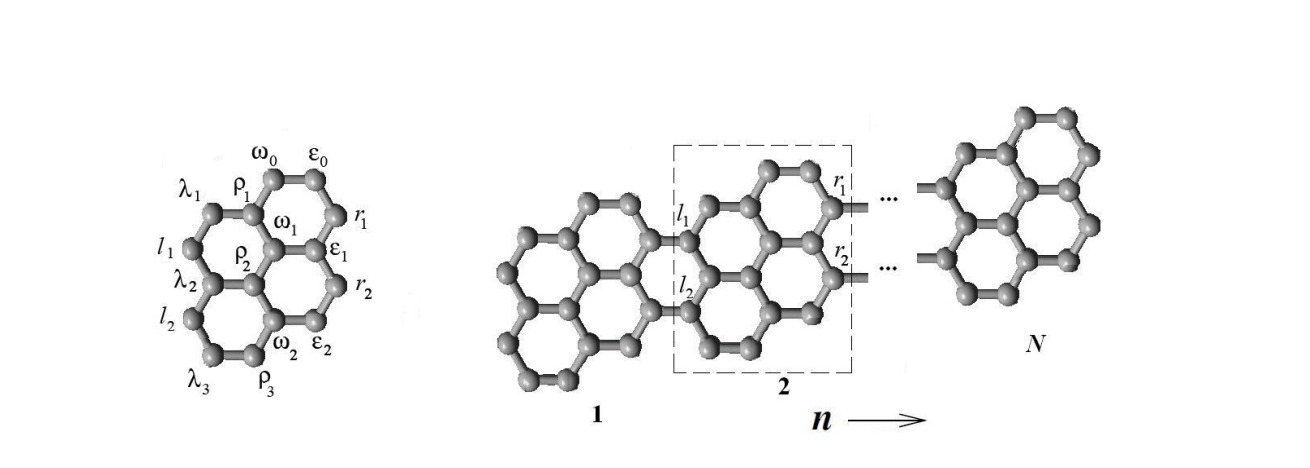
The electronic properties of narrow chiral graphene nanoribbons are investigated, specifically focusing on sequences of pyrene molecules, termed narrow graphene nanoribbons (NGNRs). Building upon previous research demonstrating edge effects in finite-size graphene layers, the study explores the existence of edge states in chiral nanoribbons. The researchers consider a sequence of N pyrene molecules, each coupled by two carbon-carbon covalent bonds, representing an ideal π-electron system with dangling bonds saturated by hydrogen atoms. The electronic properties are described using a Hückel-type Hamiltonian, with the carbon-carbon hopping integral serving as the energy unit and the Fermi energy of π-electrons as the reference.
To analyze edge states, the team determined the general solution of the eigenvalue problem for corresponding π-conjugated oligomers, employing methods developed by Lifshits and Koster-Slater. This approach allowed them to calculate the Green’s functions for the pyrene molecule using computational tools. The calculations reveal the presence of both extended and localized energy levels within the NGNR spectrum. The researchers analyzed the behaviour of the wave function coefficients to understand the electron density distribution for these different types of energy levels. For extended states, the squared wavefunction coefficients exhibit an oscillating dependence on the molecule number (n), while localized states demonstrate a sharper increase in the square of the modulus with increasing n.
This difference in behaviour is consistent with findings for bounded polynaphthalene oligomers and is considered a characteristic feature of narrow chiral graphene nanoribbons. Specifically, the team found that for certain energies, the calculated electron density distribution demonstrates sharp maxima at the ends of the bounded sequence. The study provides insights into the relationship between the electronic structure and spatial distribution of electrons in these nanoscale materials.
Pyrene Nanoribbons Exhibit Localized Electronic States
Scientists have achieved a detailed understanding of the electronic properties of narrow graphene nanoribbons constructed from pyrene molecules, revealing unique behaviours not seen in simpler structures. These nanoribbons, formed by linking pyrene molecules into a chain, exhibit a distinct electronic spectrum characterized by localized states, unlike linear acene structures which only possess extended states. This difference arises from the specific arrangement of molecules and the resulting interactions between their electrons. The team developed an exact solution to the eigenvalue problem governing electron behaviour within these nanoribbons, utilizing a sophisticated mathematical framework based on the Su-Schrieffer-Heeger-Hückel-type Hamiltonian.
This approach allowed them to derive analytic expressions for the Green’s function coefficients of individual pyrene molecules, which are crucial for determining the overall electronic structure of the ribbon. Calculations demonstrate how the energy levels within the nanoribbon are influenced by both the arrangement of molecules and the interactions between them, leading to the emergence of localized states. Further analysis revealed a quadratic equation governing the relationship between energy and wave vector, providing insights into the dispersion relation of electrons within the nanoribbon. The team identified two distinct branches within this dispersion relation, each corresponding to a different electronic state. These calculations, validated for a nanoribbon consisting of five pyrene molecules, predict unique behaviours at specific energy levels and wave vectors, offering a pathway to control electron flow within these nanoscale structures. The findings establish a foundation for designing novel electronic devices based on pyrene-based nanoribbons, potentially enabling new functionalities in areas like nanoelectronics and materials science.
Pyrene Ribbons Exhibit Localized Electronic States
This research investigates the electronic properties of narrow ribbons constructed from pyrene molecules, building upon established theories of electron behaviour in similar carbon-based structures. The study demonstrates that these pyrene-based oligomers exhibit localized electronic states, a key distinction from linear acene structures which only support extended states. This localization is evidenced by a distinct distribution of electron density, concentrating at the ends of the pyrene ribbon, and is a feature also observed in related chiral graphene nanoribbons and polynaphthalene oligomers. The team achieved these results by analysing the dispersion relation of electrons within the pyrene ribbon, using a mathematical framework to describe the system’s energy levels and wave functions.
Explicit expressions for the Green’s function, a tool for calculating electron behaviour, were also derived. These calculations reveal how electron density is distributed in both localized and extended states, providing insight into the fundamental electronic characteristics of these molecular structures. The authors acknowledge that their current model focuses on idealised ribbons and does not account for external factors such as temperature or defects. Future work could explore the impact of these real-world conditions on the observed electronic properties. Further investigation into the behaviour of these ribbons with varying widths and lengths could also refine our understanding of their potential applications in nanoscale electronics.
🗞 Specific features of the π-electron spectrum of narrow achiral nanoribbons
🧠 ArXiv: https://arxiv.org/abs/2509.04306


