

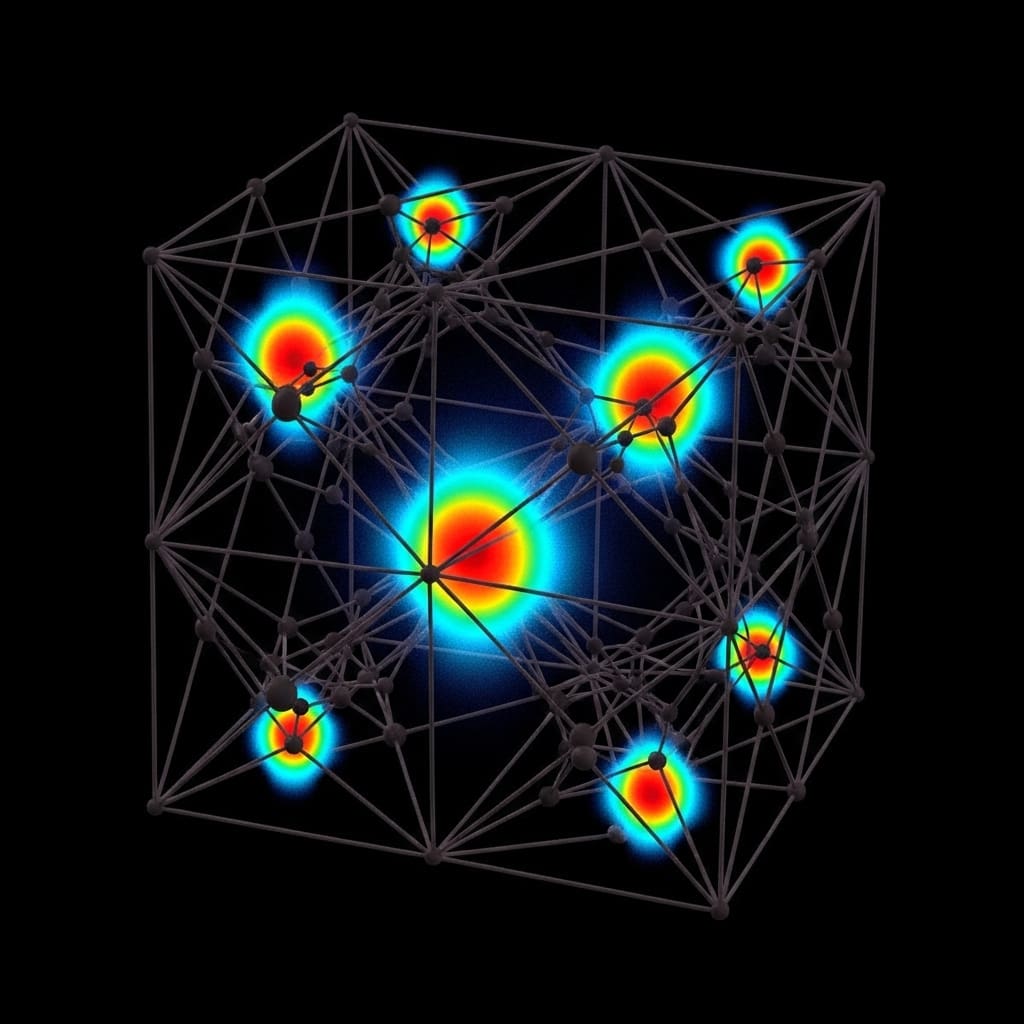
Researchers are increasingly focused on flat-band bound states in the continuum (BICs) due to their potential for revolutionary advances in photonics and non-Hermitian physics. Fuhuan Shen, Jiahao Ren, and Zhiyi Yuan, from Nanyang Technological University and the CNRS-International-NTU-Thales Research Alliance, alongside colleagues such as Kai Wu and Sai Yan, have now experimentally demonstrated polaritonic high-order BICs within a two-dimensional magnet , a significant step forward as realising truly flat-band BICs has proved challenging. Their work, utilising a van der Waals magnet called CrSBr, reveals strongly suppressed polaritonic angular dispersions and exceptionally high Q factors exceeding 1500, opening up new possibilities for designing robust and efficient optical devices and exploring fundamental light-matter interactions. This discovery highlights CrSBr as a prime material for next-generation optical technologies and a deeper understanding of flat-band polaritonics.
This discovery highlights CrSBr as a prime material for next-generation optical technologies and a deeper understanding of flat-band polaritonics.
CrSBr Metasurface Enables Polaritonic Bound States
This breakthrough reveals a novel platform for exploring advanced photonics and quantum technologies by harnessing the unique properties of this two-dimensional material. This was accomplished through the meticulous fabrication of a subwavelength (~λ/35) metasurface, carefully designed to interact with the material’s inherent excitonic properties. Experiments show that the team patterned CrSBr flakes into nanogratings, introducing diffractive coupling between propagating waves and creating both bright (guided mode resonance) and dark (BIC) modes. The research establishes CrSBr as an exceptional material for flat-band photonics and polaritonics, offering a pathway to overcome limitations found in conventional BIC implementations.
Previous demonstrations often suffered from degraded Q factors or restricted momentum ranges, but this work achieves a wide angular range for flat bands without increasing modal volume or working wavelengths. Scientists prove that the anisotropic direct-bandgap excitons in CrSBr, enhanced by magnetic ordering below the Néel temperature (132 K), are key to achieving this performance. The oscillator strength exceeds 1.5 (eV)2, with resonance sharpening to less than 1 meV, enabling the ultrastrong exciton-photon coupling observed. This work opens new avenues for advances in next-generation optical and quantum technologies, potentially impacting areas such as nonlinear optics, chiral sources, and magneto-optic applications. The ability to intrinsically tune metasurface photonic properties via CrSBr’s excitons provides a versatile platform for designing and fabricating advanced devices with unprecedented control over light-matter interactions.
CrSBr Metasurface Fabrication and Polaritonic BIC Realisation demonstrate
This work pioneers the realisation of flat-band BICs, crucial for advancements in non-Hermitian, nonlinear, and topological photonics, as well as device applications. Researchers exfoliated CrSBr flakes, ranging from 15nm to 35nm in thickness, and patterned them into nanograting Metasurfaces using a streamlined fabrication process, avoiding the need for conventional hard masks of metal or silicon nitride, thereby minimising surface residues. The team employed electron-beam lithography to define a ZEP photoresist pattern, subsequently utilising inductively coupled plasma (ICP) dry etching to transfer the pattern into the CrSBr flake, followed by O2/Ar plasma cleaning to remove any remaining residue. Experiments focused on transverse electric (TE) modes, aligning the electric field with the long axis of the grating bars and the b-axis of CrSBr, the magnetic easy axis.
Periodic nanostructures introduced diffractive coupling between propagating waves, splitting photonic modes into bright guided mode resonances (GMR) and dark BIC modes, a phenomenon further detailed in Supplementary Section A. To investigate exciton-polariton formation, scientists artificially modulated the exciton contribution, observing a significant energy shift in photonic modes when excitons were deactivated (f=0 eV²), reaching approximately 2.55 eV. Subsequently, activating the main excitons (f = 1.6 eV²) induced hybridization, forming upper and lower GMR/BIC polaritons described by a Hamiltonian incorporating photon-exciton interactions, with a coupling strength of 118 meV approaching 0.1ω, necessitating the inclusion of a fast-rotation term. Angle-resolved reflectance spectra, calculated via rigorous coupled-wave analysis (RCWA), revealed distinct behaviours; upper GMR-polaritons exhibited broad linewidths, while lower GMR-polaritons benefited from narrow excitonic linewidths of 0.85 meV. Conversely, upper BIC-polaritons vanished at normal incidence, broadening with increasing angle, while lower BIC-polaritons displayed suppressed angular dispersion and reduced linewidths, insights corroborated by calculated near-field distributions demonstrating symmetric coupling for GMR-polaritons and antisymmetric, radiation-inhibited behaviour for BIC-polaritons.
CrSBr Metasurface Yields High-Q Polaritonic Bound States
Researchers measured the energy of the main exciton in CrSBr to be approximately 1.3655 eV, with an oscillator strength of f = 1.6 eV and a linewidth of γ = 0.85 meV. These values are crucial for understanding the strong exciton-polariton interactions observed within the metasurface. Exfoliated CrSBr flakes, ranging from 15nm to 35nm in thickness, were patterned into nanograting metasurfaces to induce the desired photonic effects. The team studied transverse electric (TE) modes where the electric field aligns with the long axis of the grating bars, and the b-axis of CrSBr also aligns with this electric field configuration.
Experiments revealed that when excitons are artificially “turned off”, photonic modes appear at approximately 2.55 eV, creating a substantial detuning Δ greater than 1 eV between the photonic modes and the excitons. Upon activating the main excitons (f = 1.6 eV²), hybridization occurs, forming upper and lower polaritons, UPGMR/UPBIC and LPGMR/LPBIC, described by a Hamiltonian incorporating photon-exciton interactions. The coupling strength, g, was measured to be 118 meV, approaching 0.1ω, indicating the system is in the ultrastrong coupling regime. Data shows that upper polaritons exhibit a slight blue shift and similar angular dispersion to the original photonic modes, while lower polaritons demonstrate significantly suppressed angular dispersion due to dominant excitonic weight.
Angle-resolved reflectance spectra calculated using rigorous coupled-wave analysis (RCWA) confirmed these behaviours, with the UPGMR exhibiting a broad linewidth and the LPGMR showing a significantly reduced linewidth owing to the narrow linewidth of the main excitons (0.85 meV). Furthermore, the LPBIC exhibited strongly suppressed angular dispersion and a reduced linewidth, while the UPBIC manifested as a vanishing mode at normal incidence. Near-field distributions revealed that GMR-polaritons have symmetric distributions, coupling to radiation, while BIC polaritons exhibit antisymmetric distributions, preventing radiative coupling due to parity mismatch.,.
CrSBr Enables High-Q Flat-Band Polaritonic BICs for advanced
The research establishes CrSBr as a particularly effective material for exploring flat-band photonics and polaritonics, offering a pathway towards advancements in optical technologies. The observed flat-band BICs demonstrate exceptional robustness in resonant energies and Q factors, even with inclined incidence, surpassing the performance of traditional dispersive BICs and those achieved through energy band hybridization. The authors acknowledge that the formation of transverse magnetic modes is constrained by the subwavelength thickness and low permittivity of CrSBr. Future investigations could explore the nonlinear properties and polariton condensates within CrSBr structures, potentially overcoming limitations associated with bulky Fabry-Pérot cavities currently hindering device miniaturisation and integration. This work highlights the potential for manipulating light wavefronts and topological behaviours, opening avenues for integrating photonic, electronic, and magnetic properties within this promising platform.
👉 More information
🗞 Observation of polaritonic flat-band bound states in the continuum in a 2D magnet
🧠 ArXiv: https://arxiv.org/abs/2601.16790
