Researchers are now demonstrating new levels of control over light waves using specifically designed structures called kagome photonic crystals, or KPCs. Hai-Xiao Wang from Ningbo University, Li Liang from Nanjing University, and Junhui Hu from Guangxi Normal University, alongside their colleagues, have revealed that seemingly simple surrounding materials, or claddings, play a crucial role in manipulating these light waves. The team discovered that KPCs with specific symmetries behave similarly to materials exhibiting the quantum spin Hall effect, creating unique interface states, and that these states can be tuned by adjusting the geometry of the surrounding cladding material. This control extends even to corner states, typically associated with more complex topological phenomena, offering potential applications like rainbow trapping, where different wavelengths of light are separated, and highlighting a previously overlooked approach to manipulating light for advanced photonic devices.
Topological Photonics and Edge State Control
This research explores topological photonics, a rapidly developing field that harnesses concepts from condensed matter physics to control light in novel ways. Scientists are designing photonic structures with unique topological properties, allowing them to guide light along protected pathways at the edges of these materials. This approach builds on the principles of topological insulators and extends to higher-order topological insulators exhibiting states at corners or hinges. The work utilizes artificial materials like metamaterials and photonic crystals to precisely control light propagation, and investigates systems where gain and loss are introduced, leading to unusual phenomena.
A key goal is to create robust waveguides resistant to defects and bends, and to achieve directional isolation of light, ensuring it travels in only one direction. Early research focused on creating topologically protected waveguides, demonstrating their resilience to imperfections compared to conventional designs. Subsequent work explored higher-order topological insulators, realizing corner states and other exotic boundary modes. Scientists also investigated the interplay between non-Hermiticity and topology, discovering new phenomena like exceptional points and enhanced sensitivity. Metamaterials were utilized to engineer complex topological structures with tailored properties, and research extended to valley-Hall topological insulators, which exhibit unidirectional light propagation based on the photon’s valley index.
Recent advances include methods for dynamically tuning topological states using external stimuli, exploring multi-pole topological states, and integrating these structures with silicon photonics and microfluidic devices. Researchers are also investigating applications in sensing, signal processing, and optical computing, and utilizing machine learning to optimize topological photonic designs. The research employs photonic crystals, periodic structures that control light flow, and metamaterials, artificial materials with properties not found in nature. Silicon photonics provides a platform for integrated photonics, while dielectric metamaterials offer low loss and high performance.
Graphene and other two-dimensional materials serve as building blocks for these structures. Potential applications include robust waveguides and optical interconnects for reliable communication, new architectures for optical computers, highly sensitive sensors, advanced signal processing functions, optical isolators and circulators for controlling light flow, and utilizing topological states for quantum information processing. This work demonstrates the potential of topological principles to revolutionize photonic devices, paving the way for new applications in communication, computing, sensing, and beyond.
Kagome Crystals Control Topological Interface States
Scientists engineered a system to investigate how crystalline symmetry and topological photonic states interact, focusing on kagome photonic crystals (KPCs). They pioneered a method utilizing two distinct KPC configurations, one with six-fold symmetry and another with three-fold symmetry, to create topologically contrasting structures. The six-fold symmetric KPCs exhibit a spin Hall effect, while the three-fold symmetric KPCs function as a tunable cladding layer. Researchers then constructed domain walls by combining these KPCs, allowing precise control over the topological interface states formed at their boundary.
To characterize these interface states, the team employed a Fourier-transformed electromagnetic field scanning method, directly measuring their dispersions and comparing them with simulations. This technique revealed a gap in the dispersion originating from symmetry breaking at the boundary, which was then analyzed to understand the spin Hall nature of the system. Scientists visualized the phase profiles of the electromagnetic field and mapped the Poynting vectors, demonstrating finite orbital angular momenta and opposite angular momenta for opposite wavevectors, confirming the pseudospin-momentum locking effect. Further investigation involved quantifying the frequency difference between odd- and even-parity interface states using a Dirac mass parameter, allowing researchers to track changes in the topological properties.
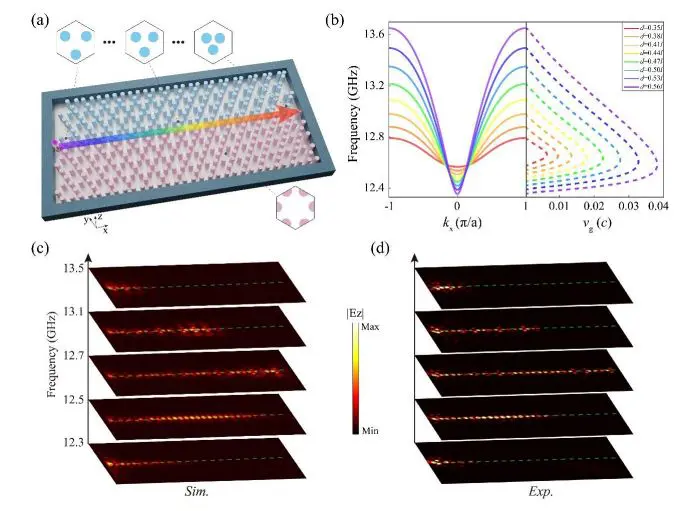
By continuously tuning the geometric parameter of the cladding, the team observed a topological phase transition, evidenced by a gap in the interface state dispersion closing and reopening. This transition was confirmed through both simulations and experiments, demonstrating the critical role of the cladding in manipulating the topological interface states. The team then designed a graded structure where the cladding’s geometric parameter varied along the interface, reshaping the dispersion and enabling spatial separation of different frequency components, paving the way for potential applications in topological rainbow trapping.
Kagome Crystals Reveal Cladding’s Topological Control
Scientists have demonstrated a novel approach to manipulating light flow within specially designed photonic crystals, structures that control light in ways similar to semiconductors controlling electrons. The research centers on kagome photonic crystals (KPCs), exhibiting unique properties based on their crystalline symmetry, and reveals how seemingly insignificant cladding layers surrounding these crystals play a crucial role in controlling topological states of light. The team fabricated KPCs with three distinct primitive cell configurations and characterized their topological properties. Measurements confirm that two of these configurations possess identical band structures, yet differ in their topological characteristics, while the third is classified as a trivial insulator.
Experiments reveal that by carefully adjusting the geometry of the cladding, scientists can effectively tune the properties of topological interface states. Specifically, the team observed a continuous change in the frequency gap size of these states, demonstrating a direct link between the cladding geometry and the behavior of light. The team quantified this effect by measuring the Dirac mass, representing the frequency difference between the upper and lower topological interface states, and found that it is critically dependent on the cladding’s geometry. Further investigation revealed the emergence of corner states, hallmarks of higher-order topology, which can be manipulated by modifying the outer cladding.
The team demonstrated that these corner states can merge into or emerge from the bulk states simply by changing the cladding’s geometry. Measurements of the phase profiles and Poynting vectors of the topological interface states confirm a spin Hall effect, with opposite angular momenta observed for opposite wavevectors, and the presence of phase vortices. These findings demonstrate a new level of control over light propagation and offer potential applications in areas such as rainbow trapping, where light of different wavelengths is spatially separated.
Cladding Controls Topological Photonic Dispersion and States
This research demonstrates the crucial role of seemingly passive materials, specifically trivial claddings, in manipulating topological photonic systems. Scientists successfully created kagome photonic crystals with differing symmetries, identifying one configuration that supports a quantum spin Hall phase with pseudospin-dependent interface states. By employing a second crystal symmetry as a trivial cladding, they discovered that the dispersion of these interface states can be effectively tuned by simply adjusting the cladding’s geometric parameters, potentially enabling applications such as topological rainbow trapping. Furthermore, the team observed that corner states, a hallmark of higher-order topology, can be merged into or emerge from the bulk states through modifications to the outer cladding. These findings reveal that claddings are not merely supportive elements, but indispensable design parameters for creating reconfigurable topological photonic systems and offer a novel approach to manipulate topological boundary states.
🗞 Manipulation of photonic topological edge and corner states via trivial claddings
🧠 ArXiv: https://arxiv.org/abs/2511.18705