Understanding how light propagates through materials is fundamental to advances in photonics, yet conventional models struggle to accurately describe behaviour in complex, non-ideal scenarios. Maxim Durach and David Keene, both from Georgia Southern University, address this challenge by extending the established framework of Fresnel wave surfaces to encompass near-field effects and the behaviour of light in materials that absorb, amplify, or exhibit non-reciprocity. Their work reinterprets near fields as ‘off-shell’ electromagnetic modes, revealing a direct link between the broadening of photonic density of states and the familiar law governing light attenuation or amplification. This unified approach not only bridges the gap between how light originates from sources and how it radiates outwards, but also provides a powerful new tool for designing advanced photonic devices relevant to technologies such as next-generation communications and engineered materials.
Om-Potential Unifies Near and Far Fields
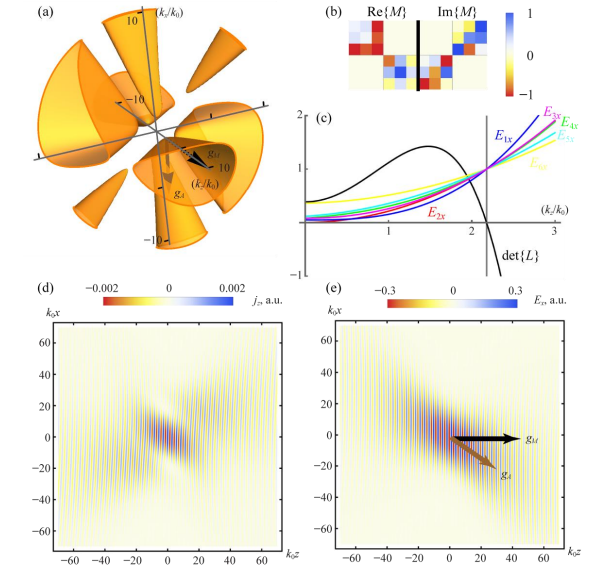
This work presents a theoretical framework that extends the classical understanding of Fresnel wave surfaces to encompass near-field electromagnetics and the behavior of materials with unusual properties, such as those exhibiting loss, gain, or non-reciprocity. Researchers reinterpret near fields as ‘off-shell’ electromagnetic modes, drawing an analogy to concepts from quantum field theory, allowing for a unified description of light behavior across different regimes. The study employs the ‘Om-potential’ approach to macroscopic electromagnetism, a technique that facilitates the analysis of complex electromagnetic phenomena in anisotropic media. Scientists demonstrate that the photonic density of states exhibits Lorentzian broadening near Fresnel surfaces in non-reciprocal materials, directly linking this effect to the Beer-Bouguer-Lambert law governing exponential attenuation or amplification of light.
This connection provides a fundamental understanding of how light intensity changes as it travels through these materials, and reveals how the Abraham and Minkowski momenta, traditionally associated with far-field radiation, characterize source structures in the near-field. To achieve these results, researchers developed a theoretical framework that bridges the gap between sources and radiation, on-shell and off-shell modes, and reciprocal and non-reciprocal responses. This unified treatment allows for a comprehensive analysis of structured light, paving the way for innovative designs of emitters and metamaterial platforms with direct implications for emerging technologies, including 6G communications, photonic density-of-states engineering, and non-Hermitian photonics.
Near-Field Light Propagation and Density of States
Scientists have developed a framework that extends the understanding of how light propagates through materials with unusual properties, such as those exhibiting loss, gain, or non-reciprocity. This work builds upon the established concept of Fresnel wave surfaces and expands its applicability to more complex scenarios, successfully linking near-field light as “off-shell” electromagnetic modes to the Beer-Bouguer-Lambert law. Experiments reveal that in non-reciprocal media, the distribution of photonic density of states acquires a Lorentzian broadening near the Fresnel surfaces, directly connected to the material’s ability to either absorb or amplify light. Measurements confirm that this broadened distribution arises from the interplay between the material’s properties and the direction of light propagation, providing a fundamental link between light shells and the density of states in momentum space.
The research demonstrates that materials with gain exhibit a negative photonic density of states, implying that the electromagnetic field returns power to the source, while lossy materials show a positive density of states, indicating power dissipation. Specifically, calculations show that the width of the broadened photonic density of states is proportional to the imaginary part of the refractive index, linking the broadening to direction-dependent Beer-Bouguer-Lambert extinction or amplification of electromagnetic waves. This framework provides a unified description of sources and radiation, on-shell and off-shell modes, and reciprocal and non-reciprocal responses, offering new tools for designing advanced photonic devices for applications such as 6G communications and non-Hermitian photonics.
Fresnel Surfaces Describe Non-Reciprocal Wave Propagation
This research extends the established framework of Fresnel wave surfaces to encompass electromagnetic wave propagation in more complex media, including those exhibiting loss, gain, or non-reciprocity. Scientists successfully demonstrated that by interpreting near-field electromagnetic interactions as deviations from standard wave behavior, a unified description of light propagation can be achieved, bridging the gap between source characteristics and radiated fields. The team showed that in non-reciprocal materials, the photonic density of states broadens near Fresnel surfaces, exhibiting a Lorentzian shape directly linked to the Beer-Bouguer-Lambert law. This broadening of the photonic density of states provides a fundamental connection between material properties and light behavior, revealing that non-reciprocity introduces a quantifiable shift in how light interacts with a medium.
Importantly, the research establishes that this framework accurately predicts energy exchange between light and matter, demonstrating that gainful materials can return power to the source, a phenomenon directly reflected in a negative photonic density of states. The authors acknowledge that their analysis relies on certain approximations and that further investigation is needed to fully explore the implications for complex material structures. Future work could focus on applying this understanding to the design of advanced photonic devices, including those for next-generation communication technologies and engineered materials with tailored optical properties.
🗞 Beyond Fresnel Wave Surfaces: Off-Shell Photonic Density of States and Near-Fields in Isotropy-Broken Materials with Loss or Gain
🧠 ArXiv: https://arxiv.org/abs/2509.17320