

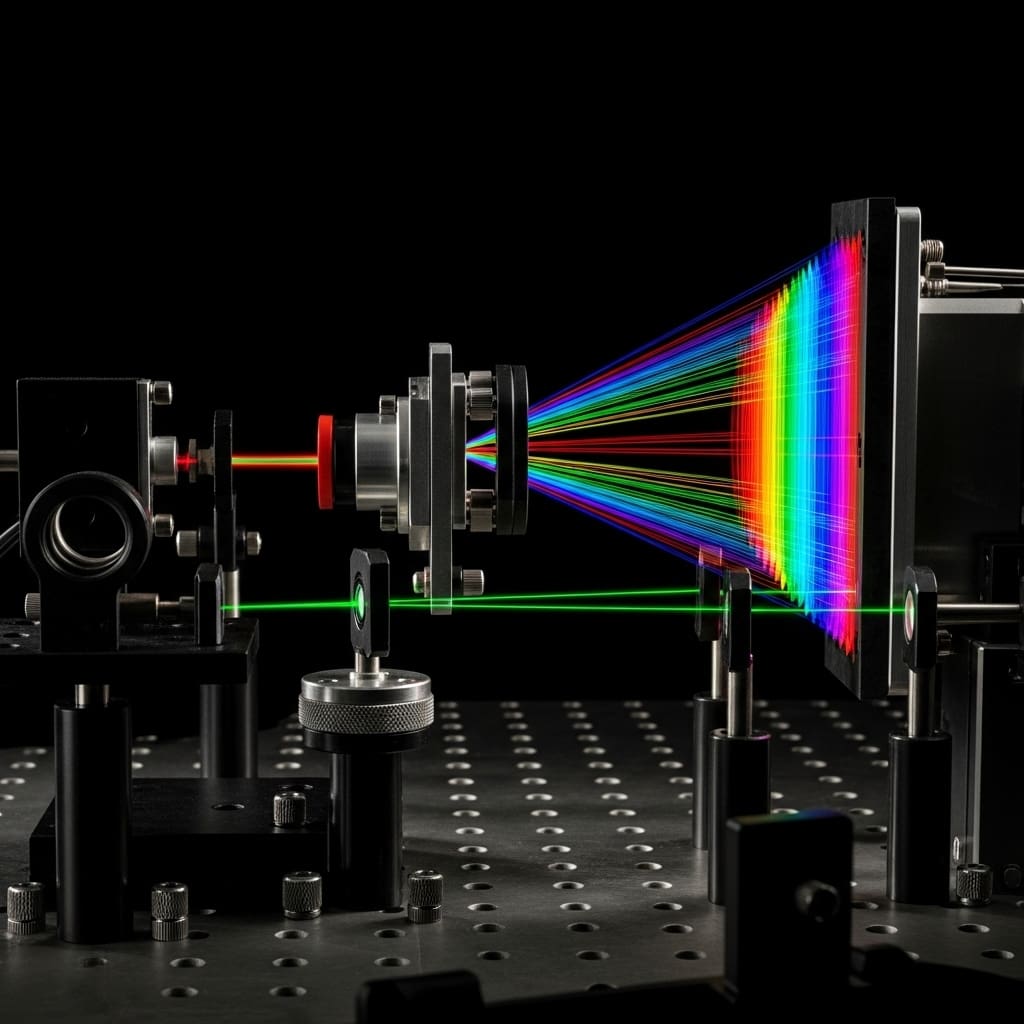
Scientists are increasingly focused on generating complex states of light for advancements in quantum communications and computing! Cody Charles Payne, Elaganuru Bashaiah, and Markus Allgaier, all from the Department of Physics and Astrophysics at the University of North Dakota, demonstrate a novel protocol utilising nonlinear interferometry with linear spectral phases to achieve precise control over spectral correlations, a significant hurdle in the field! Their research details how this technique can generate both high-dimensional spectral qudits and entangled states, modelling the impact of optical loss to maintain interference visibility and state fidelity! This work represents a crucial step towards building more robust and sophisticated quantum technologies.
The study, published recently, details a method for engineering complex quantum states essential for advancements in quantum cryptography, communications, and computing. This work addresses a significant challenge in the field, achieving fine-grained control over spectral correlations, a crucial element for high-dimensional quantum information processing.
The team’s approach centers on a nonlinear interferometer consisting of four nonlinear crystals arranged in series. Crucially, the researchers implemented a system where time delays are applied to the pump, signal, and idler photons independently at each crystal. This allows for the application of linear spectral phases, enabling the creation of both high-dimensional entangled states and grid states suitable for generating spectral qudits. By carefully selecting these time delays, the interferometer can be configured to produce either entangled states with approximately Gaussian spectral modes or grid states that, upon post-selection, yield superposition states for spectral qudits, expanding the ‘alphabet’ available for quantum protocols beyond traditional path and polarization degrees of freedom.
Experiments and simulations reveal that this scheme offers greater versatility than previous methods, which often rely on more complex fabrication processes like domain engineering or Fabry-Perot cavities. The researchers meticulously modeled the impact of photon loss and imperfect overlap on interference visibility, demonstrating how these factors affect the purity of the generated quantum states. Their analysis shows that loss, a common issue in real-world implementations, can significantly alter the spectral mode decomposition of the states produced by the interferometer. Understanding and mitigating these effects is vital for building practical quantum technologies.
This research establishes a pathway towards creating more robust and scalable quantum systems. The ability to generate high-dimensional entangled states and spectral qudits with a relatively simple and reconfigurable setup opens exciting possibilities for advanced quantum communication protocols and quantum computation. Specifically, the team’s scheme generates entanglement in a basis of approximately Gaussian spectral modes, offering a balance between state quality and implementation complexity. The work opens avenues for exploring new quantum algorithms and enhancing the security of quantum communication networks, potentially revolutionizing data transmission and processing in the future.
Spectral Qudit and Entanglement Generation via NLI represent
Scientists engineered a nonlinear interferometer (NLI) to generate both high-dimensional spectral qudits and entangled states, addressing the challenge of controlling spectral correlations inherent in such systems! The research team developed a protocol utilising four nonlinear crystals arranged in series, applying time delays to pump, signal, and idler photons independently at each crystal to precisely manipulate the generated quantum states. This innovative approach allows for the creation of high-dimensional entanglement (HDE) states with approximately Gaussian spectral modes, or grid states suitable for post-selection into spectral qudits, all achieved using only linear spectral phases. The study pioneered a method for modulating the joint spectrum of photon pairs by controlling interference within the NLI; each crystal facilitates a pair generation process, and the indistinguishability between crystals induces interference.
Researchers calculated the interaction Hamiltonian for collinear spontaneous parametric down conversion, represented as HSPDC(t) = ħg Z L 2 −L 2 dz Z dωsdωidωp α(ωp) β(ωp, ωs, ωi) ei(ωp−ωs−ωi)t ei(ks+ki−kp)z a† ωsa† ωiaωp, to model the process. Subsequently, the team determined the corresponding unitary U through time integration of HSPDC(t), resulting in the equation: Z tf t0 dt HSPDC(t) = Z L/2c −L/2c dt HSPDC(t) = ħκ Z dωpdωsdωi α(ωp) β(ωp, ωs, ωi) sinc ∆kL 2 × sinc (ωp −ωs −ωi)L 2c ei ∆kL 2 ei ∆ωL 2c a† ωsa† ωiaωp. Experiments employed simulations to demonstrate the scheme’s functionality and assess its feasibility for laboratory implementation. The team meticulously modelled the effect of photon loss on the modal purity of the generated states, a factor often overlooked in previous analyses.
Specifically, the work analysed how loss affects interference visibility and, consequently, the quality of the spectral modes, revealing that loss can significantly diminish the purity of the entangled states. This detailed analysis provides crucial insights for optimising the experimental setup and mitigating the impact of real-world imperfections. Furthermore, the research highlights a trade-off in the HDE state generation; while achieving approximately Gaussian spectral modes, the scheme necessitates type-II phase matching, which slightly reduces the joint spectral intensity along the −45◦ axis. Despite this limitation, the NLI scheme offers a versatile solution for generating both HDE and grid states, surpassing previous methods by enabling fully arbitrary modulation of the joint spectrum with only linear spectral phases, a significant advancement in quantum state engineering.
High-dimensional qudits via spectral phase control offer enhanced
Scientists have demonstrated a novel protocol for generating high-dimensional spectral qudits and entangled states using a nonlinear interferometer with precisely controlled linear spectral phases! The research, detailed in a new study, focuses on manipulating spectral correlations to achieve a high degree of control over complex states of light, a crucial requirement for advanced quantum communications and computing protocols. Experiments revealed that careful implementation of this protocol allows for the creation of states with tailored spectral properties, opening avenues for more efficient quantum information processing. The team measured the effects of photon loss and spectral overlap on interference visibility, directly impacting the quality of the generated high-dimensional entangled (HDE) states.
Results demonstrate a quantifiable diminishment in HDE state quality due to these factors, a critical consideration for practical applications. Specifically, the study models the interaction Hamiltonian for collinear spontaneous parametric down conversion, defined as HSPDC(t) = ħg Z L 2 −L 2 dz Z dωsdωidωp α(ωp) β(ωp, ωs, ωi) ei(ωp−ωs−ωi)t ei(ks+ki−kp)z a† ωsa† ωiaωp, to understand the underlying physics of the process. This Hamiltonian governs the creation of entangled photon pairs within a nonlinear crystal of length L, with a coupling amplitude g. Further analysis involved calculating the time integral of HSPDC(t), yielding a crucial expression: Z tf t0 dt HSPDC(t) = ħκ Z dωpdωsdωi α(ωp) β(ωp, ωs, ωi) sinc ∆kL 2 × sinc (ωp −ωs −ωi)L 2c ei ∆kL 2 ei ∆ωL 2c a† ωsa† ωiaωp, where κ = iΩL c.
This equation describes how the spectral amplitudes of the daughter photons are distributed, defining the joint spectral amplitude (JSA). Scientists recorded that the spectral purity of the generated states can be quantified by the Schmidt number, K, calculated as K = 1 P k |ck|4 = 1 Tr (ρ2), where ρ represents the density matrix of the joint spectral state. The work establishes that the general modulated joint spectral state, JSA(ωs, ωi), is directly proportional to the product of the unmodulated JSA0(ωs, ωi) and a modulation term β(ωs, ωi). Researchers defined JSA0 as α(ωs + ωi) sinc ∆kL 2 ei ∆kL 2, representing the joint spectrum without the modulation term. By carefully selecting phase factors, φ(μ) j (ωj) = K(μ) j (ωj)l(μ) j + kj(ωj)L, for each crystal in a series of N crystals, the team demonstrated control over the spectral properties of the entangled photons. The modulation factor β(μ) is expressed as a product of exponential terms, each representing the phase accumulated by photons passing through individual crystals, enabling precise tailoring of the generated quantum states.
Spectral Qudits and Entanglement via Interferometry
Scientists have developed a new protocol using a nonlinear interferometer with linear spectral phases to generate both high-dimensional spectral qudits and high-dimensional entangled states of photons! This approach offers a viable method for engineering complex states of light, addressing a key challenge in quantum technologies. The research demonstrates the creation of grid states and high-dimensional entangled (HDE) states through careful manipulation of spectral properties. The findings establish that frequency-resolving postselection on one photon of a grid state yields a multi-peaked spectral state on its paired photon, approximating a superposition of Gaussian spectra, a characteristic of spectral qudits useful in quantum computing!
Simultaneously, the same scheme generates HDE states by modulating a joint spectrum, potentially enabling high-dimensional quantum teleportation and signal multiplexing for increased photon bit rates. Numerical analysis revealed that projective measurement on the signal photon provides robustness against loss, although ancillary fringes become more prominent with increasing loss. The authors acknowledge that the behaviour of the generated states is affected by loss and imperfect overlap, which can degrade interference visibility! They observed that while loss impacts individual spectral modes differently, the projected state remains relatively robust, though with the appearance of additional fringes. Future research could explore the practical implementation of this protocol in real-world quantum communication and computing systems, as well as investigate the potential of these states in foundational quantum experiments.
👉 More information
🗞 State Engineering via Nonlinear Interferometry with Linear Spectral Phases
🧠 ArXiv: https://arxiv.org/abs/2601.12173


