

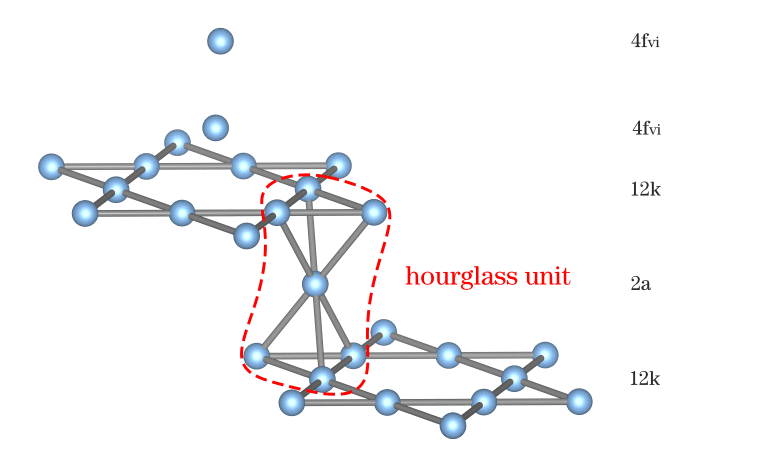
The behaviour of magnetic materials at extremely low temperatures provides crucial insights into their fundamental properties, and recent work by Siyu Zhu, Arthur P Ramirez, and Sergey Syzranov, all from the University of California, Santa Cruz, explores this phenomenon in geometrically frustrated magnets. These materials, where competing magnetic interactions prevent a simple ordering of spins, often exhibit unusual thermal behaviour, and the team’s research focuses on the entropy released as these materials cool. By simulating the entropy of higher-spin triangular-lattice systems and comparing these results with experimental data from strongly frustrated compounds, including SCGO and SCGO/BSZCGO, the researchers demonstrate that the lowest-energy states in these materials can be accurately described using a model based on doublet states. This achievement provides a new understanding of the structure of low-energy magnetic states in geometrically frustrated compounds and highlights the importance of precise measurements in this challenging field of materials science.
A prominent peak arises from spin states continuously connected to the ground states of classical models, such as the Ising model, on geometrically frustrated lattices. This peak manifests in the amount of entropy associated with observed heat capacity. This work numerically simulates the entropy released by higher-spin triangular-lattice layered systems and materials on spin-charge ordered (SCGO) lattices, then compares these theoretical values with experimentally measured entropy in strongly geometrically frustrated compounds, including NiGa2S4, FeAl2Se4 and SCGO/BSZCGO. This comparison suggests a connection between the lowest-energy states and the behaviour predicted by classical models of geometrically frustrated magnetism.
Triangular Lattice Ising Model Ground-State Entropy Calculation
Scientists have precisely calculated the ground-state entropy of the antiferromagnetic Ising model on a triangular lattice using advanced computational techniques. This calculation is crucial for understanding the fundamental properties of this model system and provides a benchmark for future studies. The team carefully justified their choice of periodic boundary conditions, ensuring the accuracy of their results by avoiding artificial effects and simulating a more realistic material. They obtained a ground-state entropy value of 0. 435854, closely matching previous findings obtained through different methods, confirming the reliability of their approach and strengthening our understanding of this complex system.
Entropy Release Reveals Spin State Arrangement
Scientists have achieved precise measurements of entropy release in insulating magnetic materials, revealing crucial information about the arrangement of their internal spin states. This work focuses on geometrically frustrated (GF) magnetic compounds, materials where competing magnetic interactions prevent simple ordering, leading to complex and potentially useful magnetic properties. Researchers simulated entropy values for systems with higher-spin arrangements on both triangular and SCGO lattices, then compared these theoretical predictions with experimentally measured entropy in several strongly frustrated compounds. Through extensive simulations, scientists calculated a ground-state entropy value, demonstrating convergence with increasing system size and providing a reliable estimate for the thermodynamic limit. These calculations allow for a direct comparison with experimental data, enabling researchers to identify effective degrees of freedom and potential structures of low-energy states within these GF compounds. The results suggest that the lowest-energy states in higher-spin layered triangular-lattice compounds can be effectively described using doublet states on individual magnetic sites.
Higher-Spin Magnets Mimic Simpler Interactions
This research successfully connects the amount of entropy released when cooling insulating magnetic materials to the properties of their internal spin states. By numerically simulating and comparing entropy values in geometrically frustrated compounds, scientists have gained insight into the behaviour of these complex materials. The team demonstrated that in higher-spin triangular-lattice compounds, such as nickel gallium sulfide and iron aluminium selenide, the measured entropy aligns with the behaviour of effective spin-1/2 degrees of freedom. This suggests that despite the materials possessing higher spins, their low-energy states behave as if governed by simpler spin-1/2 interactions, potentially arising from interactions like spin-orbit coupling and single-ion anisotropy. Further analysis extended to SCGO-type compounds, revealing good agreement between theoretical predictions and experimental measurements of entropy, provided a fraction of the material’s spins are considered free. However, measurements from barium chromium gallium oxide showed a discrepancy, with observed entropy exceeding theoretical expectations, indicating a need for further investigation into the material’s behaviour.
👉 More information
🗞 Low-temperature entropies and possible states in geometrically frustrated magnets
🧠 ArXiv: https://arxiv.org/abs/2511.02899


