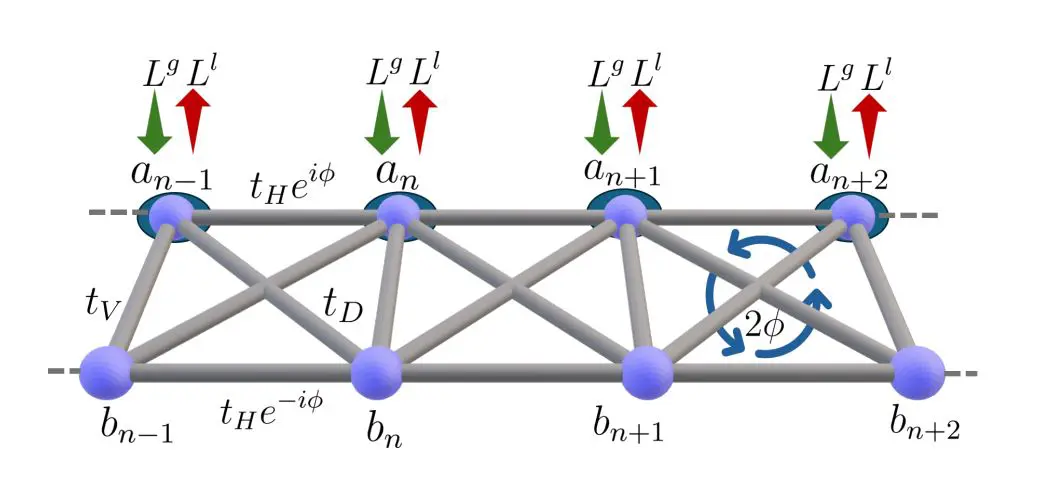
Controlling energy dissipation in topological systems represents a significant challenge in modern physics, with potential applications in robust information transfer and novel device design. Koustav Roy, Shahroze Shahab, and Saurabh Basu, from the Indian Institutes of Technology Guwahati and the National Institute of Technology Rourkela, now demonstrate a method for actively manipulating these dissipative dynamics. Their research focuses on how precisely timed, periodic driving, a technique known as Floquet driving, reshapes the behaviour of topological materials, specifically a model system called a Creutz ladder. The team reveals that this driving force induces a transition in the way energy dissipates within the material, creating a pathway to identify and isolate long-lived edge states, robust modes of energy transport that are crucial for topological applications, and offering a new tool for diagnosing the material’s unique properties.
The research investigates excitations expected to exhibit decay rates distinct from the bulk material. It proposes an efficient dynamical scheme to discern such long-lived excitations, employing a theoretical framework to explore how periodic driving reshapes the key features of a Creutz ladder, a model system for understanding chiral fermions. The results demonstrate a drive-induced transition in the Liouvillian skin effect, dynamically manifesting as a crossover from chiral to helical damping. This transition effectively rescales the bulk localization length, giving rise to a polarization drift that the researchers identify as a new invariant for efficient diagnosis of the nontrivial phases.
Drive-Induced Topological Transition in Creutz Ladders
Scientists are actively exploring the dynamics of open quantum systems, particularly those exhibiting topological properties. This work presents a new dynamical scheme to identify long-lived excitations, employing a theoretical approach to investigate how periodic driving alters the behavior of a Creutz ladder, a model system for chiral fermions. Results demonstrate a drive-induced transition in the Liouvillian skin effect, dynamically manifesting as a crossover from chiral to helical damping. This transition effectively rescales the bulk localization length, leading to a polarization drift that serves as a new invariant for diagnosing the nontrivial topological phases.
As the transition becomes more gradual through precise tuning of drive parameters, researchers uncovered signatures of scale-free localization, where both skin-localized and extended modes coexist with distinct decay rates. The emergent hierarchy of these decay rates yields two disparate timescales: a rapidly emptying chiral wavefront propagating through the bulk, followed by a long-lived regime dominated by robust edge modes. Measurements confirm that this dynamic control allows for the isolation of boundary modes from skin-localized bulk modes during the system’s transient evolution. Specifically, the team observed that increasing the drive strength induces a transition from unipolar to bipolar localization, accompanied by a reversal of eigenstate polarization.
Quantitative analysis reveals that the drive-renormalized localization length exhibits periodic modulation and divergences at points of skin suppression. These findings demonstrate that periodic driving serves as a powerful tool to manipulate dissipative topological phases and dynamically isolate boundary modes, opening new avenues for controlling quantum systems far from equilibrium. The research establishes a route for synthesizing robust topological edge modes via a drive-induced polarization drift, enabling state-selective decay and directional information transfer.
Reshaping Damping Reveals Topological Phase Transitions
Researchers have demonstrated a new method for identifying and manipulating non-hermitian topological phases in open quantum systems. By employing a specific dynamical approach involving periodic driving, the team successfully reshaped the characteristics of a topological model, revealing a crossover between different damping behaviours. This reshaping effectively alters the localization length of states within the system, leading to a measurable polarization drift that serves as a robust indicator of the underlying topological phase. The study further reveals the emergence of scale-free localization, where both skin modes and extended states coexist with distinct decay rates. This results in a hierarchy of timescales, characterized by a rapid emptying of the bulk of the system followed by a long-lived regime dominated by robust edge modes. These findings demonstrate that periodic driving provides a powerful means of controlling dissipative topological systems and dynamically isolating boundary modes.
🗞 Controlling Dissipative Topology Through Floquet Driving: From Transient Diagnostics to Boundary States Isolation
🧠 ArXiv: https://arxiv.org/abs/2511.23229