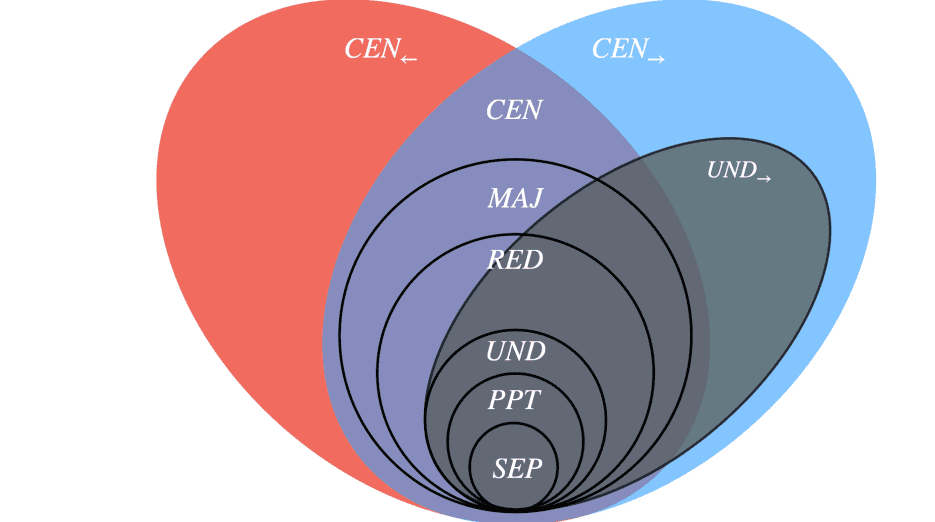
Entanglement, a uniquely quantum phenomenon, fundamentally limits how much correlation multiple parties can share, a principle known as the monogamy of entanglement. Junhyeong An and Soojoon Lee, from the Korea Institute for Advanced Study, alongside their colleagues, investigate the converse of this principle, demonstrating that weak entanglement between two parties actually enforces strong entanglement with a third. Building on previous work that identified specific conditions for this converse monogamy of entanglement, the team extends these notions to encompass a broader range of scenarios, and crucially proves that these extensions represent the maximum possible limits within established theoretical hierarchies. This achievement significantly advances understanding of entanglement’s fundamental properties and refines the boundaries of how quantum correlations can be distributed among multiple parties.
Entanglement Redistribution in Multi-Particle Systems
Scientists are deepening our understanding of quantum entanglement, a phenomenon where multiple particles become linked in a way that transcends classical physics. This research focuses on the Complementary Monogamy of Entanglement (CMoE), which describes how entanglement is distributed among multiple parties. Entanglement, a fragile resource, cannot be freely shared; if two particles are strongly entangled, it limits the extent to which they can also be entangled with a third. By carefully examining separability criteria, scientists aim to understand how entanglement is constrained and redistributed within a system.
Researchers investigated the relationship between different measures of entanglement, establishing a hierarchy of criteria to determine the strength of entanglement between quantum states. This detailed analysis provides a clearer picture of how entanglement is distributed and constrained within a system, revealing the underlying structure of entanglement collapse. This work revisits and unifies previously known forms of the CMoE, providing a more general framework for understanding entanglement distribution. The team determined the maximal ways in which the CMoE can be extended within this hierarchy, providing a foundation for future investigations into the complex interplay of entanglement in multi-particle systems.
Tripartite Entanglement and Converse Monogamy Limits
Scientists have made a significant advancement in understanding quantum entanglement, specifically extending the concept of converse monogamy of entanglement (CMoE). This research builds upon the established principle that entanglement shared between multiple particles is subject to constraints not found in classical systems. Researchers reconstructed and generalized existing formulations of the CMoE within an extended hierarchical framework, progressively refining the conditions under which it applies. The team investigated the relationship between weak and strong entanglement in three-particle quantum states, establishing conditions where weak entanglement between two parties necessitates strong entanglement with the remaining party.
They meticulously defined a hierarchy of bipartite entanglement based on nine separability criteria, allowing for a precise comparison of entanglement strength between quantum states. Through explicit examples, scientists demonstrated that their generalized formulations represent the maximal extensions of the CMoE, clarifying the boundary beyond which the principle no longer holds. This work provides a more complete understanding of how entanglement is distributed in multipartite systems, offering insights crucial for advancing quantum information processing tasks such as teleportation, superdense coding, and cryptography.
Entanglement Hierarchy Defines Converse Monogamy Limits
Scientists have significantly advanced our understanding of entanglement, a fundamental quantum phenomenon, by extending the concept of converse monogamy of entanglement (CMoE). This research demonstrates that weak entanglement between two parties in a multi-party quantum system necessitates strong entanglement with a third party, but only under specific conditions. Building upon earlier work, this study broadens these conditions and establishes the maximal extent of this relationship using a defined hierarchy of bipartite entanglement criteria. The team rigorously proved that their extensions of the CMoE represent the furthest possible reach within the considered hierarchies.
They achieved this by carefully examining various separability criteria, which characterize the strength of entanglement between quantum systems, and mapping their relationships to one another. This detailed analysis allows for a precise understanding of how entanglement is distributed within a system and how weakness in one connection implies strength in another. The authors acknowledge that resolving the reverse of certain implications within their entanglement hierarchy remains an open question, representing a limitation of the current work. They suggest that future research could focus on exploring this issue further and continuing to investigate the boundaries of entanglement distribution. This work provides a solid foundation for continued investigation into the complex interplay of entanglement in multi-party quantum systems and its implications for quantum technologies.
👉 More information
🗞 Maximal extension on converse monogamy of entanglement for tripartite pure states
🧠 ArXiv: https://arxiv.org/abs/2510.27264