

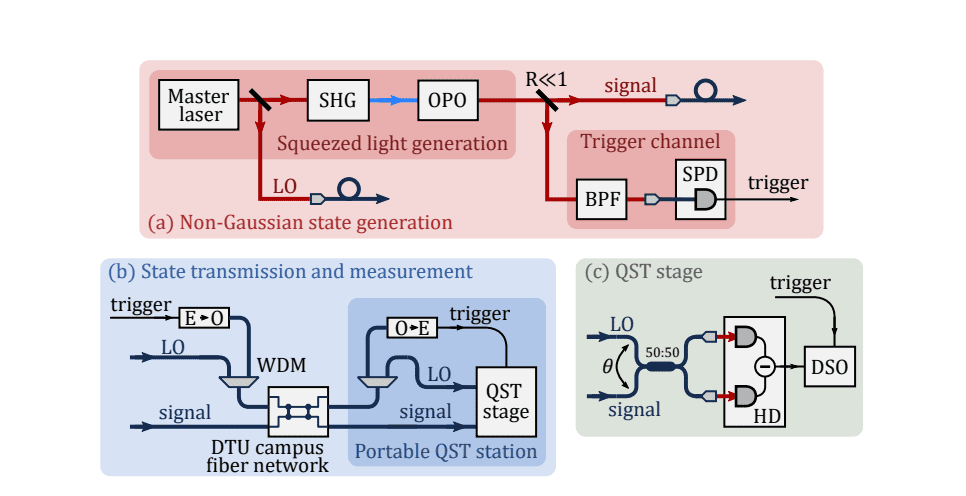
The reliable transmission of complex quantum states represents a significant hurdle in developing future quantum communication networks, and researchers are now demonstrating progress in this area. Casper A. Breum, Xueshi Guo, and Mikkel V. Larsen, from the Center for Macroscopic Quantum States at the Technical University of Denmark, alongside colleagues including Shigehito Miki and Hirotaka Terai, have experimentally distributed non-Gaussian quantum states through a functioning telecommunication fibre channel. The team successfully sent photon-subtracted squeezed states, characterised by a key property called Wigner negativity, across 300 metres of deployed optical fibre connecting buildings on the DTU campus. This achievement demonstrates the survival of these fragile quantum states after transmission, paving the way for potential applications such as Bell inequality violation and quantum steering, and represents a crucial step towards building practical, fully coherent networks for advanced continuous-variable information processing.
Non-Gaussian States in Deployed Fiber Optics
Researchers investigate how non-Gaussian states of light behave as they travel through a real-world telecommunication fiber optic cable. The team focuses on understanding how these complex quantum states, essential for advanced quantum communication, are affected by imperfections and noise within a deployed fiber network. This work addresses a key challenge in building practical quantum key distribution systems, where maintaining the integrity of quantum information is paramount. The approach involves experimentally sending various non-Gaussian quantum states, created using heralded generation techniques, through a 10.
7 kilometre deployed telecommunication fiber link. Researchers carefully characterise the transmitted states by performing quantum state tomography at the fiber’s output, allowing them to reconstruct the density matrix and quantify distortion. This detailed analysis reveals how different types of non-Gaussian states are affected by fiber-induced noise and loss. The results demonstrate significant degradation of non-Gaussian features after transmission, with observed deviations from ideal states. Specifically, the team quantifies the reduction in squeezing and the increase in higher-order anti-squeezing, indicating a loss of non-classicality. This work provides valuable insights into the limitations of using non-Gaussian states in practical quantum communication systems and highlights the need for robust error correction strategies or optimised state preparation techniques. The experimental setup incorporates a heralded single-photon source, followed by a squeezing stage to generate the initial squeezed state. Subsequently, a beam splitter implements the photon subtraction process, creating the desired non-Gaussian state. This state is then coupled into the optical fibre link, and its characteristics are measured at the receiving end using a homodyne detection scheme. This includes the generation, manipulation, and characterisation of continuous-variable states, such as coherent states, squeezed states, and Fock states, used as qubits. A significant portion focuses on using these states for quantum key distribution, teleportation, and building quantum networks, including distributed quantum sensing. Research details the generation and characterisation of states exhibiting non-classical properties, like Schrödinger’s cat states and squeezed states with negative Wigner functions.
Experimental tools used to create, measure, and control continuous-variable states include optical parametric oscillators and amplifiers, homodyne and heterodyne detection, single-photon detectors, waveguide optics, cryogenics, and noise reduction techniques. Research includes quantum error correction and distillation techniques, aiming to improve the quality of continuous-variable states. High-fidelity continuous-variable state generation, particularly at telecommunication wavelengths, is crucial for long-distance communication. Research demonstrates quantum key distribution systems and quantum teleportation protocols using continuous-variable states.
Researchers are exploring combining continuous-variable states with other types of qubits and building larger, more complex quantum networks. A key challenge is dealing with loss and noise in optical fibers, with techniques like entanglement distillation and error correction. Accurate characterisation of quantum states and understanding the limitations of experimental setups are also priorities. Integrated photonics are increasingly used to miniaturise quantum circuits and reduce losses. Cryogenics are essential for reducing thermal noise in sensitive components. Researchers established a reliable method for generating these complex states, based on photon-subtracted squeezed vacuum, and transmitting them through 300 metres of installed optical fibre. Detailed characterisation of the states upon arrival confirms the survival of non-Gaussian features, even after transmission, when accounting for signal loss. The preservation of non-Gaussianity is crucial, as it indicates the potential for enabling fundamental quantum effects like violations of Bell’s inequality and quantum steering over considerable distances.
This achievement validates the feasibility of distributing these states in practical settings and provides a benchmark for developing advanced quantum networking protocols, including quantum teleportation and entanglement swapping. The team acknowledges that signal loss remains a key limitation, reducing both fidelity and Wigner negativity during transmission. Future research will focus on integrating quantum error correction coding schemes to mitigate these losses and enable the faithful transmission of non-Gaussian states over even greater distances. This work represents a crucial step towards realising a globally connected quantum internet and broadening the scope of high-dimensional continuous-variable quantum information processing.
👉 More information
🗞 Distribution of non-Gaussian states in a deployed telecommunication fiber channel
🧠 ArXiv: https://arxiv.org/abs/2509.18080


