Atomic metasurfaces represent a promising avenue for integrating complex physical phenomena into nanoscale photonic systems, and a team led by Yi-Xin Wang and Yan Zhang from Northeast Normal University, alongside Lei Du and Lingzhen Guo from Tianjin University, now demonstrates unprecedented control over these structures. The researchers investigate a two-dimensional atomic metasurface, revealing selective higher-order topological states exhibiting a unique “chasing” behaviour, and protected by a generalized chiral symmetry. By introducing a carefully controlled impurity atom, the team observes tunable chiral emission patterns, opening up possibilities for manipulating light at the subwavelength scale. This achievement establishes atomic metasurfaces as a versatile platform for engineering customized light sources and advanced photonic devices, representing a significant step towards realising novel optical technologies.
Confined Light, Ordered Atoms, and Topology
Researchers are exploring how light interacts with matter in confined spaces, utilizing ordered arrangements of atoms as fundamental building blocks for quantum systems. This work encompasses cutting-edge research in waveguide quantum electrodynamics, atomic arrays, topological photonics, chiral quantum optics, and giant atoms, with a central theme of harnessing topological concepts to create robust quantum information processing and novel optical phenomena. Systems exhibiting broken symmetry and directional light emission are a key focus. Giant atoms are emerging as powerful tools for realizing diverse quantum phenomena, including non-reciprocal interactions, frequency conversion, and topological states.
Combining topology with waveguide quantum electrodynamics aims to create inherently stable quantum systems protected from environmental noise, while chiral systems offer unique opportunities for controlling light direction and manipulating quantum states. Investigations extend beyond linear optics, enabling stronger interactions and more complex quantum effects. This research opens exciting possibilities for hybrid quantum systems, combining platforms like atomic arrays, waveguides, and topological materials to create more powerful and versatile quantum devices. Scientists are developing robust quantum states protected by topological properties and creating devices that transmit signals in only one direction for advanced quantum communication and processing. Giant atoms are being explored for simulating complex quantum systems and uncovering new physics, while chiral systems pave the way for secure quantum networks and distributed quantum computing.
Kagome Metasurface Modeling and Topological States
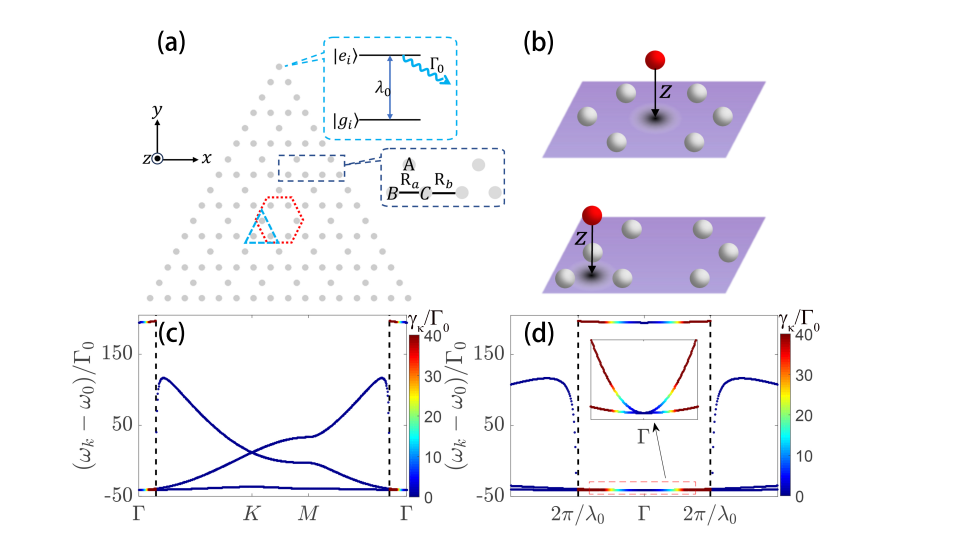
Atomic metasurfaces provide a powerful platform for exploring topological effects in nanophotonic systems, and this work investigates a two-dimensional Kagome atomic metasurface, incorporating long-range interactions between atoms. Researchers developed a comprehensive approach accurately describing these structures by accounting for all-to-all interactions at subwavelength scales, focusing on the emergence of higher-order topological states modulated by atomic polarization. To model the system, scientists constructed an effective Hamiltonian describing the interactions between atoms within the metasurface, incorporating the radiative linewidth of each atom and dipole-dipole interactions mediated by the surrounding environment. By eliminating photonic degrees of freedom and applying approximations, the team derived a Hamiltonian governing atomic interactions in the single-excitation manifold, accurately capturing the interplay between atoms and photons.
The researchers solved for the eigenmodes of the Hamiltonian, revealing the energy dispersion and decay rates of the metasurface under periodic boundary conditions, allowing for the application of mathematical tools to identify topological states. A regularization technique was employed to accurately determine the eigenmodes, accounting for long-range interactions and revealing how the energy band structure is reshaped. The study demonstrates that a spacing imbalance between atoms within the unit cell induces a topological phase transition, shifting the metasurface between topologically trivial and nontrivial phases. Scientists calculated the localization of the eigenmodes and mapped population distributions, revealing the emergence of corner modes localized at the edges of the metasurface, establishing it as a versatile platform for engineering tunable topological states and chiral phenomena.
Chiral Emission via Atomic Metasurface Impurities
Researchers have demonstrated a novel platform for manipulating light and matter using atomic metasurfaces, achieving selective higher-order topological states with a unique “chasing” behavior. This establishes these metasurfaces as a versatile tool for engineering tunable topological states and chiral phenomena, opening possibilities for customized light sources and photonic devices. The team investigated a two-dimensional Kagome atomic metasurface, incorporating all-to-all interactions between atoms. Experiments revealed that introducing an impurity atom, termed a giant atom, coupled to the array atoms generates chiral emission patterns strongly dependent on the atom’s polarization.
This nonlocal coupling structure enables the exploration of self-interference effects at subwavelength scales, significantly smaller than the wavelength of light. Measurements confirm that the observed topological modes are robust and their polarization-controlled dynamics facilitate chiral quantum transport, offering new avenues for atomic-waveguide quantum electrodynamics and long-range dipole-dipole interactions. At the topological phase transition, the team examined chiral emission from the impurity atom coupled to the metasurface, revealing polarization-dependent emission behaviors and subwavelength effects. These results fill a critical knowledge gap regarding giant atom effects at these extremely small scales, allowing scientists to customize photonic environments and create tunable light-matter interfaces, laying the foundation for developing topological photonics and advancing chiral quantum networks.
Chiral Metasurfaces Demonstrate Topological State Control
This research establishes atomic metasurfaces as a powerful platform for manipulating light and matter at the nanoscale, demonstrating higher-order topological states and chiral transport behaviors beyond traditional approximations. By investigating a two-dimensional Kagome atomic metasurface with all-to-all interactions, scientists observed unique dynamical effects, including a “chasing” behavior of topological states and efficient directional transfer of energy, protected by a generalized chiral symmetry, enabling precise control over light propagation. The team further explored the impact of introducing an impurity atom, termed a giant atom, coupled to the metasurface, revealing polarization-dependent emission patterns and subwavelength effects, allowing for detailed examination of self-interference at scales smaller than the wavelength of light, opening new possibilities for customized light sources and photonic devices. This work lays a foundation for developing topological photonics and advancing chiral quantum networks, offering new avenues for robust long-range interactions and reconfigurable quantum state localization.
🗞 Selective high-order topological states and tunable chiral emission in atomic metasurfaces
🧠 ArXiv: https://arxiv.org/abs/2510.08349