

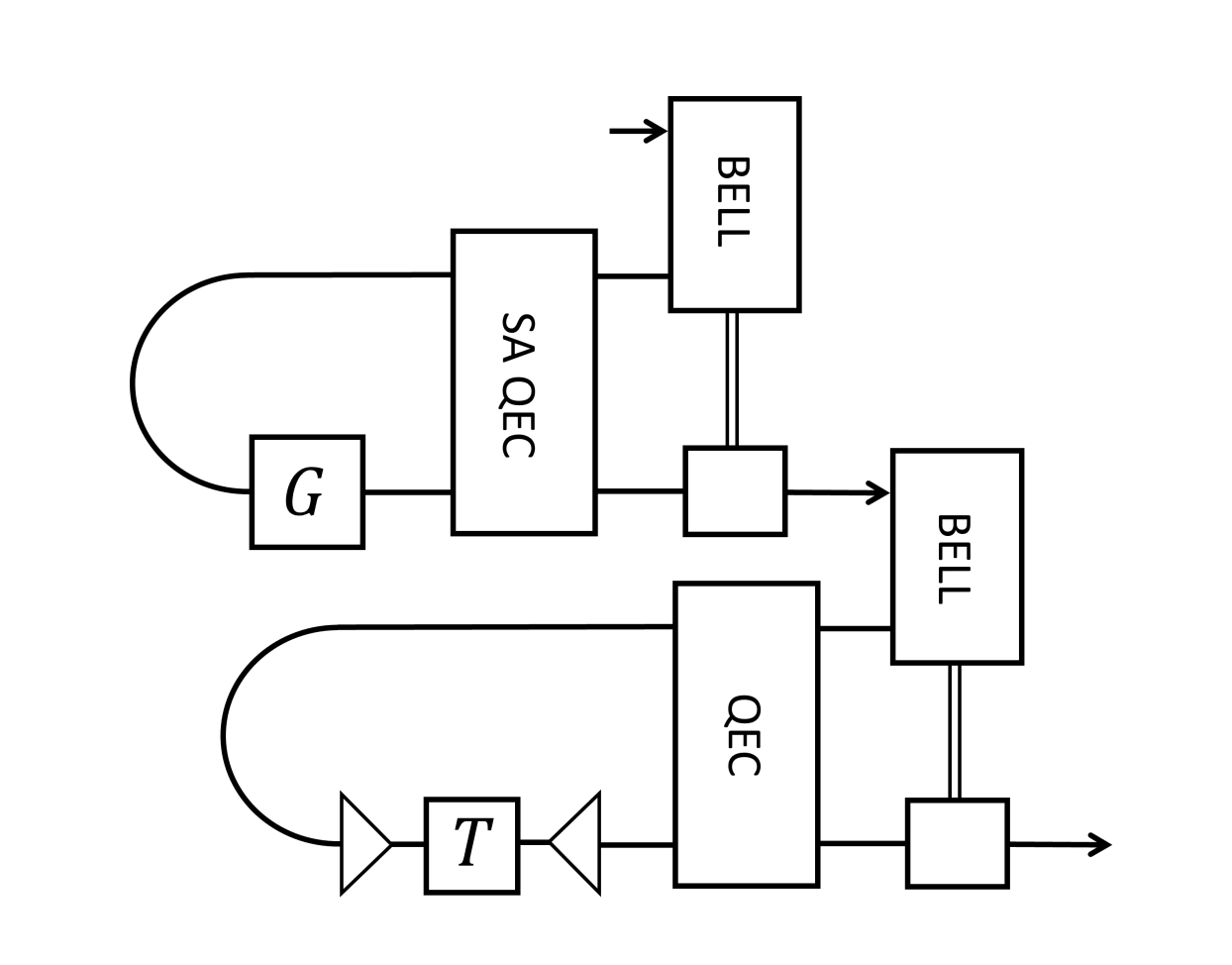
Quantum error correction remains a critical challenge in building practical quantum computers, as even slight disturbances can destroy fragile quantum information. Dong-Sheng Wang from the Institute of Theoretical Physics, Chinese Academy of Sciences, and colleagues present a new theoretical framework for state-adaptive quantum error correction that significantly improves the capacity for reliable quantum computation. This research bridges the gap between traditional error correction and more advanced protocols by incorporating knowledge of the quantum state itself into the correction process, establishing a new regime governed by mutual information. The team demonstrates that this state-adaptivity enhances error correction without requiring additional measurement, offering a pathway towards more efficient and robust fault-tolerant quantum computing and providing new insights into the fundamental limits of quantum channel capacities.
It examines various techniques for protecting fragile quantum information from noise and decoherence, including stabilizer codes, graph codes, and approximate error correction methods. The work delves into the limits of quantum communication and computation, investigating concepts like channel capacity and entanglement, and how these relate to the resources needed for error correction. Ultimately, the goal is to develop fault-tolerant quantum computers capable of performing complex calculations despite the presence of errors.
Stabilizer codes and graph codes offer powerful approaches to code design, with surface codes proving particularly promising for practical implementation due to their relatively high tolerance to errors. Researchers also investigate concatenated codes, which combine multiple layers of coding to further enhance error correction performance. Additive codes, with their specific algebraic properties, offer simplified analysis, and the study highlights the importance of transversal gates, which preserve encoded information during computation. The research establishes key theoretical results, including the concept of quantum channel capacity, which defines the maximum rate of reliable quantum information transmission.
It also explores entanglement-assisted classical capacity, the Petz recovery map for reconstructing quantum states, and duality relationships between quantum communication protocols. Threshold theorems specify the minimum error rate required for a code to be effective, acknowledging the practical challenges of building quantum computers and the need for error mitigation techniques. The study emphasizes the importance of fault tolerance, the trade-offs between code performance and complexity, and the need for realistic error models. It highlights the potential of topological quantum computation, which uses exotic particles to encode and manipulate quantum information. This work provides a comprehensive overview of the field, outlining the challenges, opportunities, and ongoing research directions.
State-Adaptive Error Correction via Petz Maps
Researchers have developed a new framework for quantum communication that bridges the gap between traditional and emerging quantum paradigms. This approach, termed state-adaptive quantum error correction, leverages complete knowledge of the input states to enhance communication fidelity. Unlike conventional methods that treat information as abstract codes, this framework directly incorporates the characteristics of the initial quantum state into the error correction process, fundamentally altering how channel capacity is understood. This allows for a more efficient and targeted error correction, as the system can anticipate and correct for errors based on the specific characteristics of the initial state.
The core of this methodology lies in a mathematical tool called the Petz map, a recovery channel used to reconstruct the original state after transmission through a noisy channel. Researchers refined this map, applying it in a unique way to focus on recovering known input states, rather than generic quantum information. The team demonstrated that this state-adaptive approach achieves enhanced performance without requiring additional measurement steps, streamlining the communication process. This improvement stems from the ability to more accurately predict and correct errors, leading to a more robust and efficient communication channel.
To prove the effectiveness of this framework, the researchers employed a “packing lemma,” a technique used to determine the maximum rate at which information can be reliably transmitted. They showed that by utilizing knowledge of the input state, the system can achieve a higher capacity compared to methods that rely solely on encoding information into abstract codes. The team further established the relationship between this state-adaptive capacity and other established quantum communication models, demonstrating its place within the broader landscape of quantum information theory. This research highlights a shift in perspective, treating the input state not merely as data to be transmitted, but as an integral part of the error correction process itself. By harnessing the power of complete state knowledge, the team has opened new avenues for optimizing quantum communication and potentially surpassing the limitations of existing methods. The framework’s ability to enhance capacity without increasing complexity suggests a practical path towards building more reliable and efficient quantum communication systems, paving the way for advancements in areas such as secure communication and distributed quantum computing.
State-Adaptive Error Correction Boosts Quantum Capacity
Researchers have established a new theoretical framework for quantum communication and computation centered around “state-adaptive” quantum error correction, a method that significantly enhances the capacity for transmitting and processing quantum information. This approach departs from traditional methods by incorporating knowledge of the quantum state itself into the error correction process, unlocking a new regime governed by mutual information rather than previously established limits. The findings demonstrate a fundamental connection between state-adaptive techniques and entanglement-assisted protocols, paving the way for more efficient quantum systems. The core breakthrough lies in the ability to achieve enhanced quantum communication without requiring additional measurement overhead, a common limitation in existing methods.
By leveraging knowledge of the input state, the framework effectively bypasses constraints that typically hinder quantum information transfer. This is achieved through a process that resembles a state conversion task, allowing for the reliable generation of logical quantum states essential for both computation and communication. The research reveals that the capacity of this state-adaptive approach is directly linked to the mutual information between the input state and the quantum channel, offering a new perspective on channel capacity itself. Importantly, the team demonstrated that the state-adaptive capacity is equivalent to half of the maximal quantum mutual information, a result proven through both simulation and a direct Shannon-style proof.
This means that, under optimal conditions, the amount of information that can be reliably transmitted is significantly increased compared to standard quantum coding methods. The proof involved showing that a state-adaptive quantum coding task can be directly linked to entanglement-assisted classical coding, and vice versa, establishing a clear relationship between these previously distinct approaches. Further analysis revealed that the state-adaptive framework doesn’t require the use of entanglement assistance, simplifying implementation and reducing the complexity of quantum systems. The research utilizes a “Petz map” for decoding, a technique that can fully recover a known input state, but acknowledges that implementing this map is not trivial and requires coding for fault tolerance. The team’s direct proof of the state-adaptive quantum capacity, utilizing the Petz map and packing lemma, provides a robust theoretical foundation for this new approach, offering a pathway towards more efficient and reliable quantum technologies.
State Knowledge Boosts Quantum Error Correction
This research introduces a theoretical framework for state-adaptive quantum error correction (SAQEC), establishing a connection between quantum computing and classical information paradigms. The findings demonstrate that incorporating knowledge of quantum states into the error correction process leads to a new capacity regime governed by mutual information, rather than coherent information, and offers potential for enhanced coding rates and error thresholds without significant overhead. This approach builds upon existing stabilizer codes, allowing their use within the SAQEC framework to improve performance.
🗞 State-adaptive quantum error correction and fault-tolerant quantum computing
🧠 ArXiv: https://arxiv.org/abs/2508.06011


